


Effects of canagliflozin on body weight and relationship to HbA1c and blood pressure changes in patients with type 2 diabetes
- PMID: 25813214
- PMCID: PMC4800739
- DOI: 10.1007/s00125-015-3547-2
Effects of canagliflozin on body weight and relationship to HbA1c and blood pressure changes in patients with type 2 diabetes
Abstract
Aims/hypothesis: Canagliflozin, a sodium glucose co-transporter 2 inhibitor, reduces HbA1c, body weight and systolic BP (SBP) in patients with type 2 diabetes. As weight loss is known to reduce both HbA1c and SBP, these analyses were performed to evaluate the contribution of weight loss resulting from treatment with canagliflozin to HbA1c and SBP reductions in patients with type 2 diabetes.
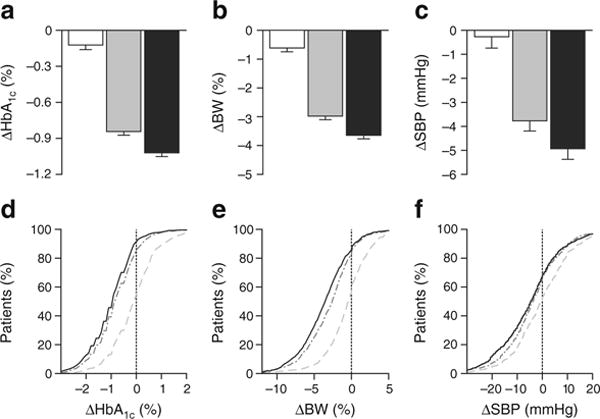
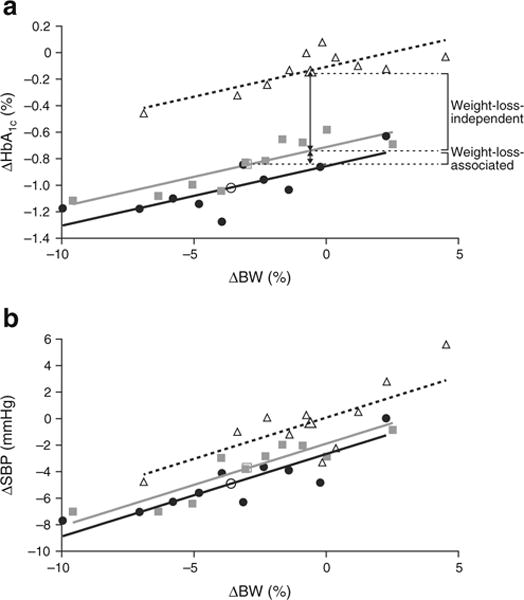
Methods: Pooled data from four placebo-controlled Phase 3 studies (N = 2,250) in patients with type 2 diabetes were used in the analyses. In each study, patients were treated with placebo, canagliflozin 100 mg or canagliflozin 300 mg, once daily for 26 weeks. Changes from baseline in body weight, HbA1c and SBP were measured at week 26, and the contribution of weight loss to the lowering of HbA1c and SBP was obtained using ANCOVA.
Results: Canagliflozin 100 and 300 mg reduced mean body weight, HbA1c and SBP compared with placebo (p < 0.001 for each), and more patients had body-weight reductions >0%, ≥5% and ≥10% with canagliflozin treatment than with placebo. Weight-loss-independent and weight-loss-associated mechanisms contributed to HbA1c and SBP lowering with canagliflozin: ~85% of HbA1c lowering and ~60% of SBP lowering was independent of weight loss.
Conclusions/interpretation: In patients with type 2 diabetes, canagliflozin provided clinically meaningful body-weight reductions, and the weight loss contributed to reductions in HbA1c and SBP.
Trial registration: ClinicalTrials.gov NCT01081834 NCT01106625 NCT01106677 NCT01106690.
Figures
References
-
- American Medical Association House of Delegates. Resolution 420 (A-13) Recognition of obesity as a disease. 2013 www.ama-assn.org/assets/meeting/2013a/a13-addendum-refcomm-d.pdf. Accessed 22 July 2013.
-
- Jensen MD, Ryan DH, Apovian CM, et al. 2013 AHA/ACC/TOS guideline for the management of overweight and obesity in adults: a report of the American College of Cardiology/American Heart Association Task Force on Practice Guidelines and The Obesity Society. Circulation. 2014;129:S102–S138. - PMC - PubMed
Publication types
MeSH terms
Substances
Associated data
Grants and funding
LinkOut - more resources
Full Text Sources
Other Literature Sources
Medical
Research Materials
