


Baby budgeting: oocyte cryopreservation in women delaying reproduction can reduce cost per live birth
- PMID: 25813281
- PMCID: PMC4457614
- DOI: 10.1016/j.fertnstert.2015.02.029
Baby budgeting: oocyte cryopreservation in women delaying reproduction can reduce cost per live birth
Abstract
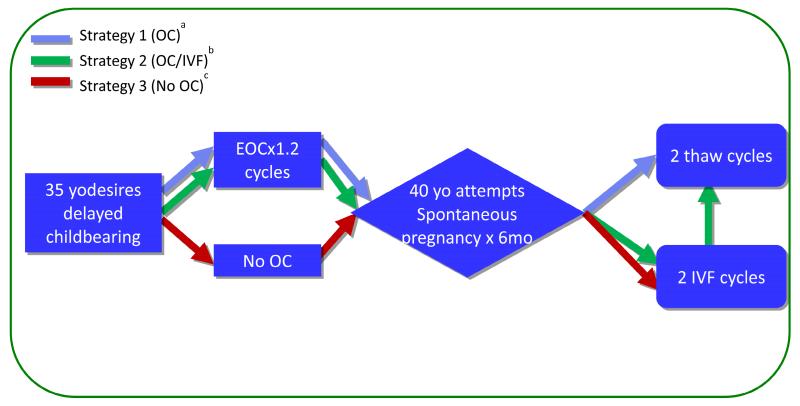
Objective: To determine whether oocyte cryopreservation for deferred reproduction is cost effective per live birth using a model constructed from observed clinical practice.
Design: Decision-tree mathematical model with sensitivity analyses.
Setting: Not applicable.
Patient(s): A simulated cohort of women wishing to delay childbearing until age 40 years.
Intervention(s): Not applicable.
Main outcome measure(s): Cost per live birth.
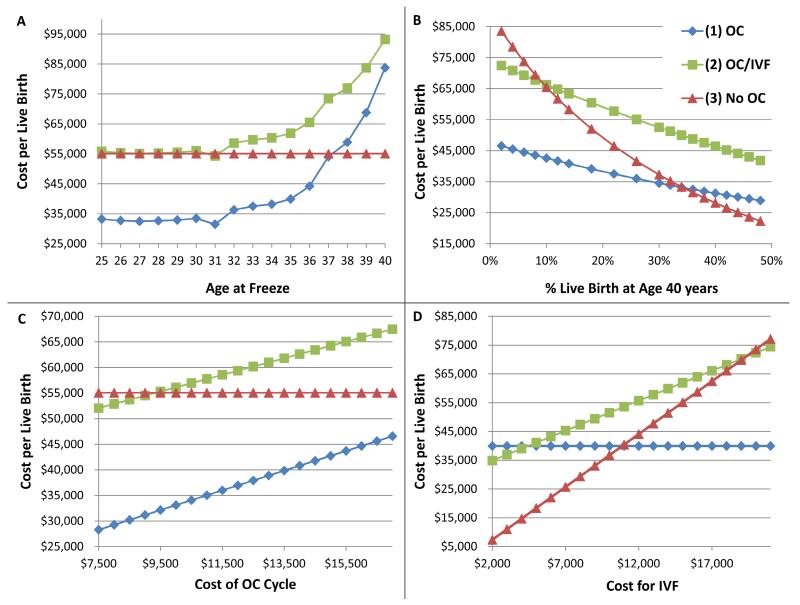
Result(s): Our primary model predicted that oocyte cryopreservation at age 35 years by women planning to defer pregnancy attempts until age 40 years would decrease cost per live birth from $55,060 to $39,946 (and increase the odds of live birth from 42% to 62% by the end of the model), indicating that oocyte cryopreservation is a cost-effective strategy relative to forgoing it. If fresh autologous assisted reproductive technology (ART) was added at age 40 years, before thawing oocytes, 74% obtained a live birth, and cost per live birth increased to $61,887. Separate sensitivity analyses demonstrated that oocyte cryopreservation remained cost effective as long as performed before age 38 years, and more than 49% of those women not obtaining a spontaneously conceived live birth returned to thaw oocytes.
Conclusion(s): In women who plan to delay childbearing until age 40 years, oocyte cryopreservation before 38 years of age reduces the cost to obtain a live birth.
Keywords: ART; Oocyte cryopreservation; cost analysis; fertility preservation; vitrification.
Published by Elsevier Inc.
Figures
References
-
- [Last Accessed September 7, 2014];OECD Family Database, SF2.3: Mean age of mothers at First Childbirth. 2012 Feb 24; Last updated: Available at: http://www.oecd.org/els/soc/SF2.3%20Mean%20age%20of%20mother%20at%20firs....
-
- Martin JA, Hamilton BE, Osterman MJK, Curtin SC, Mathews TJ. [Last Accessed: September 7, 2014];Births: Final data for 2012. Natl Vital Stat Rep. 2013 62(9):1–87. Available at: http://www.cdc.gov/nchs/data/nvsr/nvsr62/nvsr62_09.pdf#table01. - PubMed
-
- Tietze C. Reproductive span and rate of reproduction among Hutterite women. Fertil Steril. 1957;8:89–97. - PubMed
-
- Guttmacher AF. Factors affecting normal expectancy of conception. J Am Med Assoc. 1956;161:855–60. - PubMed
Publication types
MeSH terms
Grants and funding
LinkOut - more resources
Full Text Sources
Other Literature Sources
Medical
