


Prelude to oral microbes and chronic diseases: past, present and future
- PMID: 25813714
- PMCID: PMC4485946
- DOI: 10.1016/j.micinf.2015.03.007
Prelude to oral microbes and chronic diseases: past, present and future
Abstract
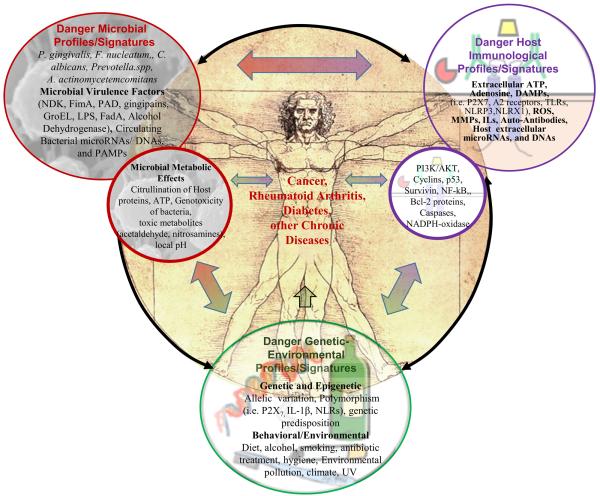
Associations between oral and systemic health are ancient. Oral opportunistic bacteria, particularly, Porphyromonas gingivalis and Fusobacterium nucleatum, have recently been deviated from their traditional roles as periodontal pathogens and arguably ascended to central players based on their participations in complex co-dependent mechanisms of diverse systemic chronic diseases risk and pathogenesis, including cancers, rheumatoid-arthritis, and diabetes.
Keywords: Cancer; Chronic diseases; Fusobacterium nucleatum; Oral microbes; Porphyromonas gingivalis; Small molecule danger signaling.
Copyright © 2015 Institut Pasteur. Published by Elsevier Masson SAS. All rights reserved.
Figures
References
-
- Adler CJ, Dobney K, Weyrich LS, Kaidonis J, Walker AW, Haak W, Bradshaw CJA, Townsend G, Soltysiak A, Alt KW, Parkhill J, Cooper A. Sequencing ancient calcified dental plaque shows changes in oral microbiota with dietary shifts of the Neolithic and Industrial revolutions. Nat Genet. 2013;45:450–455. - PMC - PubMed
-
- Coppa A, Bondioli L, Cucina A, Frayer DW, Jarrige C, Jarrige JF, Quivron G, Rossi M, Vidale M, Macchiarelli R. Palaeontology: early Neolithic tradition of dentistry. Nature. 2006;440:755–756. - PubMed
-
- Vieira CLZ, Caramelli B. The history of dentistry and medicine relationship: could the mouth finally return to the body? Oral Dis. 2009;15:538–546. - PubMed
-
- Gold SI. Periodontics. The past. Part (I). Early sources. Journal of clinical periodontology. 1985;12:79–97. - PubMed
Publication types
MeSH terms
Grants and funding
LinkOut - more resources
Full Text Sources
Other Literature Sources
Miscellaneous
