. 2015 Aug 18;112(33):10177-84.
doi: 10.1073/pnas.1422049112. Epub 2015 Mar 26.

Mitochondrial and plastid genome architecture: Reoccurring themes, but significant differences at the extremes

Affiliations

Mitochondrial and plastid genome architecture: Reoccurring themes, but significant differences at the extremes

David Roy Smith et al. Proc Natl Acad Sci U S A. .

Abstract

Mitochondrial and plastid genomes show a wide array of architectures, varying immensely in size, structure, and content. Some organelle DNAs have even developed elaborate eccentricities, such as scrambled coding regions, nonstandard genetic codes, and convoluted modes of posttranscriptional modification and editing. Here, we compare and contrast the breadth of genomic complexity between mitochondrial and plastid chromosomes. Both organelle genomes have independently evolved many of the same features and taken on similar genomic embellishments, often within the same species or lineage. This trend is most likely because the nuclear-encoded proteins mediating these processes eventually leak from one organelle into the other, leading to a high likelihood of processes appearing in both compartments in parallel. However, the complexity and intensity of genomic embellishments are consistently more pronounced for mitochondria than for plastids, even when they are found in both compartments. We explore the evolutionary forces responsible for these patterns and argue that organelle DNA repair processes, mutation rates, and population genetic landscapes are all important factors leading to the observed convergence and divergence in organelle genome architecture.

Keywords: chloroplast; endosymbiosis; mitochondrial genome; mitochondrion; plastid genome.


Conflict of interest statement

The authors declare no conflict of interest.

Figures

Fig. 1.
Fig. 1.
Number and taxonomic distribution of all complete mitochondrial and plastid DNA (mtDNA and ptDNA) sequences at the National Center for Biotechnology Information (NCBI) Database. (A) Annual number deposited from 2003 to 2013. (B) Total number of sequences (4,965) as of 1 August 2014. Statistics taken from the NCBI Organelle Genome Resources site: www.ncbi.nlm.nih.gov/genomes/GenomesHome.cgi?taxid=2759&hopt=html.
Fig. 2.
Fig. 2.
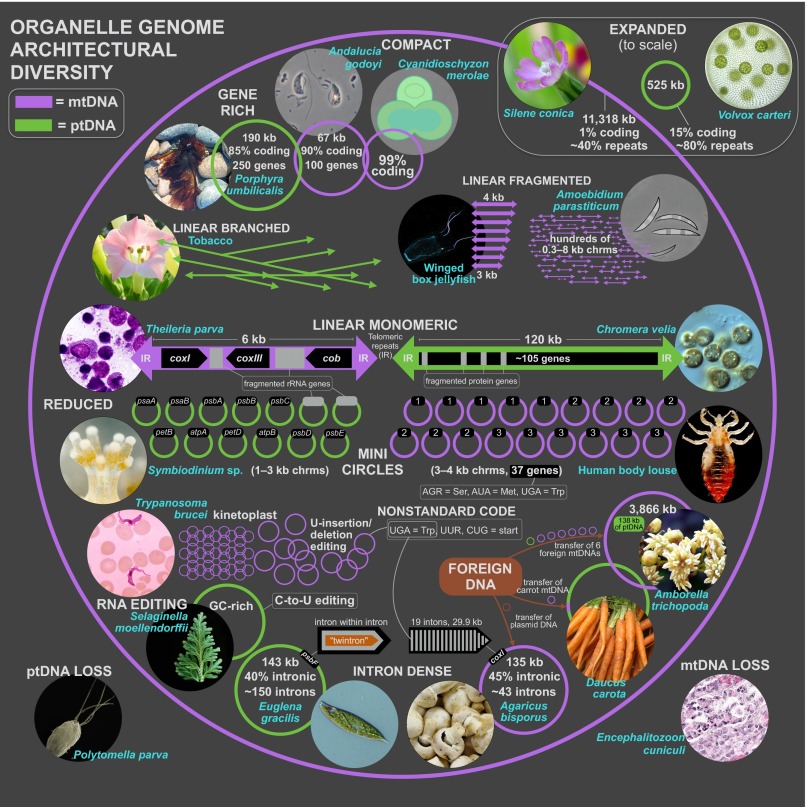
Organelle genome architectural diversity. Mitochondrial and plastid genome/gene maps are shown in pink and green, respectively. Genome maps are not to scale, unless stated otherwise on figure. Alantina image courtesy of Dr. Andre Seale (Hawaii Institute of Marine Biology, Kaneohe, HI); Amborella image courtesy of Wikimedia Commons/bff; Andalucia © Alastair Simpson; Chromera image courtesy of the National Center for Marine Algae and Microbiota (NCMA); Daucus image courtesy of Jeremy Keith on Flickr; E. cuniculi image courtesy of The Joint Pathology Center; Head louse image courtesy of the CDC; Porphyra image courtesy of Nicolas Blouin; Selaginella image courtesy of Jing-Ke Weng (Purdue University, West Lafayette, IN); Symbiodinium image by Eiichi Shoguchi, reprinted with permission of OIST; Theileria © 2008 Jan Votýpka; Trypanosoma image courtesy of the CDC.
Fig. 3.
Fig. 3.
Synonymous substitution rates in the organelle and nuclear genomes from various plastid-bearing lineages. Plastid DNA (ptDNA) is green, mitochondrial DNA (mtDNA) is pink, and nuclear DNA (nucDNA) is orange. The Archaeplastida (i.e., Plantae) comprises glaucophytes, red algae, green algae, and land plants, all of which have primary plastids. The haptophyte Phaeocystis and the dinoflagellate Symbiodinium have secondary, red algal-derived plastid. Synonymous site substitution rates come from ref. and references therein. Data for Symbiodinium come from ref. and were calculated by comparing species A2 to species C90.

References

    1. Hjort K, Goldberg AV, Tsaousis AD, Hirt RP, Embley TM. Diversity and reductive evolution of mitochondria among microbial eukaryotes. Philos Trans R Soc Lond B Biol Sci. 2010;365(1541):713–727. - PMC - PubMed
    1. Gray MW. Mitochondrial evolution. Cold Spring Harb Perspect Biol. 2012;4(9):a011403. - PMC - PubMed
    1. Keeling PJ. The endosymbiotic origin, diversification and fate of plastids. Philos Trans R Soc Lond B Biol Sci. 2010;365(1541):729–748. - PMC - PubMed
    1. Smith DR, Lee RW. A plastid without a genome: Evidence from the nonphotosynthetic green algal genus Polytomella. Plant Physiol. 2014;164(4):1812–1819. - PMC - PubMed
    1. Green BR. Chloroplast genomes of photosynthetic eukaryotes. Plant J. 2011;66(1):34–44. - PubMed

Publication types