Review
. 2015 Mar 25;5(2):1019-53.
doi: 10.3390/life5021019.

Engineering protocells: prospects for self-assembly and nanoscale production-lines

Affiliations
Review

Engineering protocells: prospects for self-assembly and nanoscale production-lines

David M Miller et al. Life (Basel). .

Abstract

The increasing ease of producing nucleic acids and proteins to specification offers potential for design and fabrication of artificial synthetic "organisms" with a myriad of possible capabilities. The prospects for these synthetic organisms are significant, with potential applications in diverse fields including synthesis of pharmaceuticals, sources of renewable fuel and environmental cleanup. Until now, artificial cell technology has been largely restricted to the modification and metabolic engineering of living unicellular organisms. This review discusses emerging possibilities for developing synthetic protocell "machines" assembled entirely from individual biological components. We describe a host of recent technological advances that could potentially be harnessed in design and construction of synthetic protocells, some of which have already been utilized toward these ends. More elaborate designs include options for building self-assembling machines by incorporating cellular transport and assembly machinery. We also discuss production in miniature, using microfluidic production lines. While there are still many unknowns in the design, engineering and optimization of protocells, current technologies are now tantalizingly close to the capabilities required to build the first prototype protocells with potential real-world applications.


Figures
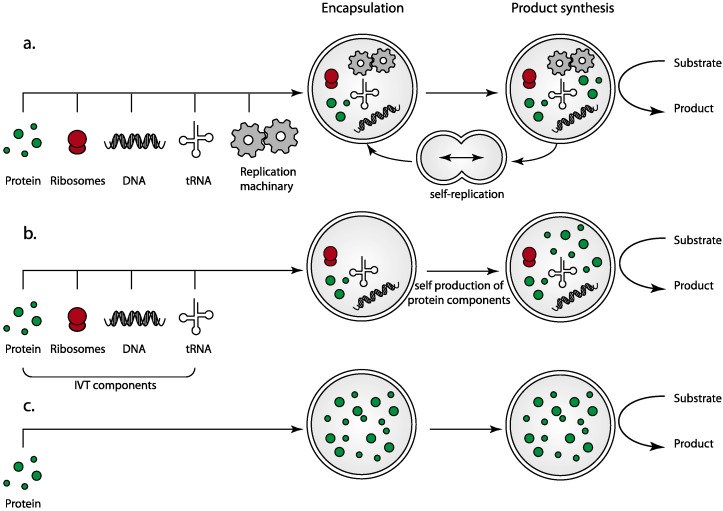
Figure 1
Figure 1
Simplified overview of the designs of lipid encapsulated protocells. (a) A fully replicating and autonomous protocell where all components for metabolism, product synthesis, maintenance and replication are provided or are readily produced by in vitro protein synthesis; (b) a simplified protocell that cannot replicate, but is capable of producing an entire metabolic pathway including receptors for sensing and responding to environmental cues by protein production from transcription/translation of provided nucleic acid templates (in vitro transcription/translation—IVT); and (c) further simplification of the design results in elimination of the transcriptional machinery components with all components required for the protocell metabolism added during protocell production. All three designs may still retain equivalent metabolism, that is, they all may produce the same end products, but the simplified designs have a significantly reduced component count.
Figure 2
Figure 2
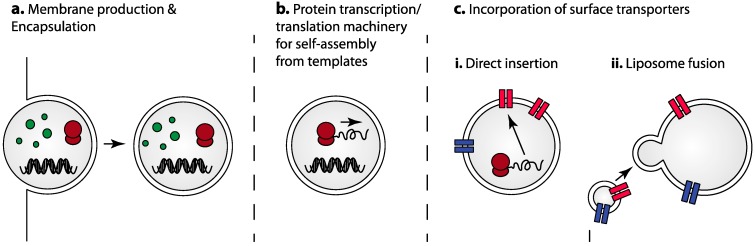
Component parts and strategies for self-assembly. The minimal steps required for the in vitro construction of protocells that self-assemble, or partially self-assemble, from component parts would consist of: (a) the production of the protein and nucleic acid components using traditional protein purification strategies, followed by encapsulation within the protocell membrane; (b) the utilization of protein transcription/translation machinery for building individual protocell protein components from nucleic acid templates creating a self-assembling protocell; and (c) incorporation of surface transporters and receptors for sensing and transport either (i) directly from in vitro transcription/translation; or (ii) through liposome fusion where membrane proteins already incorporated in liposomes are fused with the protocell membrane. The steps shown are not mutually exclusive in the process of protocell production.
Figure 3
Figure 3
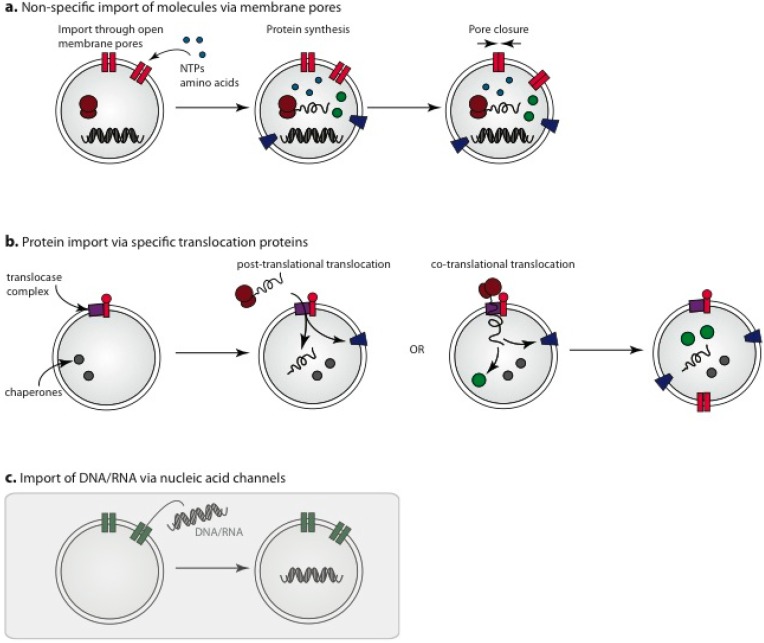
Assembly methods for protocells utilizing incorporated membrane protein channels and pores for the provision of internal components. (a) All components required for protein synthesis, by in vitro transcription/translation from an artificial nucleic acid genome, are encapsulated into the protocell precursor with all small molecules provided through integrated non-specific gated membrane channels that permeabilize the protocell membrane. Small molecules are continually supplied until the completion of protocell self-assembly, at which point the protocell is sealed from the external environment by controlled pore closure; (b) Additional possibilities for utilizing membrane protein pores include the use of organelle derived protein tranlocase components that allow for either the post-translational or co-translational import of polypeptides; and (c) nucleic acid channels to provide required nucleic acid components from the external solution. Strategies within the grey-boxed area have not yet been thoroughly explored in in vitro systems.
Figure 4
Figure 4
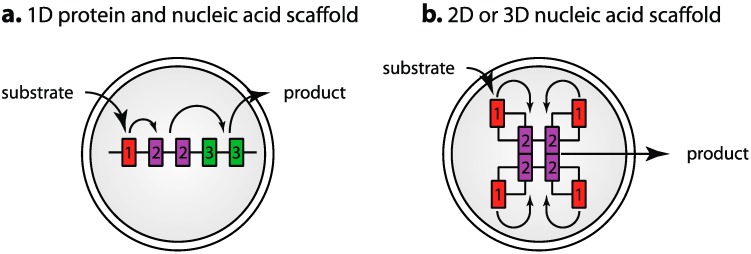
Assembly of metabolic pathway components on scaffolds for enhancement of pathway activity. The engineered scaffolds contain specific binding sites to allow the individual components to be localized to the scaffold. Current designs consist of either (a) assembly of metabolic pathway components on simple 1-dimensional nucleic acid or protein scaffolds where the stoichiometry of components can be adjusted by scaffold design for optimal pathway efficiency and product production; or (b) more complex designs for self assembly of components in multidimensional arrays as a result of the engineered scaffold’s ability to self assemble into more complex structures. Examples have been demonstrated utilizing both RNA and DNA as the scaffolding material.
Figure 5
Figure 5
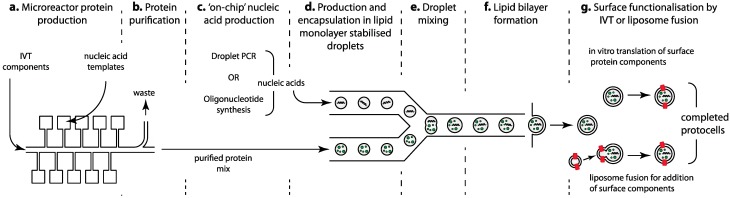
Microfluidic steps required for protocell assembly utilizing existing microfluidic production technology. (a) parallel production of the individual protein components in a microreactor array; (b) rapid purification of produced components; (c) production of nucleic acid components for “genomes” or scaffolding purposes by either PCR or oligonucleotide synthesis methods; (d) encapsulation of component mixes in lipid monolayer stabilized emulsions; (e) component mixing—multiple mixing steps with either symmetric or asymmetric droplets can be implemented; (f) formation of the outer bilayer leaflet around the emulsion droplets to complete the protocell membrane; (g) addition of surface receptors by liposome fusion or in vitro transcription/translation (refer to Figure 2 for more details of this stage of assembly). Note that not all alternatives for the individual steps are shown—refer to text for details.

References

    1. Howard T.P., Middelhaufe S., Moore K., Edner C., Kolak D.M., Taylor G.N., Parker D.A., Lee R., Smirnoff N., Aves S.J., et al. Synthesis of customized petroleum-replica fuel molecules by targeted modification of free fatty acid pools in Escherichia coli. Proc. Natl. Acad. Sci. USA. 2013;110:7636–7641. doi: 10.1073/pnas.1215966110. - DOI - PMC - PubMed
    1. Atsumi S., Hanai T., Liao J.C. Non-fermentative pathways for synthesis of branched-chain higher alcohols as biofuels. Nature. 2008;451:86–89. doi: 10.1038/nature06450. - DOI - PubMed
    1. Avalos J.L., Fink G.R., Stephanopoulos G. Compartmentalization of metabolic pathways in yeast mitochondria improves the production of branched-chain alcohols. Nat. Biotechnol. 2013;31:335–341. doi: 10.1038/nbt.2509. - DOI - PMC - PubMed
    1. Kondo T., Tezuka H., Ishii J., Matsuda F., Ogino C., Kondo A. Genetic engineering to enhance the Ehrlich pathway and alter carbon flux for increased isobutanol production from glucose by Saccharomyces cerevisiae. J. Biotechnol. 2012;159:32–37. doi: 10.1016/j.jbiotec.2012.01.022. - DOI - PubMed
    1. Chen X., Nielsen K.F., Borodina I., Kielland-Brandt M.C., Karhumaa K. Increased isobutanol production in Saccharomyces cerevisiae by overexpression of genes in valine metabolism. Biotechnol. Biofuels. 2011;4:2089–2090. doi: 10.1186/1754-6834-4-21. - DOI - PMC - PubMed