


Waldenstrom macroglobulinemia: prognosis and management
- PMID: 25815903
- PMCID: PMC4382666
- DOI: 10.1038/bcj.2015.28
Waldenstrom macroglobulinemia: prognosis and management
Erratum in
-
Waldenstrom macroglobulinemia: prognosis and management.Blood Cancer J. 2016 Feb 5;6(2):e391. doi: 10.1038/bcj.2015.42. Blood Cancer J. 2016. PMID: 26849012 Free PMC article. No abstract available.
Abstract
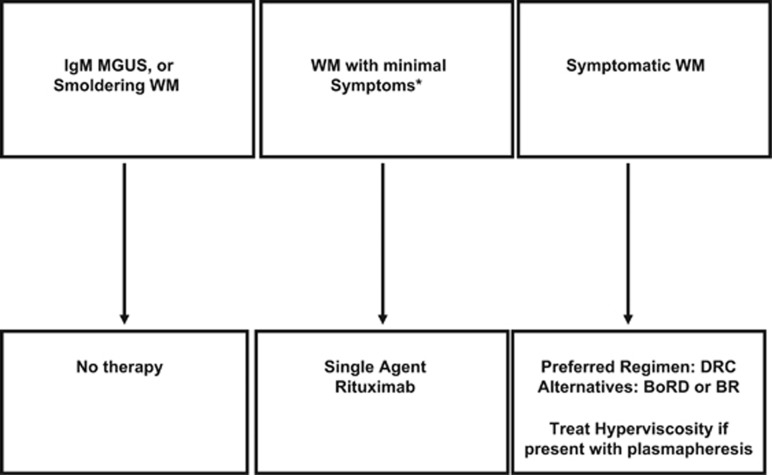
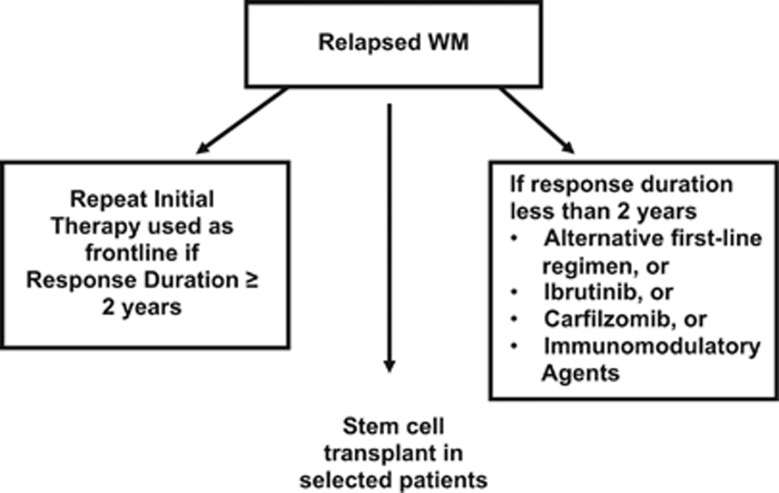
Waldenstrom macroglobulinemia (WM) is a B-cell lymphoplasmacytic lymphoma characterized by monoclonal immunoglobulin M protein in the serum and infiltration of bone marrow with lymphoplasmacytic cells. Asymptomatic patients can be observed without therapy. First-line therapy should consist of the monoclonal anti-CD20 antibody, rituximab, given typically in combination with other agents. We prefer dexamethasone, rituximab, cyclophosphamide (DRC) as initial therapy for most patients with symptomatic WM. Other reasonable options are bortezomib, rituximab, dexamethasone (BoRD) or bendamustine plus rituximab (BR). All of these regimens are associated with excellent response and tolerability. Initial therapy is usually administered for 6 months, followed by observation. Response to therapy is assessed using the standard response criteria developed by the International Working Group on Waldenstrom macroglobulinemia. Relapse is almost inevitable in WM but may occur years after initial therapy. In symptomatic patients relapsing more than 1-2 years after initial therapy, the original treatment can be repeated. For relapse occurring sooner, an alternative regimen is used. In select patients, high-dose chemotherapy followed by autologous hematopoietic cell transplantation may be an option at relapse. Options for therapy of relapsed WM besides regimens used in the front-line setting include ibrutinib, purine nucleoside analogs (cladribine, fludarabine), carfilzomib and immunomodulatory agents (thalidomide, lenalidomide).
Figures
References
-
- Gertz MA. Waldenstrom macroglobulinemia: 2013 update on diagnosis, risk stratification, and management. Am J Hematol. 2013;88:703–711. - PubMed
-
- Treon SP, Xu L, Yang G, Zhou Y, Liu X, Cao Y, et al. MYD88 L265P somatic mutation in Waldenstrom's macroglobulinemia. N Engl J Med. 2012;367:826–833. - PubMed
-
- Treon SP, Cao Y, Xu L, Yang G, Liu X, Hunter ZR. Somatic mutations in MYD88 and CXCR4 are determinants of clinical presentation and overall survival in Waldenstrom macroglobulinemia. Blood. 2014;123:2791–2796. - PubMed
-
- Castillo JJ, Olszewski AJ, Cronin AM, Hunter ZR, Treon SP. Survival trends in Waldenstrom macroglobulinemia: an analysis of the Surveillance, Epidemiology and End Results database. Blood. 2014;123:3999–4000. - PubMed
-
- Garcia-Sanz R, Montoto S, Torrequebrada A, de Coca AG, Petit J, Sureda A, et al. Waldenstrom macroglobulinaemia: presenting features and outcome in a series with 217 cases. Br J Haematol. 2001;115:575–582. - PubMed
Publication types
MeSH terms
Substances
Grants and funding
LinkOut - more resources
Full Text Sources
Other Literature Sources
