. 2015 Mar 27;10(3):e0122282.
doi: 10.1371/journal.pone.0122282. eCollection 2015.

The impact of immunosenescence on humoral immune response variation after influenza A/H1N1 vaccination in older subjects

Affiliations

The impact of immunosenescence on humoral immune response variation after influenza A/H1N1 vaccination in older subjects

Iana H Haralambieva et al. PLoS One. .

Abstract

Background: Although influenza causes significant morbidity and mortality in the elderly, the factors underlying the reduced vaccine immunogenicity and efficacy in this age group are not completely understood. Age and immunosenescence factors, and their impact on humoral immunity after influenza vaccination, are of growing interest for the development of better vaccines for the elderly.

Methods: We assessed associations between age and immunosenescence markers (T cell receptor rearrangement excision circles - TREC content, peripheral white blood cell telomerase - TERT expression and CD28 expression on T cells) and influenza A/H1N1 vaccine-induced measures of humoral immunity in 106 older subjects at baseline and three timepoints post-vaccination.

Results: TERT activity (TERT mRNA expression) was significantly positively correlated with the observed increase in the influenza-specific memory B cell ELISPOT response at Day 28 compared to baseline (p-value=0.025). TREC levels were positively correlated with the baseline and early (Day 3) influenza A/H1N1-specific memory B cell ELISPOT response (p-value=0.042 and p-value=0.035, respectively). The expression and/or expression change of CD28 on CD4+ and/or CD8+ T cells at baseline and Day 3 was positively correlated with the influenza A/H1N1-specific memory B cell ELISPOT response at baseline, Day 28 and Day 75 post-vaccination. In a multivariable analysis, the peak antibody response (HAI and/or VNA at Day 28) was negatively associated with age, the percentage of CD8+CD28 low T cells, IgD+CD27- naïve B cells, and percentage overall CD20- B cells and plasmablasts, measured at Day 3 post-vaccination. The early change in influenza-specific memory B cell ELISPOT response was positively correlated with the observed increase in influenza A/H1N1-specific HAI antibodies at Day 28 and Day 75 relative to baseline (p-value=0.007 and p-value=0.005, respectively).

Conclusion: Our data suggest that influenza-specific humoral immunity is significantly influenced by age, and that specific markers of immunosenescence (e.g., the baseline/early expression of CD28 on CD4+ and/or CD8+ T cells and T cell immune abnormalities) are correlated with different humoral immune response outcomes observed after vaccination in older individuals, and thus can be potentially used to predict vaccine immunogenicity.


Conflict of interest statement

Competing Interests: The authors have read the journal's policy and have the following competing interests: Dr. Poland is the chair of a Safety Evaluation Committee for novel investigational vaccine trials being conducted by Merck Research Laboratories. Dr. Poland offers consultative advice on vaccine development to Merck & Co. Inc., CSL Biotherapies, Avianax, Sanofi Pasteur, Dynavax, Novartis Vaccines and Therapeutics, PAXVAX Inc, and Emergent Biosolutions. Drs. Poland and Ovsyannikova hold two patents related to vaccinia and measles peptide research. These activities have been reviewed by the Mayo Clinic Conflict of Interest Review Board and are conducted in compliance with Mayo Clinic Conflict of Interest policies. This research has been reviewed by the Mayo Clinic Conflict of Interest Review Board and was conducted in compliance with Mayo Clinic Conflict of Interest policies. This does not alter the authors' adherence to all PLOS policies on sharing data and materials.

Figures

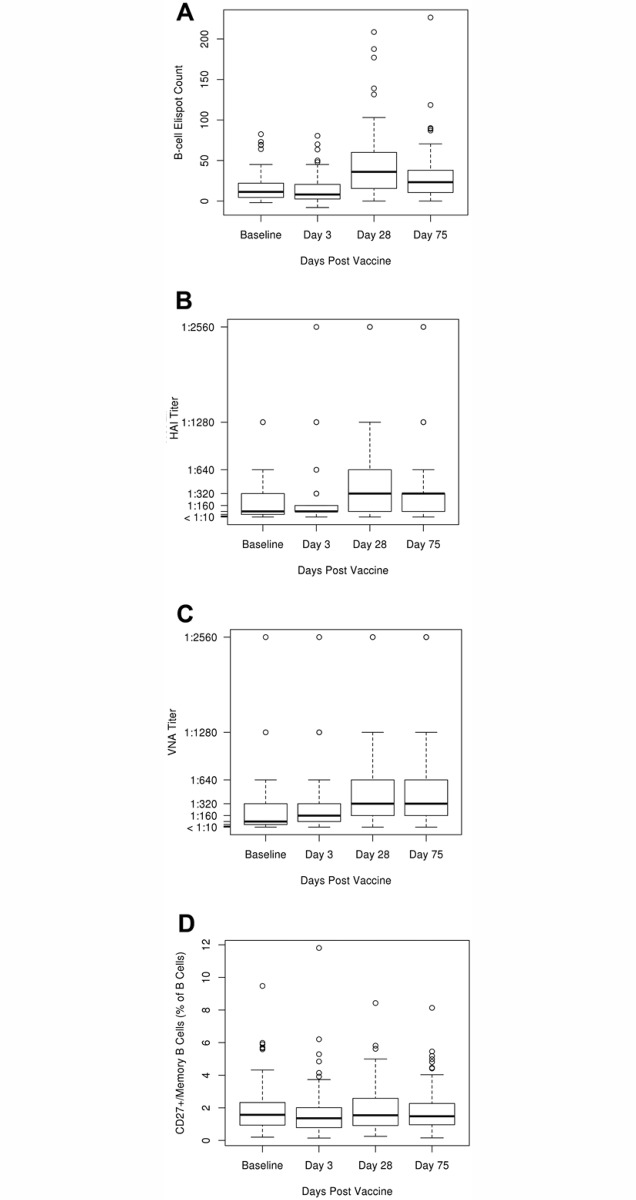
Fig 1
Fig 1. Box and whisker plots of major humoral immune response outcomes pre-vaccination (baseline) and post-vaccination (Day 3, Day 28, and Day 75).
The top (bottom) of the box indicate the 75th (25th) percentiles, respectively, while the bold line within the box indicates the median. The ‘whiskers’ extend up to 1.5 times the interquartile range above or below the 75th or 25th percentiles respectively. Beyond that point, individual points are plotted. A. B cell ELISPOT counts representing the influenza A/H1N1-specific IgG-producing memory-like B cell response plotted for each timepoint as spot forming units (SFUs) per 2x10⁵ PBMCs. B. HAI antibody titers (presented as the inverse of the greatest serum dilution that still gave a positive HAI result) are plotted over time. C. Viral neutralization antibody (VNA) titers (presented as the inverse of the greatest serum dilution that still gave a positive VN result) are plotted over time. D. CD20+ CD27+memory B cells (% of B cells) over time. Parts of Fig. 1(Fig. 1A) have been published in Viral Immunology [18,19].
Fig 2
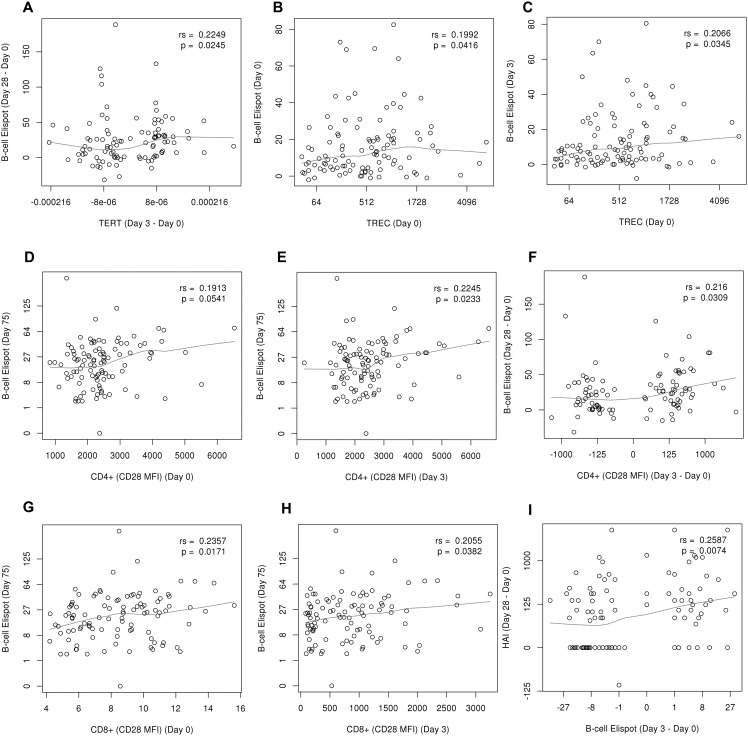
Fig 2. Correlations between markers of immunosenescence (and/or immune outcomes) and influenza A/H1N1 vaccine-induced immune responses.
A. The panel illustrates the positive correlation between early change in TERT expression at Day 3 relative to baseline on x-axis and influenza-specific B cell ELISPOT response change on y-axis (Day 28 compared to baseline). B and C. The panels illustrate the positive correlation between TREC levels on x-axis and influenza-specific B cell ELISPOT response on y-axis (Day 0 or Day 3). D, E and F. The panels illustrate the positive correlation between CD28 expression (MFI) on CD4+ T cells on x-axis (or change in expression at Day 3 relative to baseline, panel F) and influenza-specific B cell ELISPOT response on y-axis (Day 75 or increase at Day 28 compared to baseline for panel F). G and H. The panels illustrate the positive correlation between CD28 expression (MFI) on CD8+ T cells on x-axis (Day 0 or Day 3) and influenza-specific B cell ELISPOT response at Day 75 on y-axis. I. The panel illustrates the positive correlation between early change in influenza-specific B cell ELISPOT response (Day 3 relative to baseline, on x-axis) and influenza-specific HAI titer increase (Day 28 compared to baseline, on y-axis). The values on the x-axis for panels A, B, C, and F, y-axis for panels D, E, G, and H, and both x- and y-axes for panel I are displayed on the cube root scale for ease of visualization, but labeled on the raw scale. Influenza A/H1N1-specific memory-like IgG B cell ELISPOT response is presented as median SFUs per 2 x 10⁵ cells; TERT expression is presented as TERT relative abundance value (relative expression in mRNA) divided by the GAPDH abundance value (ratio); TREC levels are presented as TREC versus CCR5 copies (ratio) in genomic DNA; HAI represents the influenza A/H1N1-specific hemagglutination inhibition titer as the reciprocal of the highest serum dilution that completely inhibits hemagglutination. The expression of CD28 on CD4+ and/or CD8+ T cells is measured by the mean fluorescence intensity/MFI using flow cytometry. “rs” indicates Spearman’s correlation coefficient.
Fig 3
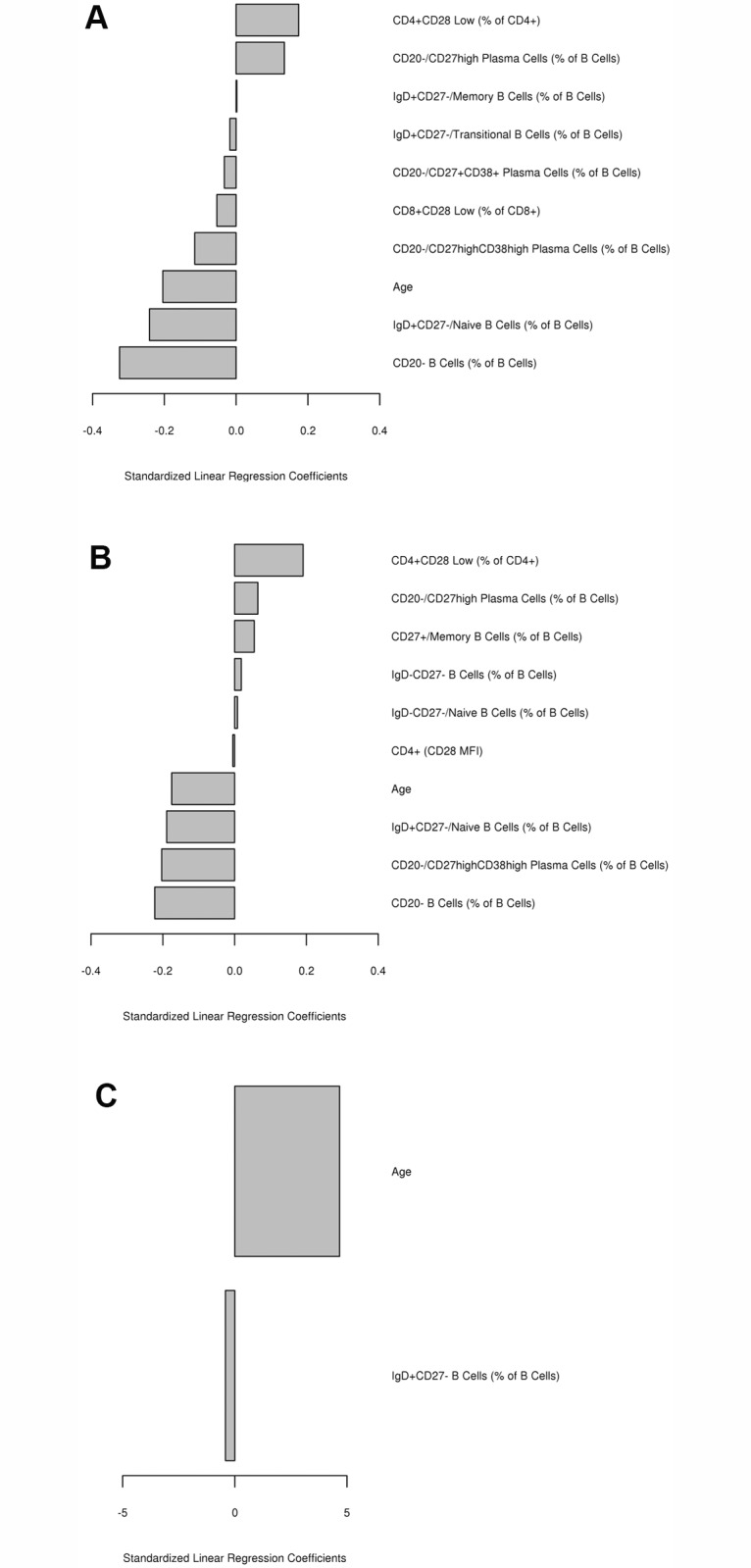
Fig 3. Multivariable associations of early variables with peak influenza/H1N1 vaccine-induced immune responses.
Standardized linear regression coefficients from the elastic net penalized linear regression models for association of early (Day 3) variables with peak (Day 28) influenza-specific humoral immune response outcomes (HAI, VNA, B cell ELISPOT). Standardized linear regression coefficients for early variables associated with: A. Day 28 HAI response; B. Day 28 VNA response; and C. Day 28 B cell ELISPOT response. The model with the minimum cross validated mean squared error is presented.

References

    1. Thompson WW, Shay DK, Weintraub E, Brammer L, Cox N, Anderson LJ, et al. Mortality associated with influenza and respiratory syncytial virus in the United States. JAMA 2003; 289:179–186. - PubMed
    1. Fiore AE, Uyeki TM, Broder K, Finelli L, Euler GL, Singleton JA, et al. Prevention and control of influenza with vaccines: recommendations of the Advisory Committee on Immunization Practices (ACIP), 2010. MMWR RecommRep 2010;59: 1–62. - PubMed
    1. Nichol KL. The efficacy, effectiveness and cost-effectiveness of inactivated influenza virus vaccines. Vaccine 2003;2:1769–1775. - PubMed
    1. Lang PO, Mendes A, Socquet J, Assir N, Govind S, Aspinall R. Effectiveness of influenza vaccine in aging and older adults: comprehensive analysis of the evidence. Clin Interv Aging 2012;7: 55–64. 10.2147/CIA.S25215 - DOI - PMC - PubMed
    1. Deans GD, Stiver HG, McElhaney JE. Influenza vaccines provide diminished protection but are cost-saving in older adults. J Intern Med 2010;267:220–227. 10.1111/j.1365-2796.2009.02201.x - DOI - PubMed

Publication types

MeSH terms