


Bupropion for the treatment of methamphetamine dependence in non-daily users: a randomized, double-blind, placebo-controlled trial
- PMID: 25818061
- PMCID: PMC4388163
- DOI: 10.1016/j.drugalcdep.2015.01.036
Bupropion for the treatment of methamphetamine dependence in non-daily users: a randomized, double-blind, placebo-controlled trial
Abstract
Aim: Bupropion was tested for efficacy to achieve methamphetamine (MA) abstinence in dependent, non-daily users.
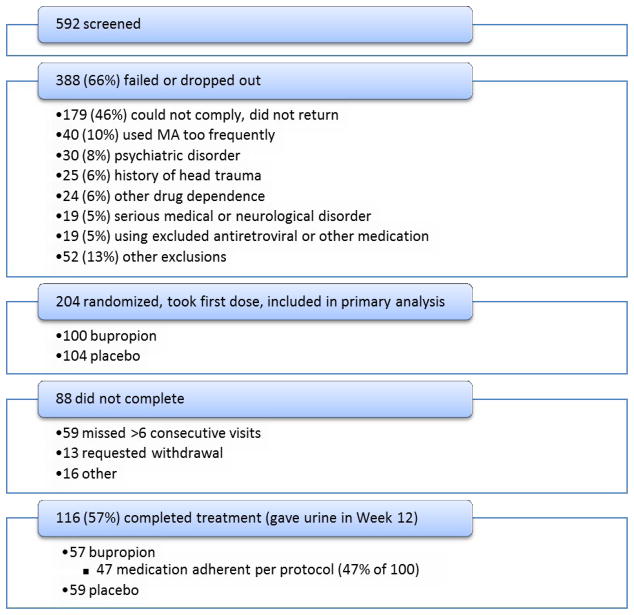
Methods: A randomized, double-blind, placebo-controlled trial, with 12-week treatment and 4-week follow-up, was conducted with 204 treatment-seeking participants having MA dependence per DSM-IV, who used MA on a less-than-daily basis. 104 were randomized to matched placebo and 100 to bupropion, sustained-release 150mg, twice daily. Participants were seen three times weekly to obtain urine for MA and bupropion assays, study assessments, and thrice weekly, 90-min, group psychotherapy. There was no biomarker for placebo adherence. The primary outcome was achievement of abstinence throughout the last two weeks of treatment; 'success' requiring at least two urine samples during each of Weeks 11 and 12, and all samples MA-negative (<300ng/mL).
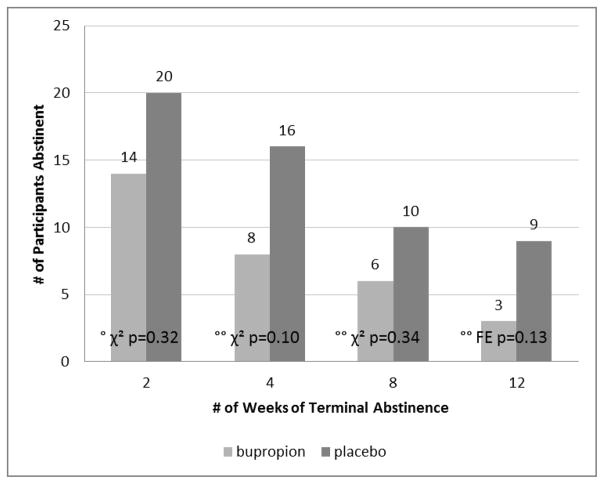
Results: Bupropion and placebo groups did not differ significantly in the percentage achieving abstinence for the last 2 weeks of treatment (chi-square, p=0.32). Subgroup analysis of participants with lower baseline MA use (≤18 of last 30 days before consent) also revealed no difference in success between groups (p=0.73). Medication adherence per protocol (detectable bupropion, >5ng/mL, in ≥50% of urine samples from Study Weeks 1-10 and ≥66% of urine samples from Weeks 11 to 12) was achieved by 47% of participants taking bupropion.
Conclusions: These data indicate that bupropion did not increase abstinence in dependent participants who were using MA less-than-daily. Medication non-adherence was a limitation in this trial. Psychosocial therapy remains the mainstay of treatment for MA dependence. Further research on subgroups who may respond to bupropion may be warranted.
Keywords: Bupropion; Drug therapy; Medication adherence; Methamphetamine; Patient acuity; Substance-related disorders.
Published by Elsevier Ireland Ltd.
Conflict of interest statement
Conflict of Interest
No pharmaceutical company supported this study. No authors have relevant patent applications or own stock in, are employed or paid for consultations by, or receive other funding from GlaxoSmithKline or relevant pharmaceutical companies.
Figures
References
-
- Adler LA, Spence T, Faraone SV, Reimherr FW, Kelsey D, Michelson D, Biederman J. Training raters to Assess Adult ADHD: reliability of Ratings. J Atten Disord. 2005;8:121–126. - PubMed
-
- Brackins T, Brahm NC, Kissack JC. Treatments for methamphetamine abuse: a literature review for the clinician. J Pharm Pract. 2011;24:541–50. - PubMed
-
- Elkashef AM, Rawson RA, Anderson AL, Li SH, Holmes T, Smith EV, Chiang N, Kahn R, Vocci F, Ling W, Pearce VJ, McCann M, Campbell J, Gorodetzky C, Haning W, Carlton B, Mawhinney J, Weis D. Bupropion for the treatment of methamphetamine dependence. Neuropsychopharmacology. 2008;33:1162–70. - PubMed
Publication types
MeSH terms
Substances
Grants and funding
LinkOut - more resources
Full Text Sources
Other Literature Sources
Medical
