


Soil microbial community variation correlates most strongly with plant species identity, followed by soil chemistry, spatial location and plant genus
- PMID: 25818073
- PMCID: PMC4417136
- DOI: 10.1093/aobpla/plv030
Soil microbial community variation correlates most strongly with plant species identity, followed by soil chemistry, spatial location and plant genus
Abstract
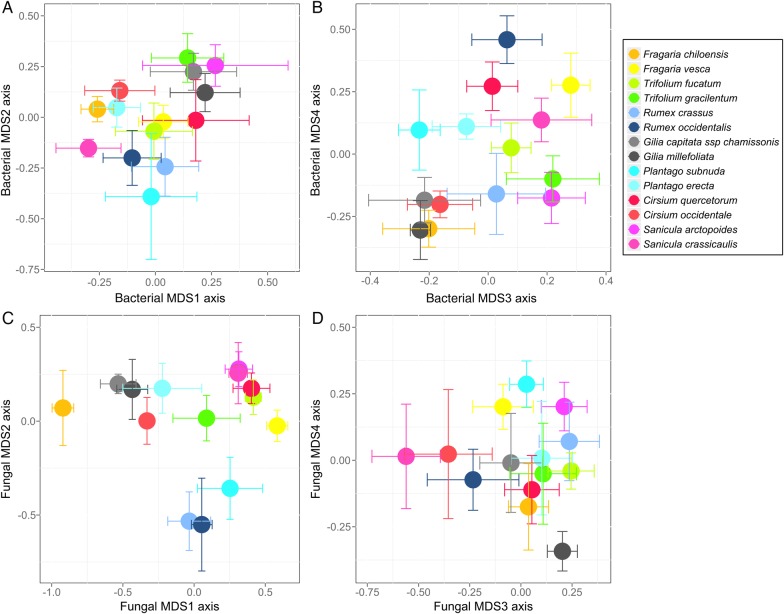
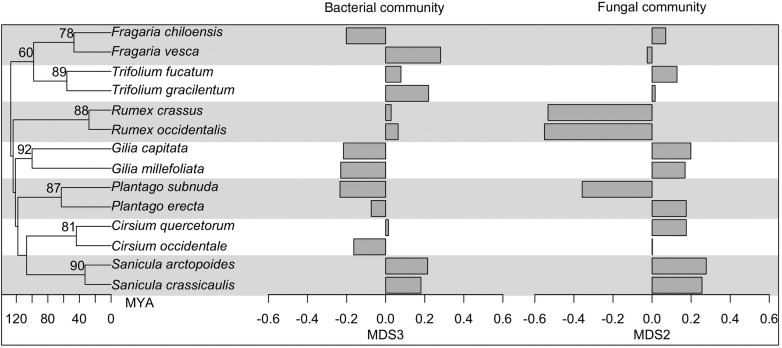
Soil ecologists have debated the relative importance of dispersal limitation and ecological factors in determining the structure of soil microbial communities. Recent evidence suggests that 'everything is not everywhere', and that microbial communities are influenced by both dispersal limitation and ecological factors. However, we still do not understand the relative explanatory power of spatial and ecological factors, including plant species identity and even plant relatedness, for different fractions of the soil microbial community (i.e. bacterial and fungal communities). To ask whether factors such as plant species, soil chemistry, spatial location and plant relatedness influence rhizosphere community composition, we examined field-collected rhizosphere soil of seven congener pairs that occur at Bodega Bay Marine Reserve, CA, USA. We characterized differences in bacterial and fungal communities using terminal-restriction fragment length polymorphism. Plant species identity was the single best statistical predictor of both bacterial and fungal community composition in the root zone. Soil microbial community structure was also correlated with soil chemistry. The third best predictor of bacterial and fungal communities was spatial location, confirming that everything is not everywhere. Variation in microbial community composition was also related to combinations of spatial location, soil chemistry and plant relatedness, suggesting that these factors do not act independently. Plant relatedness explained less of the variation than plant species, soil chemistry, or spatial location. Despite some congeners occupying different habitats and being spatially distant, rhizosphere fungal communities of plant congeners were more similar than expected by chance. Bacterial communities from the same samples were only weakly similar between plant congeners. Thus, plant relatedness might influence soil fungal, more than soil bacterial, community composition.
Keywords: Coastal grassland community; niche; soil bacterial community; soil fungal community; terminal-restriction fragment length polymorphism.
Published by Oxford University Press on behalf of the Annals of Botany Company.
Figures
References
-
- Bardgett RD, Mawdsley JL, Edwards S, Hobbs PJ, Rodwell JS, Davies WJ. 1999. Plant species and nitrogen effects on soil biological properties of temperate upland grasslands. Functional Ecology 13:650–660. 10.1046/j.1365-2435.1999.00362.x - DOI
-
- Bass Becking L. 1934. Geobiologie of Inleiding Tot de Milieukunde. The Hague: Van Stockum & Zoon.
-
- Bellier E, Monestiez P, Durbec J-P, Candau J-N. 2007. Identifying spatial relationships at multiple scales: principal coordinates of neighbour matrices (PCNM) and geostatistical approaches. Ecography 30:385–399. 10.1111/j.0906-7590.2007.04911.x - DOI
LinkOut - more resources
Full Text Sources
Other Literature Sources
