Review
. 2015 Apr:133:100-11.
doi: 10.1016/j.exer.2014.07.015.

The dynamic sclera: extracellular matrix remodeling in normal ocular growth and myopia development

Affiliations
Review

The dynamic sclera: extracellular matrix remodeling in normal ocular growth and myopia development

Angelica R Harper et al. Exp Eye Res. 2015 Apr.

Abstract

Myopia is a common ocular condition, characterized by excessive elongation of the ocular globe. The prevalence of myopia continues to increase, particularly among highly educated groups, now exceeding 80% in some groups. In parallel with the increased prevalence of myopia, are increases in associated blinding ocular conditions including glaucoma, retinal detachment and macular degeneration, making myopia a significant global health concern. The elongation of the eye is closely related to the biomechanical properties of the sclera, which in turn are largely dependent on the composition of the scleral extracellular matrix. Therefore an understanding of the cellular and extracellular events involved in the regulation of scleral growth and remodeling during childhood and young adulthood will provide future avenues for the treatment of myopia and its associated ocular complications.

Keywords: emmetropization; extracellular matrix; myopia; ocular development; sclera.


Figures

Figure 1
Figure 1
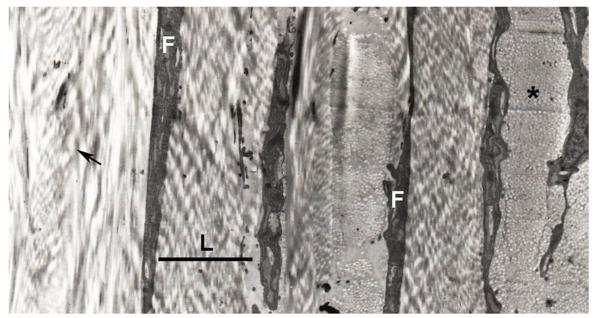
Lamellar organization of the human sclera. Scleral fibroblasts (F) can be seen between irregularly arranged collagenous lamella (L). Within each lamella, collagen fibrils are oriented in the same general direction, with some running longitudinally in the plane of section (arrow), and some running perpendicular to the plane of section and seen in cross section (asterisk). The black bar indicates the width of a lamella.
Figure 2
Figure 2
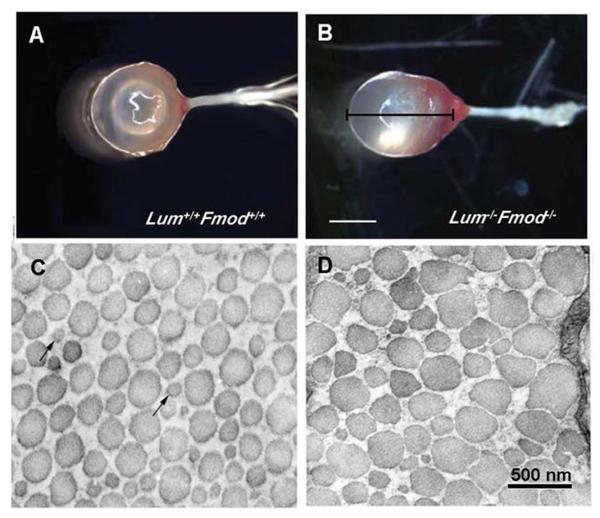
The sclera of lumican/fibromodulin deficient mice. Photographs of whole eyes of wildtype mice (Lum+/+ Fmod +/+) (A) and lumican/fibromodulin deficient mice (Lum−/− Fmod−/−) (B), demonstrating significantly higher axial length of deficient mice as compared with wildytpe mice. Collagen fibril morphology in the posterior sclera of wildtype mice (C) and Lum−/− Fmod −/− deficient mice (D). Collagen fibrils from deficient mice displayed abnormal small-to very large-diameter fibrils with irregular contours. Bar in B = 2 mm; Bar in D = 500 nm. From: Chakravarti S., et al. Ocular and scleral alterations in gene-targeted lumican-fibromodulin double-null mice. Invest Ophthalmol Vis Sci 44: 2422–2432. 2003 Reproduced with permission © Association for Research in Vision and Ophthalmology.
Figure 3
Figure 3
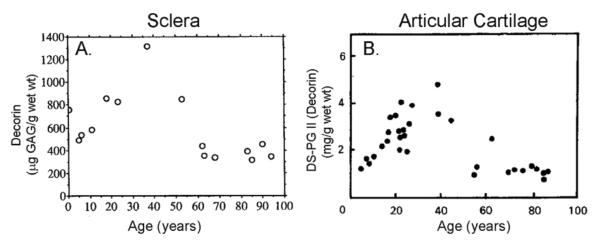
Age-related changes in decorin/DS-PG-II in human sclera and articular cartilage. A) Decorin was extracted from human sclera from ages 2 months to 94 years (n = 15), separated from other sulfated proteoglycans and quantified as micrograms of glycosaminoglycan per gram wet weight. B) Proteoglycans were extracted from normal human articular cartilage (ages 5 – 86 years, n = 32) and DS-PG-II (= decorin) was determined using a competitive radioimmunoassay. Note the striking similarity in the relative concentrations of decorin/DSPGII in the sclera and articular cartilage with increasing age. From: Rada J A, et al. Proteoglycan composition in the human sclera during growth and aging. Invest Ophthalmol Vis Sci 41: 1639–1648. 2000 Reproduced with permission © Association for Research in Vision and Ophthalmology and Sampaio LO et al., Dermatan sulphate proteoglycan from human articular cartilage. Variation in its content with age and its structural comparison with a small chondroitin sulphate proteoglycan from pig laryngeal cartilage. Biochem J 254: 757–764. 1988. Reproduced with permission © the Biochemical Society.
Figure 4
Figure 4
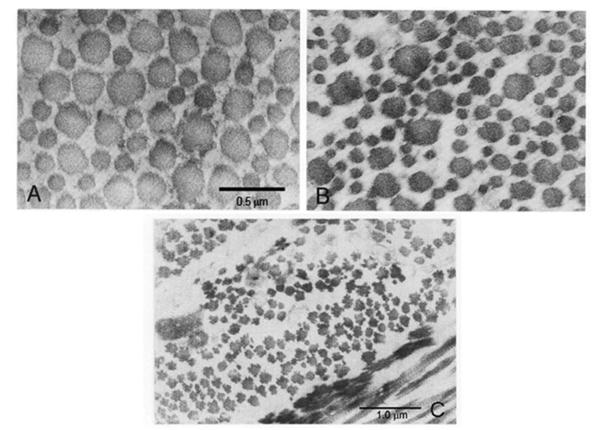
Collagen fibrils in the sclera of normal and highly myopic human eyes. In contrast to normal human sclera, the highly myopic human sclera shows greater variability in collagen fibril diameters and contains an increased number of smaller diameter collagen fibrils (A, B). Additionally, an increase in unusual star-shaped fibrils and fibrils associated with amorphous cementing substance were observed on cross section (C)., B) Bar = 0.5 μ; C) Bar = 1 μm. Adapted From: Curtin BJ. The Myopias, Basic Science and Clinical Management. Philadelphia, PA, Harper & Row. Pages 256–258.
Figure 5
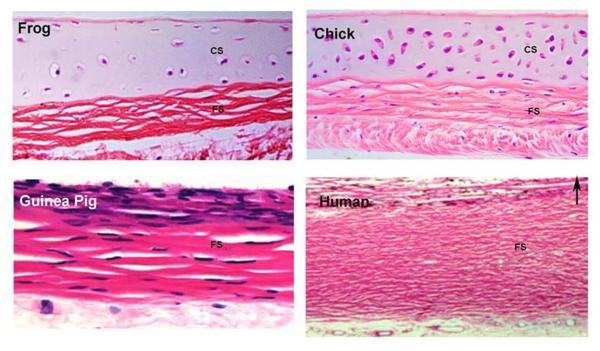
Figure 5. Vertebrate Scleras
Light microscopic histological appearance of frog, chick, guinea pig and human scleras. Note the presence of both a cartilaginous sclera (CS) and a fibrous sclera (FS) in the frog and chick and lack of cartilage in the guinea pig and human sclera. In all micrographs, the choroidal surface of the sclera is on the top (indicated by arrow in D). Note these micrographs are not reproduced at original relative size; they are re-scaled to allow histologcial comparisons of the entire scleral thickness of each species. Frog sclera was generously donated by Dr. Allan Wiechmann (University of Oklahoma Health Science Center). Guinea pig sclera from: Simpanya et al., Expressed sequence tag analysis of guinea pig (Cavia porcellus) eye tissues for NEI Bank Mol Vis. 14:2413–2427, 2008.
Figure 6
Figure 6
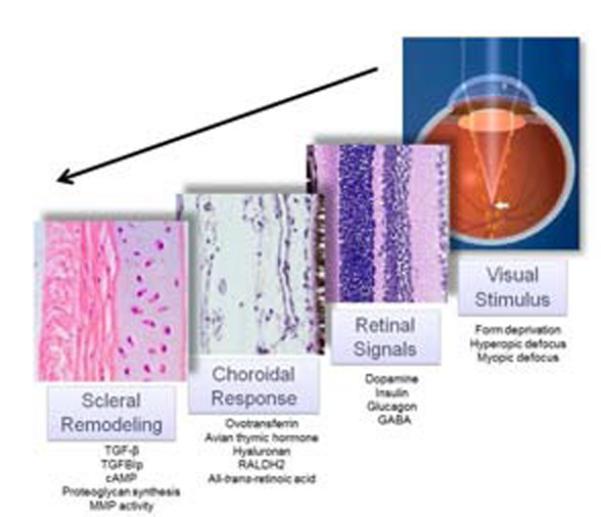
The retina-to-sclera signaling cascade. In response to visual stimuli such as form deprivation (blur), hyperopic defocus (minus lens treatment), or myopic defocus (plus lens treatment), changes in a variety of chemical moieties have been documented in the retina/RPE, choroid and sclera (listed under each tissue). Although the relationships, if any, between these tissue specific moieties have not been determined, it is likely that visual stimuli are transduced through the retina and choroid to ultimately affect scleral matrix remodeling and ocular axial length.
Figure 7
Figure 7
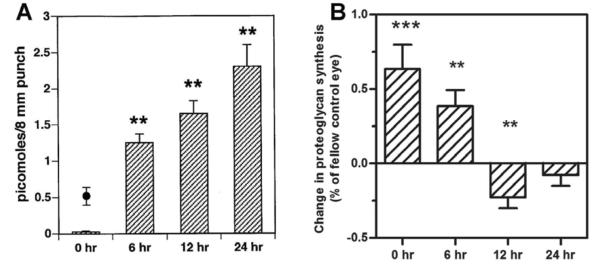
Comparison of changes in choroidal retinoic acid synthesis and scleral proteoglycan synthesis during recovery from induced myopia. A) Time course of increase in choroidal alltrans-retinoic acid (atRA) synthesis in eyes recovering from form deprivation myopia. B) Time course of decreased scleral proteoglycan synthesis in eyes recovering from form deprivation myopia. Fig. 7a from: Mertz JR, Wallman J. Choroidal retinoic acid synthesis: a possible mediator between refractive error and compensatory eye growth. Exp Eye Res, 70(4): p. 519–527 2000. Reproduced with permission © Elsevier and Fig. 7b adapted from: Summers JA, Hollaway LR. Regulation of the biphasic decline in scleral proteoglycan synthesis during the recovery from induced myopia. Exp. Eye Res. 92(5):394–400 2011. Reproduced with permission © Elsevier.
Figure 8
Figure 8
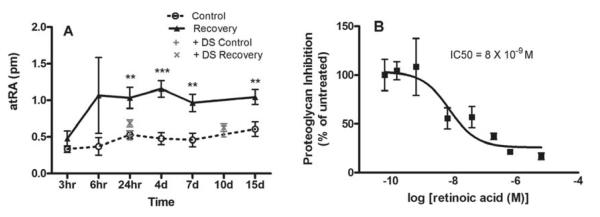
Choroidal retinoic acid as a potential scleral growth regulator. Retinoic acid was measured in organ cultures of choroids isolated from eyes recovering from induced myopia (3 hr – 15 day of unrestricted vision) using LC/MS/MS. Concentrations of retinoic acid were increased in cultures of recovering choroids following 1 – 15 days of recovery. Based on the volume of the organ cultures, the concentration of retinoic acid was determined to be ~1.45 × 10⁻⁸ M and ~5.0 × 10⁻⁹ M in recovering and control cultures, respectively (A). Comparison of a dose response curve for retinoic acid on scleral proteoglycan synthesis indicated the retinoic acid concentrations synthesized by choroids in vitro are within the range to significantly inhibit scleral proteoglycan synthesis (IC50 = 8 × 10⁻⁹ M). From: Summers JA, et al. Identification of RALDH2 as a Visually Regulated Retinoic Acid Synthesizing Enzyme in the Chick Choroid. Invest Ophthalmol Vis Sci 53: 1649–1662 2012 Reproduced with permission © Association for Research in Vision and Ophthalmology.

References

    1. Annunen S, Korkko J, Czarny M, Warman ML, Brunner HG, Kaariainen H, Mulliken JB, Tranebjaerg L, Brooks DG, Cox GF, Cruysberg JR, Curtis MA, Davenport SL, Friedrich CA, Kaitila I, Krawczynski MR, Latos-Bielenska A, Mukai S, Olsen BR, Shinno N, Somer M, Vikkula M, Zlotogora J, Prockop DJ, Ala-Kokko L. Splicing mutations of 54-bp exons in the COL11A1 gene cause Marshall syndrome, but other mutations cause overlapping Marshall/Stickler phenotypes. Am J Hum Genet. 1999;65:974–983. - PMC - PubMed
    1. Austin BA, Coulon C, Liu CY, Kao WW, Rada JA. Altered collagen fibril formation in the sclera of lumican-deficient mice. Invest Ophthalmol Vis Sci. 2002;43:1695–1701. - PubMed
    1. Avetisov ES, Savitskaya NF, Vinetskaya MI, Iomdina EN. A study of biochemical and biomechanical qualities of normal and myopic eye sclera in humans of different age groups. Metab Pediatr Syst Ophthalmol. 1983;7:183–188. - PubMed
    1. Barathi VA, Boopathi VG, Yap EP, Beuerman RW. Two models of experimental myopia in the mouse. Vision Res. 2008;48:904–916. - PubMed
    1. Birk DE, Lande MA. Corneal and scleral collagen fiber formation in vitro. Biochim Biophys Acta. 1981;670:362–369. - PubMed

Publication types