


Amphibian Symbiotic Bacteria Do Not Show a Universal Ability To Inhibit Growth of the Global Panzootic Lineage of Batrachochytrium dendrobatidis
- PMID: 25819964
- PMCID: PMC4421062
- DOI: 10.1128/AEM.00010-15
Amphibian Symbiotic Bacteria Do Not Show a Universal Ability To Inhibit Growth of the Global Panzootic Lineage of Batrachochytrium dendrobatidis
Abstract
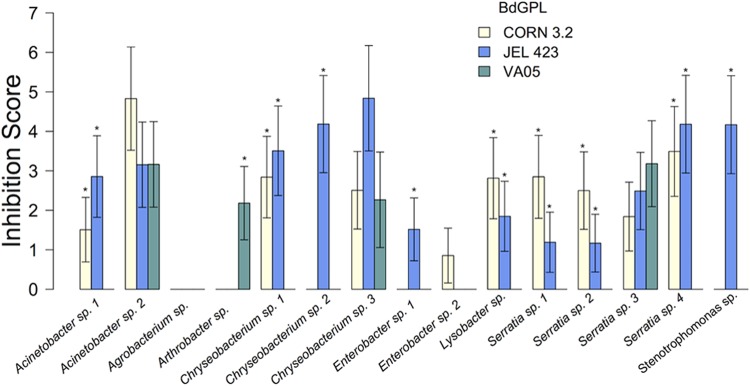
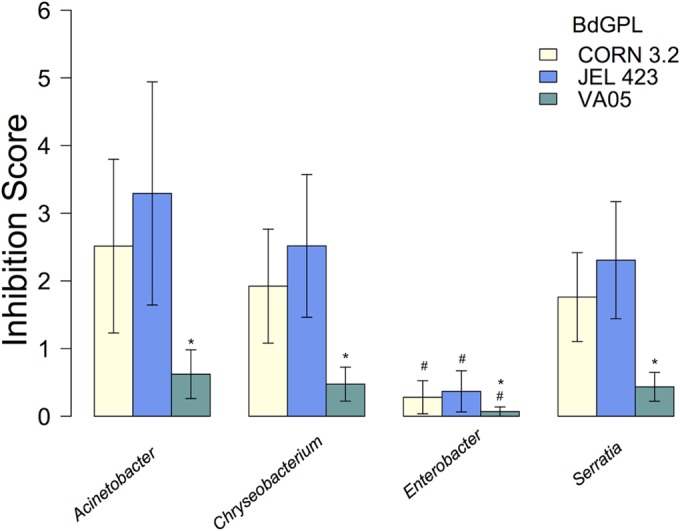
Microbiomes associated with multicellular organisms influence the disease susceptibility of hosts. The potential exists for such bacteria to protect wildlife from infectious diseases, particularly in the case of the globally distributed and highly virulent fungal pathogen Batrachochytrium dendrobatidis of the global panzootic lineage (B. dendrobatidis GPL), responsible for mass extinctions and population declines of amphibians. B. dendrobatidis GPL exhibits wide genotypic and virulence variation, and the ability of candidate probiotics to restrict growth across B. dendrobatidis isolates has not previously been considered. Here we show that only a small proportion of candidate probiotics exhibited broad-spectrum inhibition across B. dendrobatidis GPL isolates. Moreover, some bacterial genera showed significantly greater inhibition than others, but overall, genus and species were not particularly reliable predictors of inhibitory capabilities. These findings indicate that bacterial consortia are likely to offer a more stable and effective approach to probiotics, particularly if related bacteria are selected from genera with greater antimicrobial capabilities. Together these results highlight a complex interaction between pathogens and host-associated symbiotic bacteria that will require consideration in the development of bacterial probiotics for wildlife conservation. Future efforts to construct protective microbiomes should incorporate bacteria that exhibit broad-spectrum inhibition of B. dendrobatidis GPL isolates.
Copyright © 2015, American Society for Microbiology. All Rights Reserved.
Figures
References
-
- Newaj-Fyzul A, Al-Harbi H, Austin B. 2014. Review: developments in the use of probiotics for disease control in aquaculture. Aquaculture 431:1–11. doi: 10.1016/j.aquaculture.2013.08.026. - DOI
Publication types
MeSH terms
Grants and funding
LinkOut - more resources
Full Text Sources
Molecular Biology Databases
