


'Carriers of variant luteinizing hormone (V-LH) among 1593 Baltic men have significantly higher serum LH'
- PMID: 25820123
- PMCID: PMC4832392
- DOI: 10.1111/andr.12022
'Carriers of variant luteinizing hormone (V-LH) among 1593 Baltic men have significantly higher serum LH'
Abstract
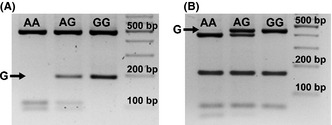
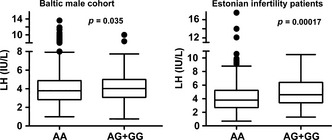
Luteinizing hormone (LH) is a pituitary heterodimeric glycoprotein essential in male and female reproduction. Its functional polymorphic variant (V-LH) is determined by two missense mutations (rs1800447, A/G, Trp8Arg; rs34349826, A/G, Ile15Thr) in the LH β-subunit encoding gene (LHB; 19q13.3; 1111 bp; 3 exons). Among women, V-LH has been associated with higher circulating LH and reduced fertility, but the knowledge of its effect on male reproductive parameters has been inconclusive. The objective of this study was to assess the effect of V-LH on hormonal, seminal and testicular parameters in the Baltic young men cohort (n = 986; age: 20.1 ± 2.1 years) and Estonian idiopathic infertility patients (n = 607; 35.1 ± 5.9 years). V-LH was detected by genotyping of the underlying DNA polymorphisms using PCR-RFLP combined with resequencing of a random subset of subjects. Genetic associations were tested using linear regression under additive model and results were combined in meta-analysis. No significant difference was detected between young men and infertility patients for the V-LH allele frequency (11.0 vs. 9.3%, respectively). V-LH was associated with higher serum LH in both, the young men cohort (p = 0.022, allelic effect = 0.26 IU/L) and the idiopathic infertility group (p = 0.008, effect = 0.59 IU/L). In meta-analysis, the statistical significance was enhanced (p = 0.0007, resistant to Bonferroni correction for multiple testing; effect = 0.33 IU/L). The detected significant association of V-LH with increased serum LH remained unchanged after additional adjustment for the SNPs previously demonstrated to affect LH levels (FSHB -211G/T, FSHR Asn680Ser, FSHR -29A/G). Additionally, a suggestive trend for association with reduced testicular volume was observed among young men, and with lower serum FSH among infertility patients. The V-LH carrier status did not affect sperm parameters and other circulating reproductive hormones. For the first time, we show a conclusive contribution of V-LH to the natural variance in male serum LH levels. Its downstream clinical consequences are still to be learned.
Keywords: LHB gene; V-LH; luteinizing hormone; testes volume.
© 2015 The Authors. Andrology published by John Wiley & Sons Ltd on behalf of American Society of Andrology.
Figures
References
-
- Berger K, Billerbeck AEC, Costa EMF, Carvalho LS, Arnhold IJP & Mendonca BB. (2005) Frequency of the allelic variant (Trp8Arg/Ile15Thr) of the luteinizing hormone gene in a Brazilian cohort of healthy subjects and in patients with hypogonadotropic hypogonadism. Clinics 60(6), 461–464. - PubMed
-
- Du JW, Xu KY, Fang LY & Qi XL. (2012) Association between mutations of the luteinizing hormone β subunit and female infertility. Mol Med Rep 5(2), 473–476. - PubMed
-
- Elkins DA, Yokomizo A, Thibodeau SN, Schaid DJ, Cunningham JM, Marks A, Christensen E, McDonnell SK, Slager S, Peterson BJ, Jacobsen SJ, Cerhan JR, Blute ML, Tindall DJ & Liu W. (2003) Luteinizing hormone β polymorphism and risk of familial and sporadic prostate cancer. Prostate 56(1), 30–36. - PubMed
-
- Elter K, Erel CT, Cine N, Ozbek U, Hacihanefioglu B & Ertungealp E. (1999) Role of the mutations Trp8⇒ Arg and Ile15⇒ Thr of the human luteinizing hormone β‐subunit in women with polycystic ovary syndrome. Fertil Steril 71(3), 425–430. - PubMed
Publication types
MeSH terms
Substances
Grants and funding
LinkOut - more resources
Full Text Sources
Other Literature Sources
