Review
. 2015 May 12;34(10):1296-308.
doi: 10.15252/embj.201490649. Epub 2015 Mar 27.

Reprogramming of cell fate: epigenetic memory and the erasure of memories past

Affiliations
Review

Reprogramming of cell fate: epigenetic memory and the erasure of memories past

Buhe Nashun et al. EMBO J. .

Abstract

Cell identity is a reflection of a cell type-specific gene expression profile, and consequently, cell type-specific transcription factor networks are considered to be at the heart of a given cellular phenotype. Although generally stable, cell identity can be reprogrammed in vitro by forced changes to the transcriptional network, the most dramatic example of which was shown by the induction of pluripotency in somatic cells by the ectopic expression of defined transcription factors alone. Although changes to cell fate can be achieved in this way, the efficiency of such conversion remains very low, in large part due to specific chromatin signatures constituting an epigenetic barrier to the transcription factor-mediated reprogramming processes. Here we discuss the two-way relationship between transcription factor binding and chromatin structure during cell fate reprogramming. We additionally explore the potential roles and mechanisms by which histone variants, chromatin remodelling enzymes, and histone and DNA modifications contribute to the stability of cell identity and/or provide a permissive environment for cell fate change during cellular reprogramming.

Keywords: cell fate; chromatin; induced pluripotent stem cells; reprogramming; transcription factors.


Figures

Figure 1
Figure 1
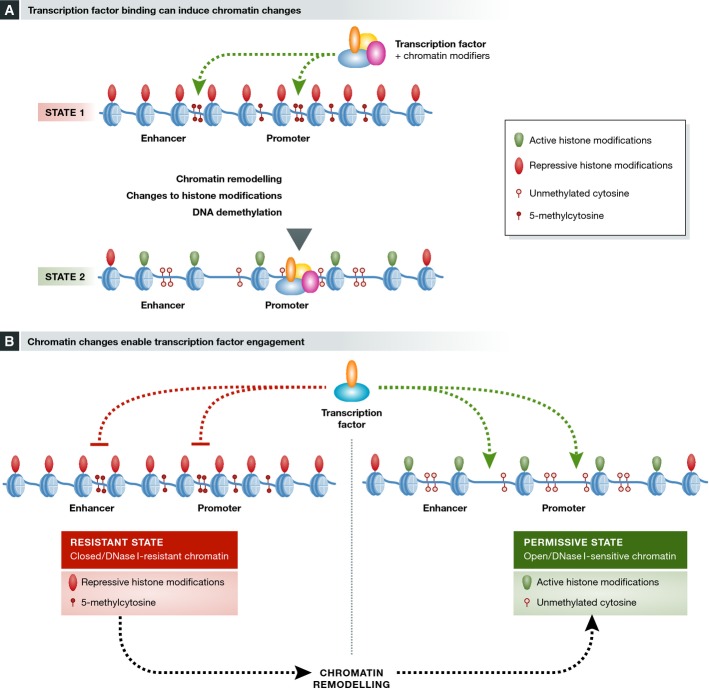
Relationship between transcription factors and chromatin configuration during cell reprogramming (A) Pioneer transcription factors (TFs) are known to reshape the chromatin landscape in the regions where they bind, both by enabling the binding of other TFs and through direct recruitment of various histone modifiers. In addition, the binding of both pioneer and non-pioneer TFs is known to induce locus-specific DNA demethylation. (B) Closed inaccessible chromatin in the original somatic cell type, marked by repressive histone modifications and DNA methylation, hinders the initial engagement of reprogramming-associated TFs. In turn, the activity of chromatin-modifying enzymes results in a permissive chromatin configuration that allows for fast and effective engagement of the introduced TFs, enabling efficient reprogramming.
Figure 2
Figure 2
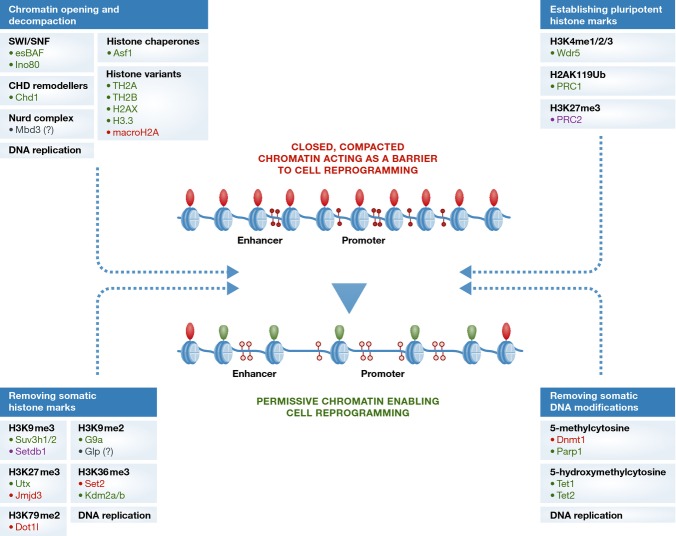
Chromatin components and modifiers affecting reprogramming efficiency Reprogramming requires the establishment of permissive chromatin and is associated with chromatin opening and changes to histone and DNA modifications. Multiple factors have been implicated in these processes: marked in green and red are factors whose presence/activity is associated with increased and decreased reprogramming efficiency, respectively; marked in purple are those factors whose presence/activity has been shown to both increase and decrease reprogramming efficiency in a context-dependent manner; factors whose influence on reprogramming requires further investigation are marked by (?).
Figure 3
Figure 3
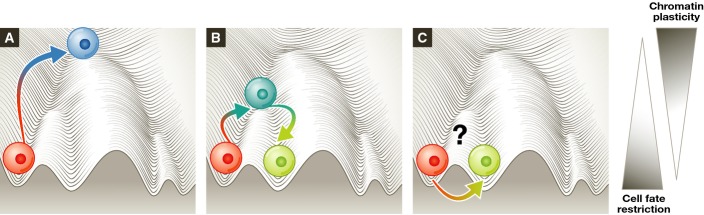
Is transition through a state characterised by open, dynamic chromatin a pre-requisite for all cell fate transitions? (A) Reprogramming to pluripotency appears to require increased chromatin plasticity. (B, C) Possible relationship between chromatin dynamics and trans-differentiation: (B) trans-differentiation via an upstream progenitor may be connected with a transient increase in chromatin permissiveness, and/or (C) direct trans-differentiation between two somatic states without transition through an intermediary state characterised by more plastic chromatin may be possible, although this has yet to be experimentally validated.

References

    1. Adachi K, Scholer HR. Directing reprogramming to pluripotency by transcription factors. Curr Opin Genet Dev. 2012;22:416–422. - PubMed
    1. Alabert C, Groth A. Chromatin replication and epigenome maintenance. Nat Rev Mol Cell Biol. 2012;13:153–167. - PubMed
    1. Ancelin K, Lange UC, Hajkova P, Schneider R, Bannister AJ, Kouzarides T, Surani MA. Blimp1 associates with Prmt5 and directs histone arginine methylation in mouse germ cells. Nat Cell Biol. 2006;8:623–630. - PubMed
    1. Ang YS, Tsai SY, Lee DF, Monk J, Su J, Ratnakumar K, Ding J, Ge Y, Darr H, Chang B, Wang J, Rendl M, Bernstein E, Schaniel C, Lemischka IR. Wdr5 mediates self-renewal and reprogramming via the embryonic stem cell core transcriptional network. Cell. 2011;145:183–197. - PMC - PubMed
    1. Apostolou E, Hochedlinger K. Chromatin dynamics during cellular reprogramming. Nature. 2013;502:462–471. - PMC - PubMed

Publication types

MeSH terms