


Systematic review and meta-analysis of objective and subjective quality of life among pediatric, adolescent, and young adult bone tumor survivors
- PMID: 25820683
- PMCID: PMC4515170
- DOI: 10.1002/pbc.25514
Systematic review and meta-analysis of objective and subjective quality of life among pediatric, adolescent, and young adult bone tumor survivors
Erratum in
-
ERRATUM.Pediatr Blood Cancer. 2015 Dec;62(12):2252. doi: 10.1002/pbc.25825. Pediatr Blood Cancer. 2015. PMID: 26496679 No abstract available.
Abstract
Background: Pediatric, adolescent, and young adult survivors of bone sarcomas are at risk for poor quality of life (QOL). We conducted a systematic review and meta-analysis to summarize the literature describing QOL in this population and differences in QOL based on local control procedures.
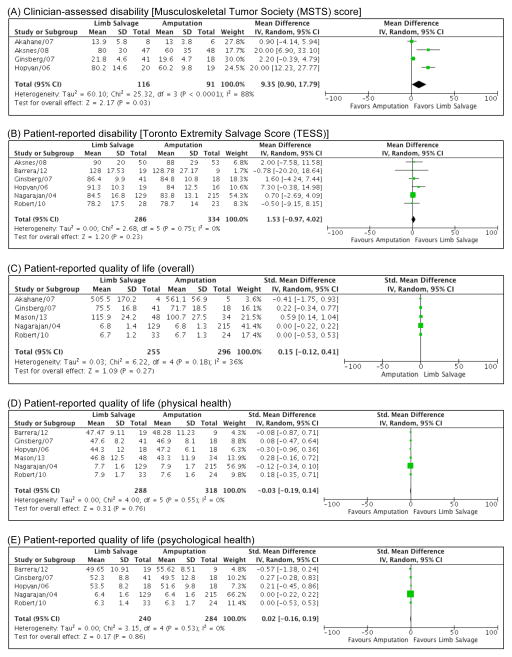
Procedure: Included studies described ≥5 patients <25 years old who had completed local control treatment for bone sarcoma, defined QOL as a main outcome, and measured it with a validated instrument. Data extraction and quality assessments were conducted with standardized tools. Meta-analyses compared QOL based on surgical procedure (limb-sparing vs. amputation) and were stratified by assessment type (objective physical function, clinician-assessed disability, patient-reported disability, and patient-reported QOL). Effect sizes were reported as the standard mean difference when multiple instruments were used within a comparison and weighted mean difference otherwise. All were weighted by inverse variance and modeled with random effects.
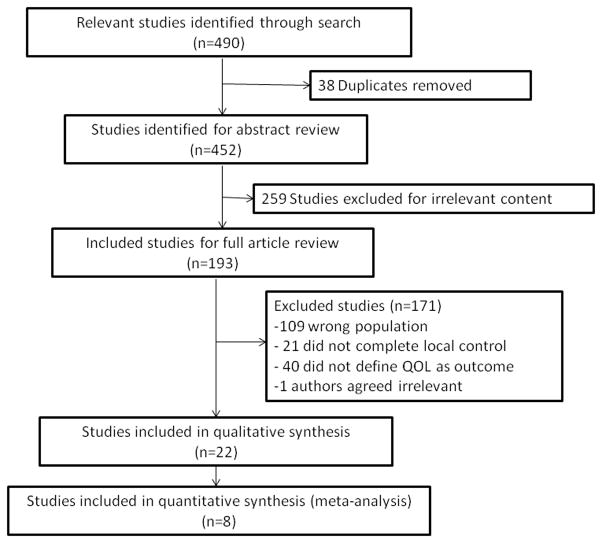
Results: Twenty-two of 452 unique manuscripts were included in qualitative syntheses, eight of which were included in meta-analyses. Manuscripts were heterogeneous with respect to included patient populations (age, tumor type, time since treatment) and QOL instruments. Prospective studies suggested that QOL improves over time, and that female sex and older age at diagnosis are associated with poor QOL. Meta-analyses showed no differences in outcomes between patients who underwent limb-sparing versus amputation for local control.
Conclusion: QOL studies among children and AYAs with bone sarcoma are remarkably diverse, making it difficult to detect trends in patient outcomes. Future research should focus on standardized QOL instruments and interpretations.
Keywords: Ewing Sarcoma; bone cancer; late effects; osteosarcoma; patient-reported outcomes; pediatric cancer; quality of life; sarcoma; survivorship.
© 2015 Wiley Periodicals, Inc.
Conflict of interest statement
None of the authors has a financial or other conflict of interest related to this research.
Figures
References
-
- Ries LAGSM, Gurney JG, Linet M, Tamra T, Young JL, Bunin GR, editors. NIH Pub No 99-4649. Bethesda, MD: 1999. Cancer Incidence and Survival among Children and Adolescents: United States SEER Program 1975–1995, National Cancer Institute, SEER Program.
-
- Zebrack BJ, Zevon MA, Turk N, Nagarajan R, Whitton J, Robison LL, Zeltzer LK. Psychological distress in long-term survivors of solid tumors diagnosed in childhood: a report from the childhood cancer survivor study. Pediatr Blood Cancer. 2007;49(1):47–51. - PubMed
-
- Oeffinger KC, Mertens AC, Sklar CA, Kawashima T, Hudson MM, Meadows AT, Friedman DL, Marina N, Hobbie W, Kadan-Lottick NS, Schwartz CL, Leisenring W, Robison LL. Chronic health conditions in adult survivors of childhood cancer. N Engl J Med. 2006;355(15):1572–1582. - PubMed
-
- Audino AN, Yeager ND, Asti L, Miao Y, O’Brien SH. Length of stay and treatment-related complications are similar in pediatric and AYA patients with bone sarcoma in United States children’s hospitals. Pediatr Blood Cancer. 2013;60(3):415–419. - PubMed
Publication types
MeSH terms
Grants and funding
LinkOut - more resources
Full Text Sources
Other Literature Sources
Medical
