


Serotonergic psychedelics temporarily modify information transfer in humans
- PMID: 25820842
- PMCID: PMC4571623
- DOI: 10.1093/ijnp/pyv039
Serotonergic psychedelics temporarily modify information transfer in humans
Erratum in
-
Erratum.Int J Neuropsychopharmacol. 2015 Sep 8;19(3):pyv099. doi: 10.1093/ijnp/pyv099. Int J Neuropsychopharmacol. 2015. PMID: 26351300 Free PMC article. No abstract available.
Abstract
Background: Psychedelics induce intense modifications in the sensorium, the sense of "self," and the experience of reality. Despite advances in our understanding of the molecular and cellular level mechanisms of these drugs, knowledge of their actions on global brain dynamics is still incomplete. Recent imaging studies have found changes in functional coupling between frontal and parietal brain structures, suggesting a modification in information flow between brain regions during acute effects.
Methods: Here we assessed the psychedelic-induced changes in directionality of information flow during the acute effects of a psychedelic in humans. We measured modifications in connectivity of brain oscillations using transfer entropy, a nonlinear measure of directed functional connectivity based on information theory. Ten healthy male volunteers with prior experience with psychedelics participated in 2 experimental sessions. They received a placebo or a dose of ayahuasca, a psychedelic preparation containing the serotonergic 5-HT2A agonist N,N-dimethyltryptamine.
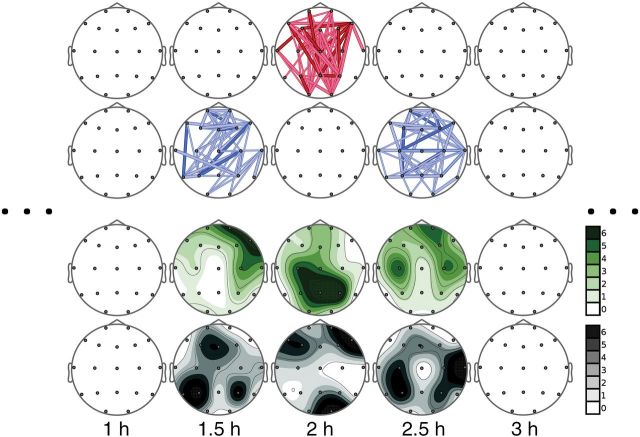
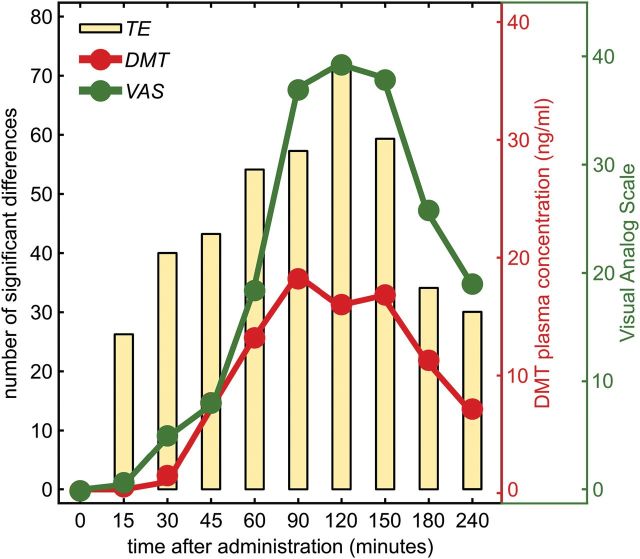
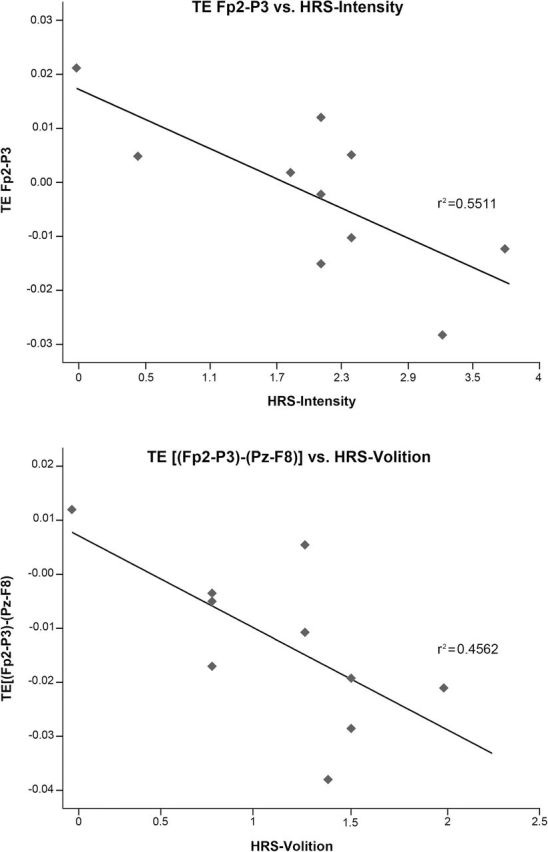
Results: The analysis showed significant changes in the coupling of brain oscillations between anterior and posterior recording sites. Transfer entropy analysis showed that frontal sources decreased their influence over central, parietal, and occipital sites. Conversely, sources in posterior locations increased their influence over signals measured at anterior locations. Exploratory correlations found that anterior-to-posterior transfer entropy decreases were correlated with the intensity of subjective effects, while the imbalance between anterior-to-posterior and posterior-to-anterior transfer entropy correlated with the degree of incapacitation experienced.
Conclusions: These results suggest that psychedelics induce a temporary disruption of neural hierarchies by reducing top-down control and increasing bottom-up information transfer in the human brain.
Keywords: Oscillatory brain dynamics; functional connectivity; human; psychedelics; transfer entropy.
© The Author 2015. Published by Oxford University Press on behalf of CINP.
Figures
References
-
- Abraham HD, Duffy FH. (1996) Stable quantitative EEG difference in post-LSD visual disorder by split-half analysis: evidence for disinhibition. Psychiatry Res 67:173–187. - PubMed
-
- Abraham HD, Duffy FH. (2001) EEG coherence in post-LSD visual hallucinations. Psychiatry Res 107:151–163. - PubMed
-
- Barnett L, Barrett AB, Seth AK. (2009) Granger causality and transfer entropy are equivalent for Gaussian variables. Phys Rev Lett 103:238701. - PubMed
-
- Barnett L, Seth AK. (2014) The MVGC multivariate Granger causality toolbox: a new approach to Granger-causal inference. J Neurosci Methods 223:50–68. - PubMed
Publication types
MeSH terms
Substances
LinkOut - more resources
Full Text Sources
Other Literature Sources
