Review
. 2015 Aug;56(3):317-27.
doi: 10.1007/s13353-015-0281-x. Epub 2015 Mar 28.

Fundus albipunctatus: review of the literature and report of a novel RDH5 gene mutation affecting the invariant tyrosine (p.Tyr175Phe)

Affiliations
Review

Fundus albipunctatus: review of the literature and report of a novel RDH5 gene mutation affecting the invariant tyrosine (p.Tyr175Phe)

Anna Skorczyk-Werner et al. J Appl Genet. 2015 Aug.

Abstract

Fundus albipunctatus (FA) is a rare, congenital form of night blindness with rod system impairment, characterised by the presence of numerous small, white-yellow retinal lesions. FA belongs to a heterogenous group of so-called flecked retina syndromes. This disorder shows autosomal recessive inheritance and is caused mostly by mutations in the RDH5 gene. This gene encodes the enzyme that is a part of the visual cycle, the 11-cis retinol dehydrogenase. This study is a brief review of the literature on FA and a report of the first molecular evidence for RDH5 gene mutation in a Polish patient with this rare disorder. We present a novel pathogenic RDH5 gene mutation in a 16-year-old female patient with symptoms of night blindness. The patient underwent ophthalmological examinations, including colour vision testing, fundus photography, automated visual field testing, full-field electroretinography (ERG) and spectral optical coherent tomography (SOCT). The patient showed typical FA ERG records, the visual field was constricted and fundus examination revealed numerous characteristic, small, white-yellowish retinal lesions. DNA sequencing of the RDH5 gene coding sequence (exons 2-5) enabled the detection of the homozygous missense substitution c.524A > T (p.Tyr175Phe) in exon 3. This is the first report of RDH5 gene mutation that affects the invariant tyrosine, one of the most conserved amino acid residues in short-chain alcohol dehydrogenases/reductases (SDRs), crucial for these enzymes' activity. The location of this substitution, together with its predicted influence on the protein function, indicate that the p.Tyr175Phe mutation is the cause of FA in our patient.


Figures

Fig. 1
Fig. 1
The amino acid conservation of part of the active site (residues 157–196 according to the numbering system of the RDH5 protein) among RDH5 of several species and three other short-chain dehydrogenases. The red frame indicates the invariant tyrosine, while the black frame indicates two other highly conserved residues involved in the catalytic mechanism: serine-163 and lysine-179. The abbreviation ‘DH’ in the names of three aligned proteins’ sequences stands for ‘dehydrogenase’
Fig. 2
Fig. 2
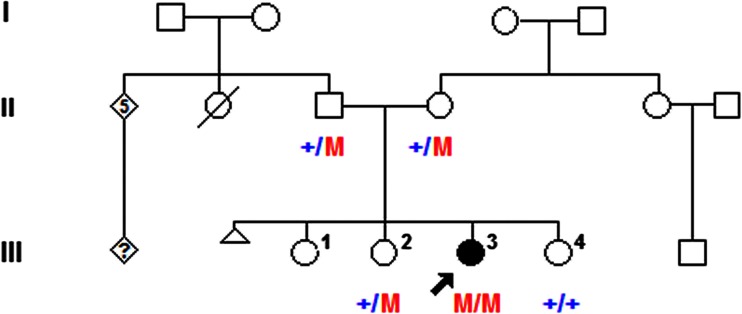
Pedigree and genotypes at the RDH5 gene nucleotide position 524 of the family with the c.524A > T mutation. The mutation is marked with red ‘M’ letter, while the blue ‘+’ symbol indicates a wild-type allele. The parents and two sisters of the proband were involved in the exon 3 sequencing analysis
Fig. 3
Fig. 3
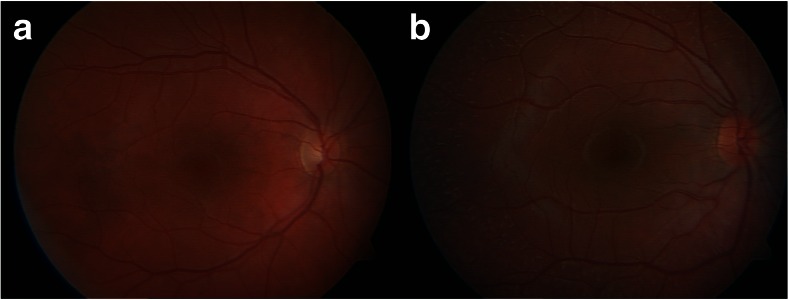
Fundus examination. a The right eye of a healthy individual, b The right eye of the patient with the c.524A > T mutation in the RDH5 gene. Numerous small, white-yellowish retinal lesions are located in the upper segments of the retina
Fig. 4
Fig. 4
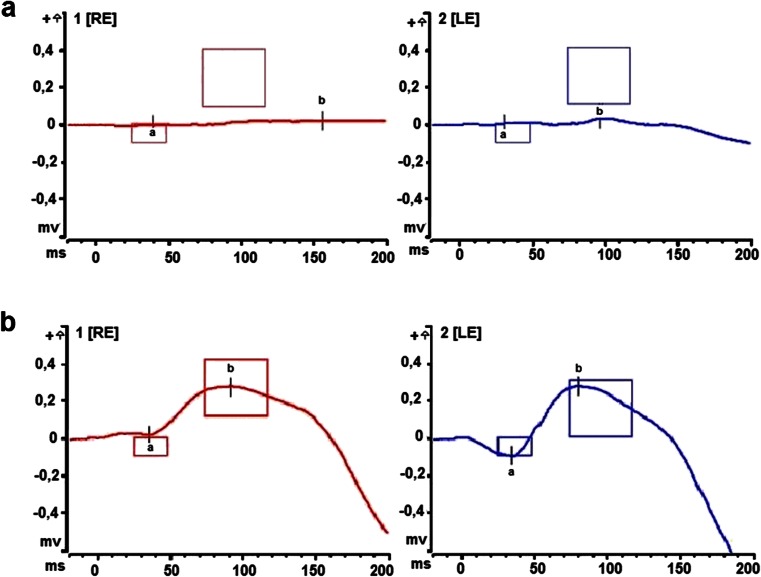
Comparison of scotopic responses after 30 and 120 min of dark adaptation: RE, right eye; LE, left eye. a The reduction of scotopic responses (DA 0.009 cdxs/m2) (b-wave amplitude RE: 26.68 μV, LE: 26.53 μV, normal 260 ± 151.4 μV), standard electroretinography (ERG) response (3 cdxs/m2) on the borderline after 30 min of dark adaptation. b The normalisation of scotopic responses after 120 min of scotopic adaptation (b-wave amplitude RE: 259.1 μV, LE: 378.2 μV)
Fig. 5
Fig. 5
A chromatogram showing the c.524A > T mutation in the RDH5 gene. a The wild-type nucleotide sequence and the wild-type protein sequence. The orange frame indicates the most conservative element between short-chain alcohol dehydrogenases, located within the active site of the enzyme. Invariant tyrosine is labelled blue and indicated with the red frame. b The nucleotide sequence of the heterozygous parent. c The sequence of the patient with c.524A > T mutation and truncated protein sequence

References

    1. 1000 Genomes Project Consortium, Abecasis GR, Auton A, Brooks LD, DePristo MA, Durbin RM, Handsaker RE, Kang HM, Marth GT, McVean GA (2012) An integrated map of genetic variation from 1,092 human genomes. Nature 491:56–65. http://www.1000genomes.org. Accessed 11 February 2015 - PMC - PubMed
    1. Adzhubei IA, Schmidt S, Peshkin L, Ramensky VE, Gerasimova A, Bork P, Kondrashov AS, Sunyaev SR. A method and server for predicting damaging missense mutations. Nat Methods. 2010;7:248–249. doi: 10.1038/nmeth0410-248. - DOI - PMC - PubMed
    1. Ajmal M, Khan MI, Neveling K, Khan YM, Ali SH, Ahmed W, Iqbal MS, Azam M, den Hollander AI, Collin RW, Qamar R, Cremers FP. Novel mutations in RDH5 cause fundus albipunctatus in two consanguineous Pakistani families. Mol Vis. 2012;18:1558–1571. - PMC - PubMed
    1. Albalat R, González-Duarte AS. Protein engineering of Drosophila alcohol dehydrogenase. The hydroxyl group of Tyr152 is involved in the active site of the enzyme. FEBS Lett. 1992;308:235–239. doi: 10.1016/0014-5793(92)81282-Q. - DOI - PubMed
    1. Burstedt MS, Sandgren O, Golovleva I, Wachtmeister L. Effects of prolonged dark adaptation in patients with retinitis pigmentosa of Bothnia type: an electrophysiological study. Doc Ophthalmol. 2008;116:193–205. doi: 10.1007/s10633-007-9082-9. - DOI - PubMed

Supplementary concepts