. 2015:2015:806418.
doi: 10.1155/2015/806418. Epub 2015 Mar 3.

Physical activity enhances metabolic fitness independently of cardiorespiratory fitness in marathon runners

Affiliations

Physical activity enhances metabolic fitness independently of cardiorespiratory fitness in marathon runners

M J Laye et al. Dis Markers. 2015.

Abstract

High levels of cardiovascular fitness (CRF) and physical activity (PA) are associated with decreased mortality and risk to develop metabolic diseases. The independent contributions of CRF and PA to metabolic disease risk factors are unknown. We tested the hypothesis that runners who run consistently >50 km/wk and/or >2 marathons/yr for the last 5 years have superior metabolic fitness compared to matched sedentary subjects (CRF, age, gender, and BMI). Case-control recruitment of 31 pairs of runner-sedentary subjects identified 10 matched pairs with similar VO2max (mL/min/kg) (similar-VO2max). The similar-VO2max group was compared with a group of age, gender, and BMI matched pairs who had the largest difference in VO2max (different-VO2max). Primary outcomes that defined metabolic fitness including insulin response to an oral glucose tolerance test, fasting lipids, and fasting insulin were superior in runners versus sedentary controls despite similar VO2max. Furthermore, performance (velocity at VO2max, running economy), improved exercise metabolism (lactate threshold), and skeletal muscle levels of mitochondrial proteins were superior in runners versus sedentary controls with similar VO2max. In conclusion subjects with a high amount of PA have more positive metabolic health parameters independent of CRF. PA is thus a good marker against metabolic diseases.


Figures
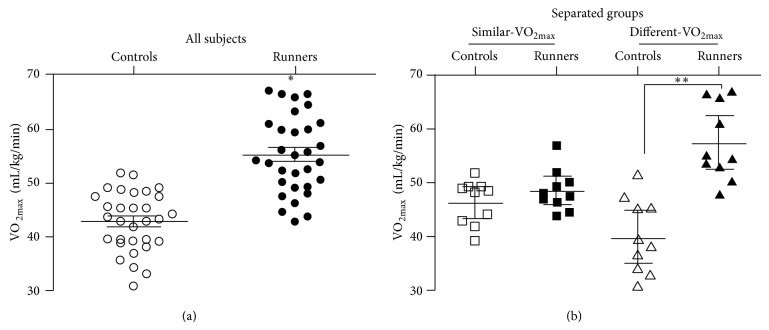
Figure 1
Figure 1
VO2max (mL/kg/min) was determined in marathon runners and controls who were individually matched for age, BMI, and gender with one runner. Runners as a group had a significantly higher VO2max than their sedentary paired control (Panel (a)) (n = 31/group, P < 0.0001, t-test). When we stratified the pairs by difference in VO2max between each runner and their control the 10 pairs with the most similar-VO2max did not significantly differ in VO2max (Panel (b)) (n = 10, P = 0.22, t-test). In 10 pairs with the most different-VO2max the runners had a significantly higher VO2max (n = 10, P < 0.0001, t-test).
Figure 2
Figure 2
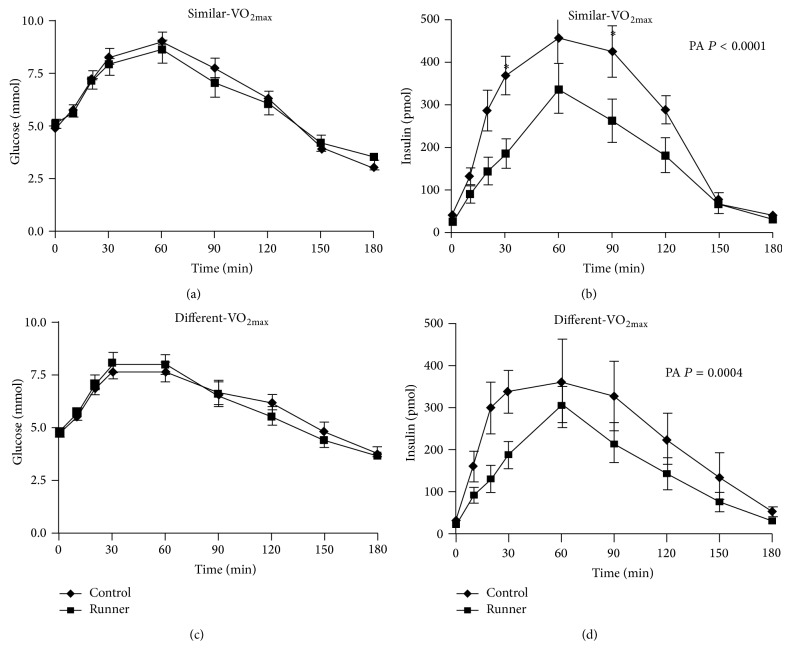
Oral glucose tolerance tests were conducted on marathon runners and sedentary paired controls with similar-VO2max ((a, b),  n = 10) and with different-VO2max ((c, d), n = 10). While no differences in plasma glucose were seen between runners and sedentary controls regardless of VO2max stratification, runners regardless of VO2max stratification had a significantly lower insulin response (P < 0.0005 for both groups, One-Way Repeated Measures ANOVA).
Figure 3
Figure 3
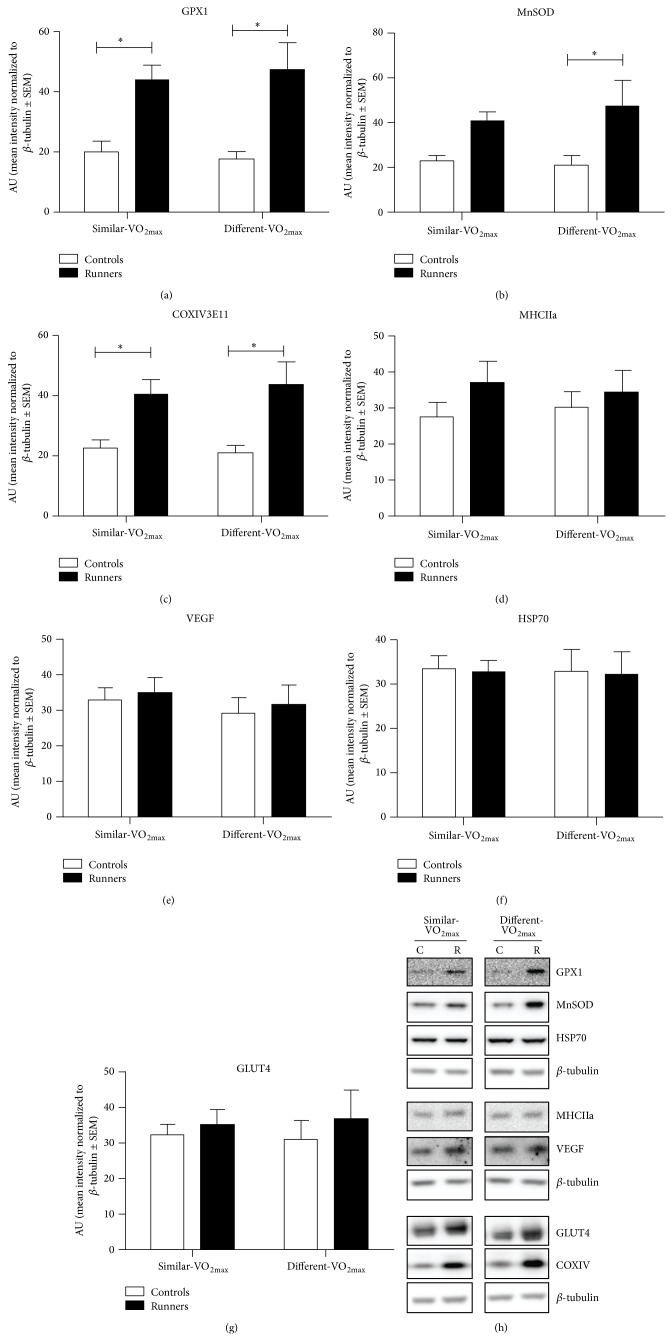
Protein levels as measured by western blot of traditional training markers in runners (solid bars) or pair sedentary controls (open bars) in resting vastus lateralis biopsies. Glutathione peroxidase 1 (a) and manganese superoxide dismutase (MnSOD) (b) were significantly higher in runners (n = 10, P < 0.001, 2-way ANOVA). Mitochondrial complex IV (COXIV) (c) was significantly higher in runners (n = 10, P < 0.001, 2-way ANOVA). Post hoc significance as determined by Bonferroni corrected t-test is indicated by a *(P < 0.05). Myosin heavy chain IIa (d), vascular endothelial growth factor (VEGF) (e), heat shock protein 70 (HSP70) (f), nor glucose transporter 4 (GLUT4) (g) did not differ between groups. Proteins of interest are normalized to β-tubulin as a loading control that did not differ between groups. Representative blots are shown in (h), with C indicating control and R indicating runner.

References

    1. Booth F. W., Roberts C. K., Laye M. J. Lack of exercise is a major cause of chronic diseases. Comprehensive Physiology. 2012;2(2):1143–1211. doi: 10.1002/cphy.c110025. - DOI - PMC - PubMed
    1. Telford R. D. Low physical activity and obesity: causes of chronic disease or simply predictors? Medicine and Science in Sports and Exercise. 2007;39(8):1233–1240. doi: 10.1249/mss.0b013e31806215b7. - DOI - PubMed
    1. Fogelholm M. Physical activity, fitness and fatness: relations to mortality, morbidity and disease risk factors. A systematic review. Obesity Reviews. 2010;11(3):202–221. doi: 10.1111/j.1467-789x.2009.00653.x. - DOI - PubMed
    1. Lee D. C., Sui X., Blair S. N. Does physical activity ameliorate the health hazards of obesity? British Journal of Sports Medicine. 2009;43(1):49–51. doi: 10.1136/bjsm.2008.054536. - DOI - PubMed
    1. Twisk J. W. R., Kemper H. C. G., Van Mechelen W. The relationship between physical fitness and physical activity during adolescence and cardiovascular disease risk factors at adult age. The Amsterdam Growth and Health Longitudinal Study. International Journal of Sports Medicine, 2002;23(supplement 1):S8–S14. - PubMed

Publication types