


Hematopoietic Stem Cell Transplantation for Severe Combined Immunodeficiency
- PMID: 25821657
- PMCID: PMC4371740
- DOI: 10.1007/s40124-014-0071-7
Hematopoietic Stem Cell Transplantation for Severe Combined Immunodeficiency
Abstract
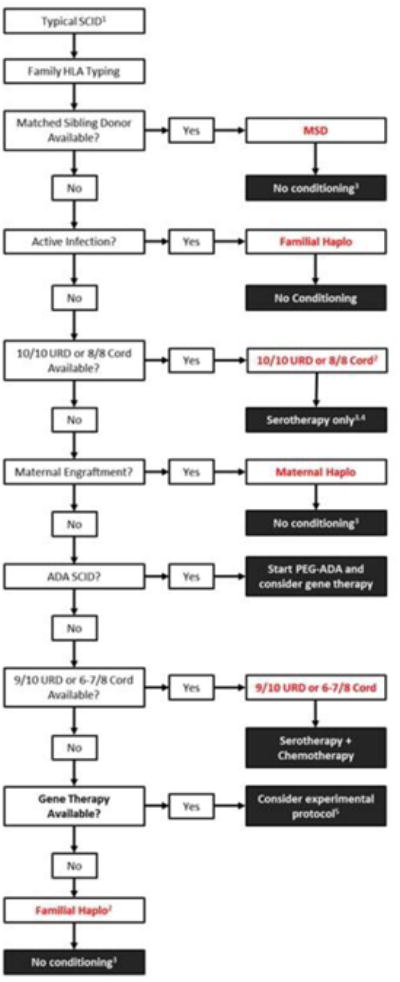
Hematopoietic stem cell transplantation (HSCT) is an effective approach for the treatment of severe combined immunodeficiency (SCID). However, SCID is not a homogeneous disease, and the treatment required for successful transplantation varies significantly between SCID subtypes and the degree of HLA mismatch between the best available donor and the patient. Recent studies are beginning to more clearly define this heterogeneity and how outcomes may vary. With a more detailed understanding of SCID, new approaches can be developed to maximize immune reconstitution, while minimizing acute and long-term toxicities associated with chemotherapy conditioning.
Conflict of interest statement
Figures
Similar articles
-
Immune reconstitution after HSCT in SCID-a cohort of conditioned and unconditioned patients.Immunol Res. 2019 Jun;67(2-3):166-175. doi: 10.1007/s12026-019-09081-z. Immunol Res. 2019. PMID: 31222511
-
Hematopoietic stem cell transplantation for severe combined immunodeficiency diseases.Biol Blood Marrow Transplant. 2008 Jan;14(1 Suppl 1):73-5. doi: 10.1016/j.bbmt.2007.10.017. Biol Blood Marrow Transplant. 2008. PMID: 18162224 Review.
-
Hematopoietic Stem Cell Transplantation in Primary Immunodeficiency Diseases: Current Status and Future Perspectives.Front Pediatr. 2019 Aug 8;7:295. doi: 10.3389/fped.2019.00295. eCollection 2019. Front Pediatr. 2019. PMID: 31440487 Free PMC article. Review.
-
Graft Versus Host Disease Following HLA-Matched Sibling Donor Compared with Matched Related Donor for Hematopoietic Stem Cell Transplantation for the Treatment of Severe Combined Immunodeficiency Disease.J Clin Immunol. 2019 May;39(4):414-420. doi: 10.1007/s10875-019-00634-3. Epub 2019 Apr 30. J Clin Immunol. 2019. PMID: 31041574
-
Matched versus Haploidentical Hematopoietic Stem Cell Transplantation as Treatment Options for Primary Immunodeficiencies in Children.Transplant Cell Ther. 2021 Jan;27(1):71.e1-71.e12. doi: 10.1016/j.bbmt.2020.09.010. Epub 2020 Sep 20. Transplant Cell Ther. 2021. PMID: 32966882
Cited by
-
A Decade Experience on Severe Combined Immunodeficiency Phenotype in Oman, Bridging to Newborn Screening.Front Immunol. 2021 Jan 15;11:623199. doi: 10.3389/fimmu.2020.623199. eCollection 2020. Front Immunol. 2021. PMID: 33519828 Free PMC article.
-
Immune reconstitution after HSCT in SCID-a cohort of conditioned and unconditioned patients.Immunol Res. 2019 Jun;67(2-3):166-175. doi: 10.1007/s12026-019-09081-z. Immunol Res. 2019. PMID: 31222511
-
Update on Clinical Ex Vivo Hematopoietic Stem Cell Gene Therapy for Inherited Monogenic Diseases.Mol Ther. 2021 Feb 3;29(2):489-504. doi: 10.1016/j.ymthe.2020.11.020. Epub 2020 Nov 20. Mol Ther. 2021. PMID: 33221437 Free PMC article. Review.
-
Immunological barriers to haematopoietic stem cell gene therapy.Nat Rev Immunol. 2022 Dec;22(12):719-733. doi: 10.1038/s41577-022-00698-0. Epub 2022 Mar 17. Nat Rev Immunol. 2022. PMID: 35301483 Free PMC article. Review.
-
A general practitioner's guide to hematopoietic stem-cell transplantation.Curr Oncol. 2019 Jun;26(3):187-191. doi: 10.3747/co.26.5033. Epub 2019 Jun 1. Curr Oncol. 2019. PMID: 31285665 Free PMC article. Review.
References
-
- Shearer WT, et al. Establishing diagnostic criteria for severe combined immunodeficiency disease (SCID), leaky SCID, and Omenn syndrome: the Primary Immune Deficiency Treatment Consortium experience. The Journal of allergy and clinical immunology. 2014 Apr;133:1092. Provides the rationale and detailed analysis of criteria for making a diagnosis of SCID. - PMC - PubMed
Grants and funding
LinkOut - more resources
Full Text Sources
Other Literature Sources
Medical
Research Materials