


Effect of endobronchial valve therapy on pulmonary perfusion and ventilation distribution
- PMID: 25822624
- PMCID: PMC4379022
- DOI: 10.1371/journal.pone.0118976
Effect of endobronchial valve therapy on pulmonary perfusion and ventilation distribution
Abstract
Introduction: Endoscopic lung volume reduction (ELVR) is an emerging therapy for emphysematous COPD. However, any resulting changes in lung perfusion and ventilation remain undetermined. Here, we report ELVR-mediated adaptations in lung perfusion and ventilation, as investigated by means of pulmonary scintigraphy.
Methods: In this observational study, we enrolled 26 patients (64.9 ± 9.4 yrs, 57.7% male) with COPD heterogeneous emphysema undergoing ELVR with endobronchial valves (Zephyr, Pulmonx, Inc.). Mean baseline FEV1 and RV were 32.9% and 253.8% predicted, respectively. Lung scintigraphy was conducted prior to ELVR and eight weeks thereafter. Analyses of perfusion and ventilation shifts were performed and complemented by correlation analyses between paired zones.
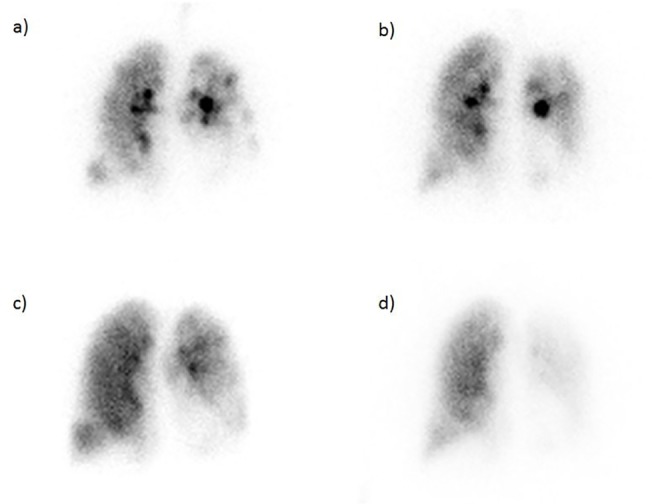
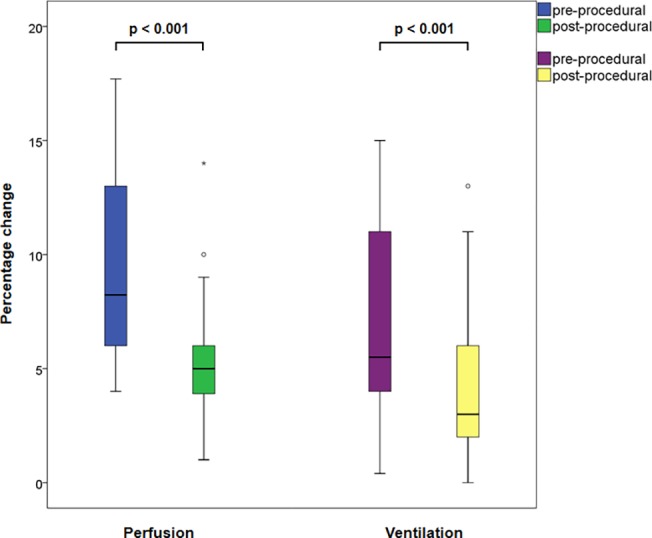
Results: After ELVR, target zone perfusion showed a mean relative reduction of 43.32% (p<0.001), which was associated with a significant decrease in target zone ventilation (p<0.001). Perfusion of the contralateral untreated zone and of the contralateral total lung exhibited significant increases post-ELVR (p = 0.002 and p = 0.005, respectively); both correlated significantly with the corresponding target zone perfusion adaptations. Likewise, changes in target zone ventilation correlated significantly with ventilatory changes in the contralateral untreated zone and the total contralateral lung (Pearson's r: -0.42, p = 0.04 and Pearson's r: -0.42, p = 0.03, respectively). These effects were observed in case of clinical responsiveness to ELVR, as assessed by changes in the six-minute walk test distance.
Discussion: ELVR induces a relevant decrease in perfusion and ventilation of the treated zone with compensatory perfusional and ventilatory redistribution to the contralateral lung, primarily to the non-concordant, contralateral zone.
Conflict of interest statement
Figures
References
-
- Rabe KF, Hurd S, Anzueto A, Barnes PJ, Buist SA, Calverley P, et al. (2007) Global Initiative for Chronic Obstructive Lung Disease. Global strategy for the diagnosis, management, and prevention of chronic obstructive pulmonary disease: GOLD executive summary. Am J Respir Crit Care Med 176: 532–555. - PubMed
-
- Mannino DM, Buist AS (2007) Global burden of COPD: risk factors, prevalence, and future trends. Lancet 370: 765–773. - PubMed
-
- Martinez FJ, Chang A (2005) Surgical therapy for chronic obstructive pulmonary disease. Semin Respir Crit Care Med 26: 167–191. - PubMed
-
- Fishman A, Martinez F, Naunheim K, Piantadosi S, Wise R, Ries A, et al. (2003) A randomized trial comparing lung-volume-reduction surgery with medical therapy for severe emphysema. N Engl J Med 348: 2059–2073. - PubMed
-
- Naunheim KS, Wood DE, Mohsenifar Z, Sternberg AL, Criner GJ, DeCamp MM, et al. (2006) Long-term follow-up of patients receiving lung-volume-reduction surgery versus medical therapy for severe emphysema by the National Emphysema Treatment Trial Research Group. Ann Thorac Surg 82: 431–443. - PubMed
Publication types
MeSH terms
LinkOut - more resources
Full Text Sources
Other Literature Sources
Medical
