Micronutrient intakes and potential inadequacies of community-dwelling older adults: a systematic review
- PMID: 25822905
- PMCID: PMC4531469
- DOI: 10.1017/S0007114515000203
Micronutrient intakes and potential inadequacies of community-dwelling older adults: a systematic review
Abstract
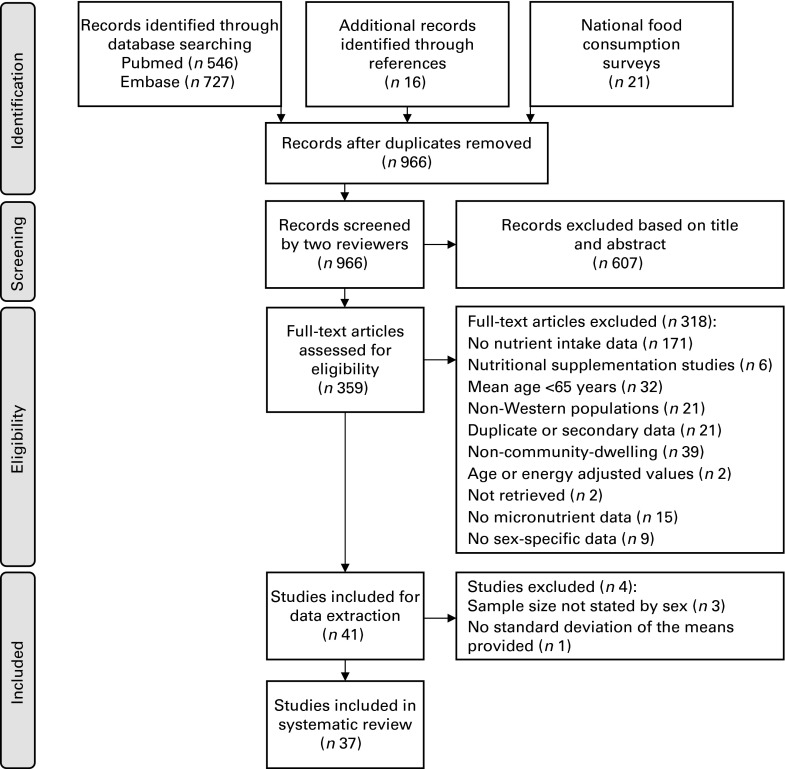
Micronutrient deficiencies and low dietary intakes among community-dwelling older adults are associated with functional decline, frailty and difficulties with independent living. As such, studies that seek to understand the types and magnitude of potential dietary inadequacies might be beneficial for guiding future interventions. We carried out a systematic review following the Preferred Reporting Items for Systematic Reviews and Meta-Analyses statement. Observational cohort and longitudinal studies presenting the habitual dietary intakes of older adults (≥65 years) were included. Sex-specific mean (and standard deviation) habitual micronutrient intakes were extracted from each article to calculate the percentage of older people who were at risk for inadequate micronutrient intakes using the estimated average requirement (EAR) cut-point method. The percentage at risk for inadequate micronutrient intakes from habitual dietary intakes was calculated for twenty micronutrients. A total of thirty-seven articles were included in the pooled systematic analysis. Of the twenty nutrients analysed, six were considered a possible public health concern: vitamin D, thiamin, riboflavin, Ca, Mg and Se. The extent to which these apparent inadequacies are relevant depends on dynamic factors, including absorption and utilisation, vitamin and mineral supplement use, dietary assessment methods and the selection of the reference value. In light of these considerations, the present review provides insight into the type and magnitude of vitamin and mineral inadequacies.
Keywords: Older adults.
Figures

 ) and women
(
) and women
( ) at risk for inadequate intake of vitamins.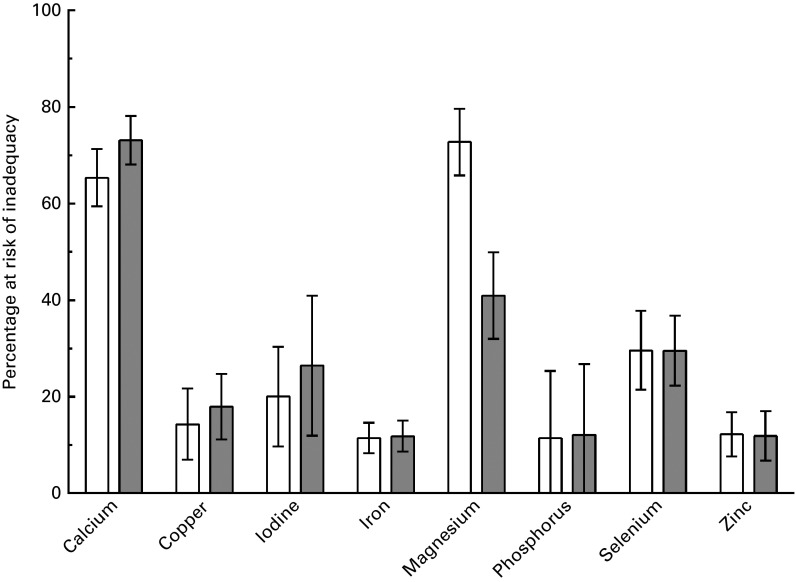
 ) and women
(
) and women
( ) at risk for inadequate intake of minerals.
Comment in
-
Thiamine deficiency in the Western diet and dementia risk.Br J Nutr. 2016 Jul;116(1):188-9. doi: 10.1017/S000711451600177X. Epub 2016 May 12. Br J Nutr. 2016. PMID: 27170224 No abstract available.
Similar articles
-
Micronutrient supplementation in adults with HIV infection.Cochrane Database Syst Rev. 2017 May 18;5(5):CD003650. doi: 10.1002/14651858.CD003650.pub4. Cochrane Database Syst Rev. 2017. PMID: 28518221 Free PMC article.
-
Effectiveness and safety of vitamin D in relation to bone health.Evid Rep Technol Assess (Full Rep). 2007 Aug;(158):1-235. Evid Rep Technol Assess (Full Rep). 2007. PMID: 18088161 Free PMC article.
-
Supplementation with multiple micronutrients for breastfeeding women for improving outcomes for the mother and baby.Cochrane Database Syst Rev. 2016 Feb 18;2(2):CD010647. doi: 10.1002/14651858.CD010647.pub2. Cochrane Database Syst Rev. 2016. PMID: 26887903 Free PMC article.
-
Home fortification of foods with multiple micronutrient powders for health and nutrition in children under two years of age.Cochrane Database Syst Rev. 2011 Sep 7;(9):CD008959. doi: 10.1002/14651858.CD008959.pub2. Cochrane Database Syst Rev. 2011. Update in: Cochrane Database Syst Rev. 2020 Feb 28;2:CD008959. doi: 10.1002/14651858.CD008959.pub3. PMID: 21901727 Updated.
-
Multiple micronutrient powders for home (point-of-use) fortification of foods in pregnant women.Cochrane Database Syst Rev. 2015 Jun 19;2015(6):CD011158. doi: 10.1002/14651858.CD011158.pub2. Cochrane Database Syst Rev. 2015. PMID: 26091836 Free PMC article.
Cited by
-
Of Sound Mind and Body: Exploring the Diet-Strength Interaction in Healthy Aging.Front Nutr. 2020 Aug 28;7:145. doi: 10.3389/fnut.2020.00145. eCollection 2020. Front Nutr. 2020. PMID: 32984401 Free PMC article. Review.
-
Effect of individually tailored nutritional counselling on protein and energy intake among older people receiving home care at risk of or having malnutrition: a non-randomised intervention study.BMC Geriatr. 2022 May 4;22(1):391. doi: 10.1186/s12877-022-03088-2. BMC Geriatr. 2022. PMID: 35505290 Free PMC article. Clinical Trial.
-
Dietary Intake in Population with Metabolic Syndrome: Is the Prevalence of Inadequate Intake Influenced by Geographical Area? Cross-Sectional Analysis from PREDIMED-Plus Study.Nutrients. 2018 Nov 4;10(11):1661. doi: 10.3390/nu10111661. Nutrients. 2018. PMID: 30400355 Free PMC article.
-
Energy and nutrient intakes in relation to National Nutrition Recommendations in a Norwegian population-based sample: the Tromsø Study 2015-16.Food Nutr Res. 2019 Dec 10;63. doi: 10.29219/fnr.v63.3616. eCollection 2019. Food Nutr Res. 2019. PMID: 32082100 Free PMC article.
-
The effect of standard-dose wintertime vitamin D supplementation on influenza infection in immunized nursing home elderly residents.Croat Med J. 2021 Oct 31;62(5):495-503. doi: 10.3325/cmj.2021.62.495. Croat Med J. 2021. PMID: 34730890 Free PMC article. Clinical Trial.
References
-
- United Nations Population Fund, HelpAge International (2012) Aging in the twenty-first century http://www.unfpa.org/public/op/edit/home/publications/pid/11584 (accessed April 2014)..
-
- Schilp J, Kruizenga HM, Wijnhoven HA, et al. (2012) High prevalence of undernutrition in Dutch community-dwelling older individuals. Nutrition 28, 1151–1156. - PubMed
-
- van Staveren WA & de Groot LC (2011) Evidence-based dietary guidance and the role of dairy products for appropriate nutrition in the elderly. J Am Coll Nutr 30, 429S–437S. - PubMed
-
- Houston DK, Stevens J, Cai J, et al. (2005) Dairy, fruit, and vegetable intakes and functional limitations and disability in a biracial cohort: the Atherosclerosis Risk in Communities Study. Am J Clin Nutr 81, 515–522. - PubMed
-
- de Groot CP, van den Broek T & van Staveren W (1999) Energy intake and micronutrient intake in elderly Europeans: seeking the minimum requirement in the SENECA study. Age Ageing 28, 469–474. - PubMed
Publication types
MeSH terms
Substances
LinkOut - more resources
Full Text Sources
Research Materials