. 2015 Apr 20;6(11):9173-88.
doi: 10.18632/oncotarget.3277.

ANO1/TMEM16A interacts with EGFR and correlates with sensitivity to EGFR-targeting therapy in head and neck cancer

Affiliations

ANO1/TMEM16A interacts with EGFR and correlates with sensitivity to EGFR-targeting therapy in head and neck cancer

Anke Bill et al. Oncotarget. .

Abstract

The epidermal growth factor receptor (EGFR) contributes to the pathogenesis of head&neck squamous cell carcinoma (HNSCC). However, only a subset of HNSCC patients benefit from anti-EGFR targeted therapy. By performing an unbiased proteomics screen, we found that the calcium-activated chloride channel ANO1 interacts with EGFR and facilitates EGFR-signaling in HNSCC. Using structural mutants of EGFR and ANO1 we identified the trans/juxtamembrane domain of EGFR to be critical for the interaction with ANO1. Our results show that ANO1 and EGFR form a functional complex that jointly regulates HNSCC cell proliferation. Expression of ANO1 affected EGFR stability, while EGFR-signaling elevated ANO1 protein levels, establishing a functional and regulatory link between ANO1 and EGFR. Co-inhibition of EGFR and ANO1 had an additive effect on HNSCC cell proliferation, suggesting that co-targeting of ANO1 and EGFR could enhance the clinical potential of EGFR-targeted therapy in HNSCC and might circumvent the development of resistance to single agent therapy. HNSCC cell lines with amplification and high expression of ANO1 showed enhanced sensitivity to Gefitinib, suggesting ANO1 overexpression as a predictive marker for the response to EGFR-targeting agents in HNSCC therapy. Taken together, our results introduce ANO1 as a promising target and/or biomarker for EGFR-directed therapy in HNSCC.

Keywords: EGFR-targeted therapy; biomarker; calcium-activated chloride channel; epidermal growth factor receptor (EGFR); protein-protein interaction.


Conflict of interest statement

CONFLICT OF INTEREST

A.B., A.G., D.B., H.V., L.A.G are employees of Novartis Institutes for Biomedical Research.

This work does not represent the views of the US Government or the Department of Veterans Affairs.

This work was supported in part by funds from the Department of Veterans Affairs BLSR&D PNC Foundation (U.D.).

Figures
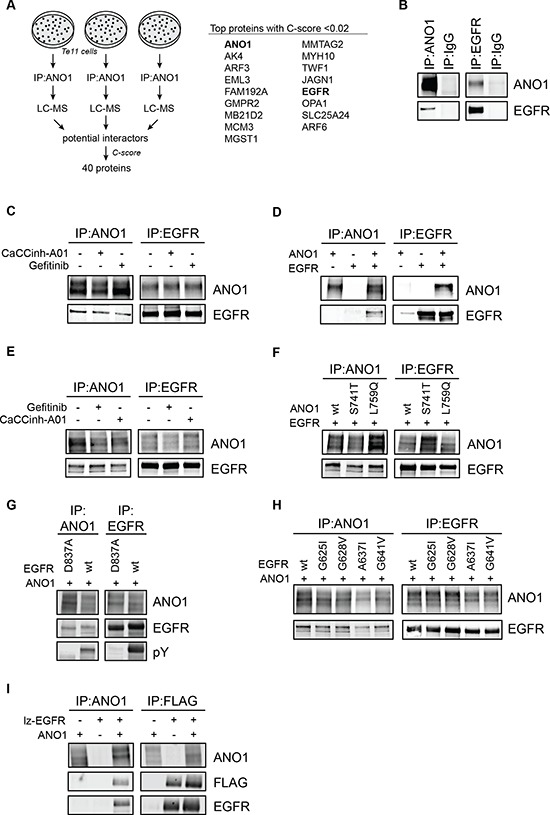
Figure 1
Figure 1. ANO1 and EGFR form a complex in HNSCC cells
(A) Summary of discovery proteomics experiments after ANO1-pulldown in Te11 cells. ANO1 was immunoprecipitated from Te11 cell lysates and proteins co-purified with ANO1 were analyzed by LC-MS. 40 proteins were identified to interact with ANO1 in all three experiments with a C-score < 0.1. The top proteins with a C-score < 0.02 are shown. The full list of identified proteins is included as Supplementary Table 1. (B) Immunoblot after immunoprecipitation of ANO1 (left) or EGFR (right) from Te11 cell lysates using an anti-ANO1 or anti-EGFR antibody coupled to magnetic beads. IgG was used a control. Eluted proteins were run on a western blot and probed with antibodies against ANO1 and EGFR. Representative immunoblots are shown. (C) Immunoprecipitation of ANO1 and EGFR in Te11 cell lysates after 24 h treatment with Gefitinib (1 μM) or CaCCinh-A01 (10 μM). (D) Immunoprecipitation of ANO1 and EGFR in HEK293T cell lysates. HEK293T cells were transfected with equal amounts of plasmids encoding EGFR, ANO1 or both plasmids and EGFR/ANO1 complexes were analyzed as in Figure 1B. The band for EGFR in the first lane of the IP against EGFR represents endogenous EGFR. (E) Immunoprecipitation of ANO1 and EGFR in HEK293T cell lysates after 24 h treatment with Gefitinib (1 μM) or CaCCinh-A01 (10 μM). (F) Immunoprecipitation of ANO1-mutants and EGFR in HEK293T cell lysates. HEK293T cells were transfected with equal amounts of plasmids encoding EGFR and ANO1-wt, -S741T (constitutively active) or -L759Q (inactive). (G) Immunoprecipitation of ANO1 and an EGFR-kinase mutant in HEK293T cell lysates. HEK293T cells were transfected with equal amounts of plasmids encoding EGFR-wt or an inactive kinase mutant (EGFR-D837A) and ANO1. (H) Immunoprecipitation of ANO1 and EGFR-dimerization mutants in HEK293T cell lysates. HEK293T cells were transfected with equal amounts of plasmids encoding ANO1 and EGFR-wt or dimerization mutants of EGFR. (I) Immunoprecipitation of ANO1 and FLAG-lz-EGFR in HEK293T cell lysates. HEK293T cells were transfected with equal amounts of plasmids encoding ANO1, lz-EGFR or both plasmids. ANO1 /lz-EGFR complexes were analyzed by immunoprecipitation using an anti-ANO1 or anti-FLAG antibody coupled to magnetic beads and by immunoblotting of the eluted proteins.
Figure 2
Figure 2. Interaction between ANO1 and EGFR involves the trans/juxtamembrane domain of EGFR
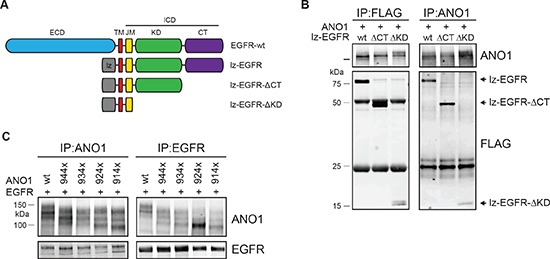
(A) Schematic of the EGFR-constructs tested for interaction with ANO1. (B) Immunoprecipitation of ANO1 and FLAG-tagged truncation variants of lz-EGFR in HEK293T cell lysates. HEK293T cells were transfected with equal amounts of plasmids encoding ANO1 and lz-EGFR-variants. EGFR/ANO1 complexes were analyzed by immunoprecipitation using an anti-ANO1 or anti-FLAG antibody coupled to magnetic beads and immunoblotting of the eluted proteins. Representative immunoblots are shown. (C) Immunoprecipitation of lz-EGFR and ANO1 truncation variants in HEK293T cell lysates. HEK293T cells were transfected with equal amounts of plasmids encoding lz-EGFR and ANO1-variants and ANO1/lz-EGFR complexes were analyzed as in Figure 2B. The multiple bands for ANO1 represent different glycosylation variants of ANO1 [39].
Figure 3
Figure 3. EGFR and ANO1 regulate each other's protein levels
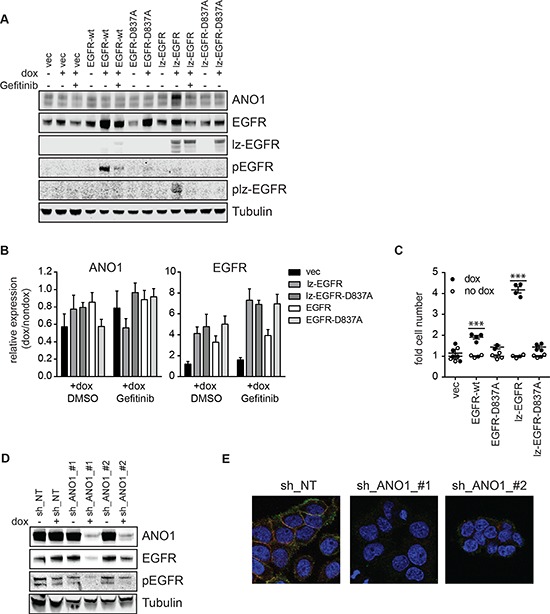
(A) Immunoblot of EGFR, phospho-EGFR and ANO1 protein levels in Te11 cells stably expressing dox-inducible expression constructs for EGFR-wt, -D837A, lz-EGFR or lz-EGFR-D837A or an empty vector control, in the presence or absence of dox (48 h) and Gefitinib (1 μM, 24 h). Tubulin served as a loading control. Representative immunoblots are shown. (B) Relative mRNA levels of EGFR and ANO1 in the same samples as used in A. mRNA-levels in dox-treated samples were normalized to the respective non-dox treated sample and are presented as the mean ± SEM of three independent experiments. (C) Relative cell proliferation of Te11 cells stably expressing the indicated dox-inducible constructs analyzed by Cell Titer Glo. Signals were normalized to the respective non-dox treated sample and are presented as the mean ± SEM of four independent experiments, p < 0.001*** as compared to respective no-dox condition. (D) Immunoblots of EGFR, phospho-EGFR and ANO1 protein levels in Te11 cells stably expressing dox-inducible shRNAs against ANO1 or a non-targeting control (NT) after treatment with dox for 72 h. Representative immunoblots are shown. (E) Immunofluorescence of ANO1 (green) and EGFR (red) in Te11 cells treated as in A analyzed by confocal microscopy. Representative images are shown.
Figure 4
Figure 4. EGFR and ANO1 form a functional complex which regulates cancer cell proliferation
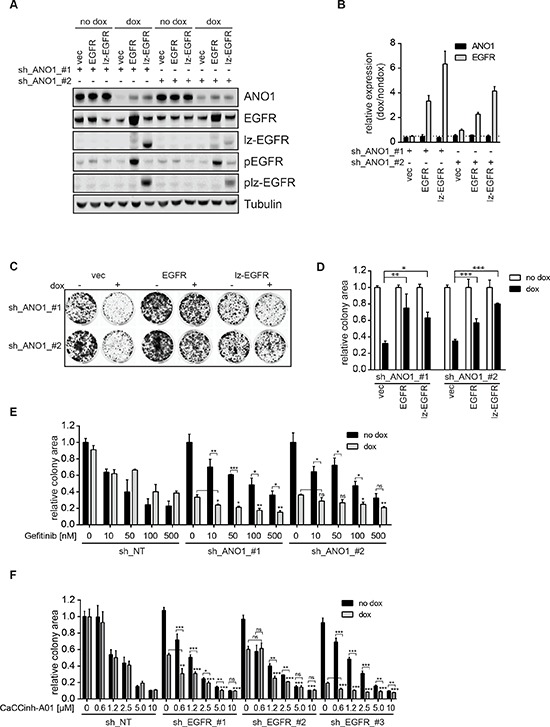
(A) Immunoblots of EGFR, phospho-EGFR (Y1068) and ANO1 protein levels in Te11 cells stably co-expressing dox-inducible shRNAs against ANO1 and dox-inducible expression constructs for EGFR-wt, lz-EGFR or an empty vector control after treatment with dox for 72 h. Representative immunoblots are shown. (B) Relative mRNA-levels of ANO1 and EGFR in Te11 cells treated as in A. mRNA-levels in dox-treated samples were normalized to the respective non-dox treated sample and are presented as the mean ± SEM of three independent experiments. (C) Colony formation assay of Te11 cells stably co-expressing dox-inducible shRNAs against ANO1 and dox-inducible expression constructs for EGFR-wt, lz-EGFR or an empty vector control. Representative images are shown. (D) Quantification of the relative colony area of Te11 cells treated as in C. Values were normalized to the respective non-dox treated sample and are presented as the mean ± SEM of three independent experiments. ( p < 0.05*; p < 0.01**; p < 0.001***) (E) Relative colony area of Te11 cells stably expressing dox-inducible shRNAs against ANO1 or a non-targeting control (NT) after treatment with dox and/or Gefitinib. Values were normalized to the respective non-dox treated sample and are presented as the mean ± SEM of four independent experiments. Statistical analyses were performed using the Student's t-test or ANOVA with Tukey's post test as appropriate (*p < 0.05; **p < 0.01; ***p < 0.001); ns. not significant). (F) Relative colony area of Te11 cells stably expressing dox-inducible shRNAs against EGFR or a non-targeting control (NT) after treatment with dox and/or CaCCinh-A01. Values were normalized to the respective non-dox treated sample and are presented as the mean ± SEM of six independent experiments. Statistical analysis was performed as in Figure 4E.
Figure 5
Figure 5. Expression of ANO1 predicts susceptibility to Gefitinib in HNSCC cell lines
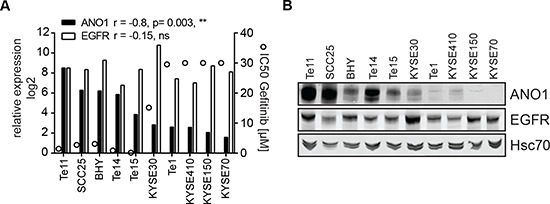
(A) Relative mRNA-levels of ANO1 and EGFR (bars, left y-axis) and sensitivity to Gefitinib (IC50, circles, right y-axis) of HNSCC cell lines, determined by quantitative PCR and Cell Titer Glo, respectively. A Pearson-correlation test was used to test for correlation between ANO1/EGFR expression and sensitivity to Gefitinib. (B) ANO1 protein levels in the HNSCC cell lines shown in Figure 5A.

References

    1. Siegel R, Ma J, Zou Z, Jemal A. Cancer statistics, 2014. CA Cancer J Clin. 2014;64:9–29. - PubMed
    1. Cohen RB. Current challenges and clinical investigations of epidermal growth factor receptor (EGFR)- and ErbB family-targeted agents in the treatment of head and neck squamous cell carcinoma (HNSCC) Cancer Treat Rev. 2014;40:567–577. - PubMed
    1. Cassell A, Grandis JR. Investigational EGFR-targeted therapy in head and neck squamous cell carcinoma. Expert Opin Investig Drugs. 2010;19:709–722. - PMC - PubMed
    1. Yarden Y, Sliwkowski MX. Untangling the ErbB signalling network. Nat Rev Mol Cell Biol. 2001;2:127–137. - PubMed
    1. Roskoski R., Jr The ErbB/HER family of protein-tyrosine kinases and cancer. Pharmacol Res. 2014;79:34–74. - PubMed

Publication types

MeSH terms