Review
. 2015 May 19;370(1668):20140310.
doi: 10.1098/rstb.2014.0310.

Brain/MINDS: brain-mapping project in Japan

Affiliations
Review

Brain/MINDS: brain-mapping project in Japan

Hideyuki Okano et al. Philos Trans R Soc Lond B Biol Sci. .

Abstract

There is an emerging interest in brain-mapping projects in countries across the world, including the USA, Europe, Australia and China. In 2014, Japan started a brain-mapping project called Brain Mapping by Integrated Neurotechnologies for Disease Studies (Brain/MINDS). Brain/MINDS aims to map the structure and function of neuronal circuits to ultimately understand the vast complexity of the human brain, and takes advantage of a unique non-human primate animal model, the common marmoset (Callithrix jacchus). In Brain/MINDS, the RIKEN Brain Science Institute acts as a central institute. The objectives of Brain/MINDS can be categorized into the following three major subject areas: (i) structure and functional mapping of a non-human primate brain (the marmoset brain); (ii) development of innovative neurotechnologies for brain mapping; and (iii) human brain mapping; and clinical research. Brain/MINDS researchers are highly motivated to identify the neuronal circuits responsible for the phenotype of neurological and psychiatric disorders, and to understand the development of these devastating disorders through the integration of these three subject areas.

Keywords: brain mapping by integrated neurotechnologies for disease studies; neuropsychiatric and neurodegenerative diseases; optogenetics; super-resolution microscopy; tissue clearing; transgenic non-human primates.


Figures
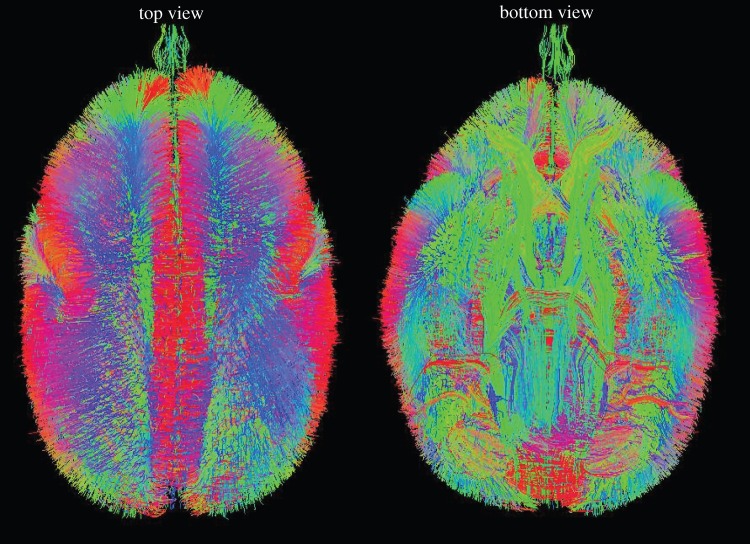
Figure 1.
Figure 1.
Reconstruction of whole-brain fibre structures of marmoset brain. Whole-brain tractography was reconstructed from high angular resolution diffusion MRI (HARDI) of marmoset brain and it enables analysis of the structural connectivity between remote anatomical regions in macro scale.
Figure 2.
Figure 2.
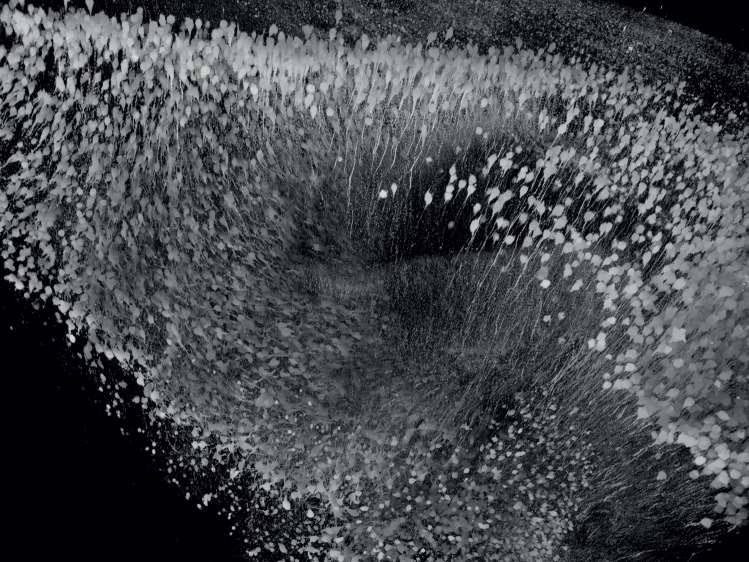
Clearing the mammalian brain. Three-dimensional reconstruction of yellow fluorescent protein- (YFP-)-expressing neurons in the hippocampal formation containing the dendate gyrus (DG) and Ammon's horn fields. The sample was excised from a fixed and optically cleared YFP-H mouse brain. Clearing was performed using ScaleA2 solution. This method will be applied for transgenic marmoset brains. (Copyright © RIKEN.)
Figure 3.
Figure 3.
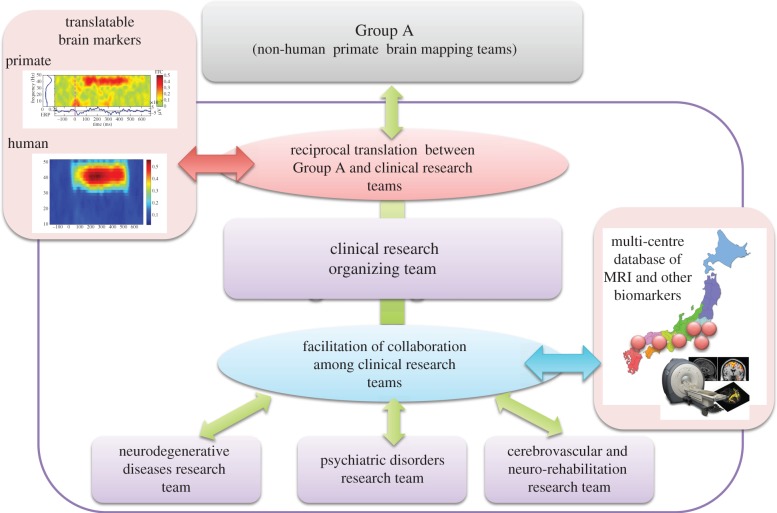
Research framework of Group C. Group C is responsible for human brain mapping and clinical research within Brain/MINDS. Through tight collaborations with Group A, the Clinical Research Organizing Team will organize the research conducted by Group C into three clinical research teams: Psychiatric Disorders Research Team, Neurodegenerative Disease Research Team and Cerebrovascular and Neuro-rehabilitation Research Team. Group C will manage a multi-centre database of structural MRI, rs fMRI and DTI data as well as data on other biomarkers to develop translatable brain markers that will facilitate reciprocal translation between human or clinical research in Group C and non-human primate research in Group A.

References

    1. Kandel ER, Markram H, Matthews PM, Yuste R, Koch C. 2013. Neuroscience thinks big (and collaboratively). Nat. Rev. Neurosci. 14, 659–664. ( 10.1038/nrn3578) - DOI - PubMed
    1. Okano H, Mitra P. In press. Brain-mapping projects using the common marmoset. Neurosci. Res. ( 10.1016/j.neures.2014.08.014) - DOI - PubMed
    1. Cyranoski D. 2014. Marmosets are stars of Japan's ambitious brain project. Nature 514, 151–152. ( 10.1038/514151a) - DOI - PubMed
    1. Sasaki E, et al. 2009. Generation of transgenic non-human primates with germline transmission. Nature 459, 523–527. ( 10.1038/nature08090) - DOI - PubMed
    1. Okano H, Hikishima K, Iriki A, Sasaki E. 2012. The common marmoset as a novel animal model system for biomedical and neuroscience research applications. Semin. Fetal Neonatal Med. 17, 336–340. ( 10.1016/j.siny.2012.07.002) - DOI - PubMed

Publication types

LinkOut - more resources