


Dynamic instability 30 years later: complexities in microtubule growth and catastrophe
- PMID: 25823928
- PMCID: PMC4454169
- DOI: 10.1091/mbc.E13-10-0594
Dynamic instability 30 years later: complexities in microtubule growth and catastrophe
Abstract
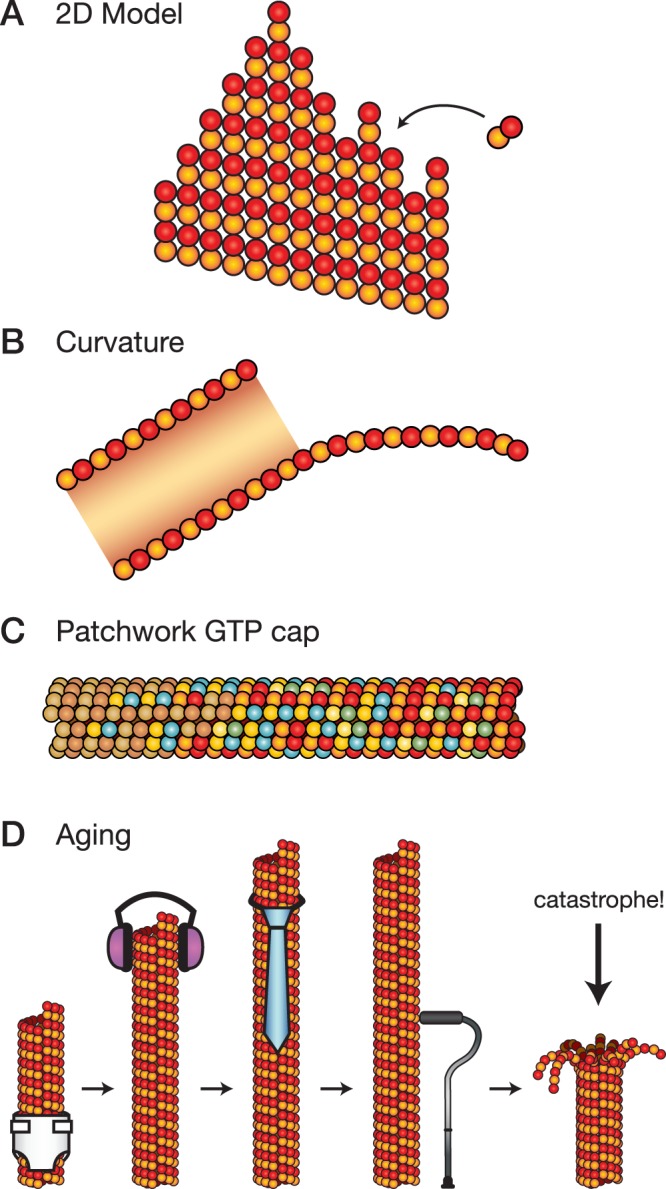
Microtubules are not like other polymers. Whereas polymers such as F-actin will grow continuously as long as the subunit concentration is high enough, a steadily growing microtubule can suddenly shrink even when there is ample αβ-tubulin around. This remarkable behavior was discovered in 1984 when Tim Mitchison and Marc Kirschner deduced that microtubules switch from growth to shrinkage when they lose their GTP caps. Here, I review the canonical explanation of dynamic instability that was fleshed out in the years after its discovery. Many aspects of this explanation have been recently subverted, particularly those related to how GTP-tubulin forms polymers and why GTP hydrolysis disrupts them. I describe these developments and speculate on how our explanation of dynamic instability can be changed to accommodate them.
© 2015 Brouhard. This article is distributed by The American Society for Cell Biology under license from the author(s). Two months after publication it is available to the public under an Attribution–Noncommercial–Share Alike 3.0 Unported Creative Commons License (http://creativecommons.org/licenses/by-nc-sa/3.0).
Figures
References
-
- Bechstedt S, Lu K, Brouhard GJ. Doublecortin recognizes the longitudinal curvature of the microtubule end and lattice. Curr Biol. 2014;24:2366-2375. - PubMed
-
- Bieling P, Laan L, Schek H, Munteanu EL, Sandblad L, Dogterom M, Brunner D, Surrey T. Reconstitution of a microtubule plus-end tracking system in vitro. Nature. 2007;450:1100–1105. - PubMed
Publication types
MeSH terms
Substances
Grants and funding
LinkOut - more resources
Full Text Sources
Miscellaneous
