


RHOA mutation in diffuse-type gastric cancer: a comparative clinicopathology analysis of 87 cases
- PMID: 25823974
- PMCID: PMC4824805
- DOI: 10.1007/s10120-015-0493-0
RHOA mutation in diffuse-type gastric cancer: a comparative clinicopathology analysis of 87 cases
Abstract
Background: Recent studies have discovered recurrent RHOA mutations in diffuse-type gastric cancers. These reports show mutant RhoA is an important cancer driver and is a potential therapeutic target. This study aims to investigate the clinicopathological features of diffuse-type gastric cancers with RHOA mutation.
Methods: We performed a thorough review of 87 diffuse-type gastric cancers, including 22 RHOA-mutated and 65 RHOA wild-type gastric cancers.
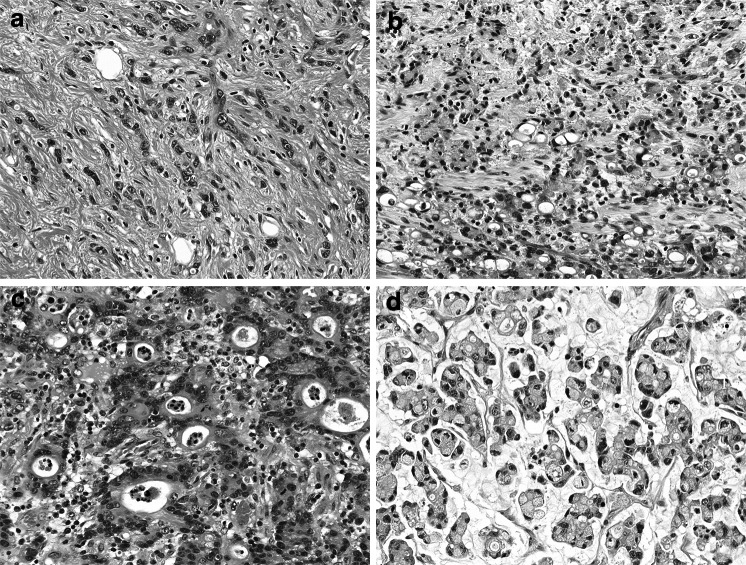
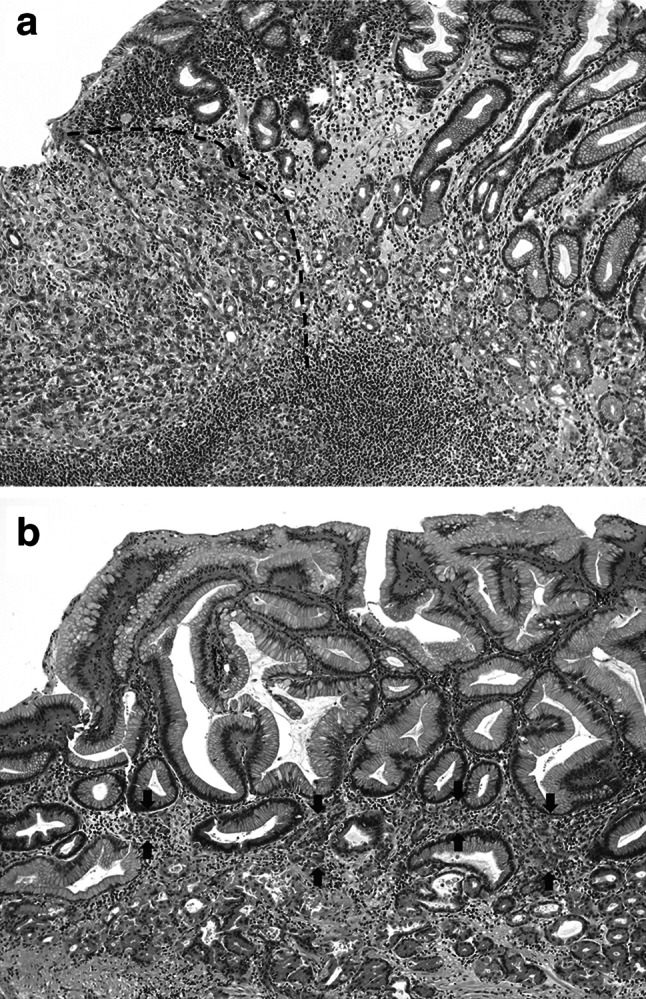
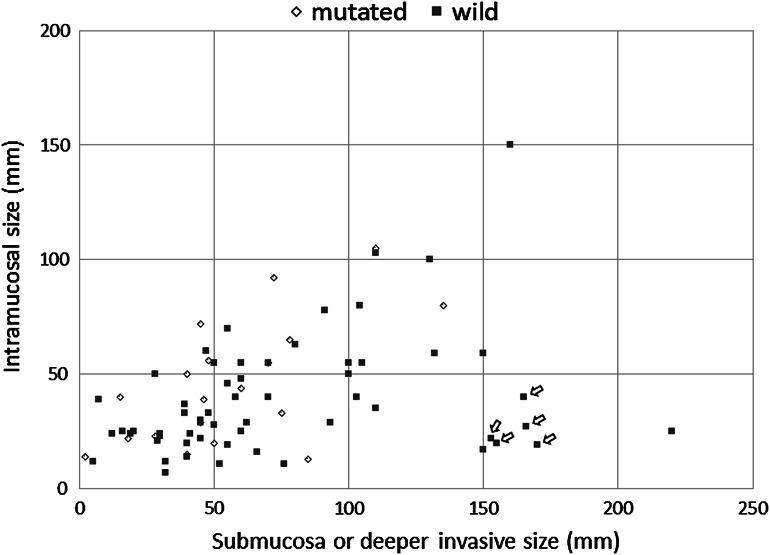
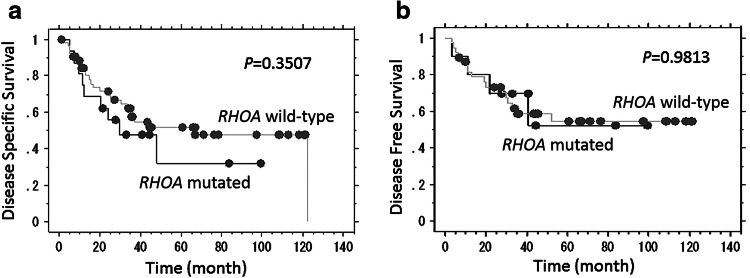
Results: Most advanced tumors with RHOA mutation appeared as Borrmann type 3 lesions (81 %) developing in the middle (50 %) or distal (32 %) third of the stomach. Histologically, although all of the tumors were predominantly or exclusively composed of poorly cohesive carcinoma, limited tubular differentiation was also observed in 73 % of the RHOA-mutated tumors. Notably, RHOA-mutated tumors more frequently showed a permeative growth pattern at the edge of the mucosal area (59 %) compared with RHOA wild-type tumors (29 %, P = 0.0202). Additionally, the size ratios of the deeply invasive components to the mucosal components were significantly lower in RHOA-mutated tumors [less than 1.45 (median) in 68 % of cases] than in RHOA wild-type tumors (less than 1.45 in 42 % of cases, P = 0.0482). RHOA mutation did not significantly impact survival in this study.
Conclusions: These observations suggest that RHOA mutation may be associated with the growth patterns of diffuse-type gastric cancer but have a limited prognostic impact in isolation. Further studies, including analyses of the other alterations involving the RhoA pathways, such as CLDN18-ARHGAP fusion, as well as functional studies of mutant RhoA, are necessary to clarify the significance of alterations in the RhoA-signaling pathway in diffuse-type gastric cancers.
Keywords: Diffuse type; Gastric cancer; Mutation; RHOA.
Figures
Comment in
-
RHOA mutation may be associated with diffuse-type gastric cancer progression, but is it gain or loss?Gastric Cancer. 2016 Apr;19(2):326-328. doi: 10.1007/s10120-015-0525-9. Epub 2015 Aug 22. Gastric Cancer. 2016. PMID: 26296386 No abstract available.
References
-
- Hundahl SA, Phillips JL, Menck HR. The National Cancer Data Base report on poor survival of US gastric carcinoma patients treated with gastrectomy: fifth edition American Joint Committee on Cancer staging, proximal disease, and the “different disease” hypothesis. Cancer. 2000;88:921–932. doi: 10.1002/(SICI)1097-0142(20000215)88:4<921::AID-CNCR24>3.0.CO;2-S. - DOI - PubMed
-
- Bang YJ, Van Cutsem E, Feyereislova A, Chung HC, Shen L, Sawaki A, et al. Trastuzumab in combination with chemotherapy versus chemotherapy alone for treatment of HER2-positive advanced gastric or gastro-oesophageal junction cancer (ToGA): a phase 3, open-label, randomised controlled trial. Lancet. 2010;376:687–697. doi: 10.1016/S0140-6736(10)61121-X. - DOI - PubMed
-
- Lauren P. The two histological main types of gastric carcinoma: diffuse and so-called intestinal-type carcinoma. An attempt at a histo-clinical classification. Acta Pathol Mcrobiol Scand. 1965;64:31–49. - PubMed
Publication types
MeSH terms
Substances
LinkOut - more resources
Full Text Sources
Other Literature Sources
Medical
