


Gait Speed and Mortality, Hospitalization, and Functional Status Change Among Hemodialysis Patients: A US Renal Data System Special Study
- PMID: 25824124
- PMCID: PMC4516659
- DOI: 10.1053/j.ajkd.2015.01.024
Gait Speed and Mortality, Hospitalization, and Functional Status Change Among Hemodialysis Patients: A US Renal Data System Special Study
Abstract
Background: Slow walk (gait) speed predicts functional decline, institutionalization, and mortality risks in the geriatric population. A gait speed evidence base for dialysis patient outcomes is needed.
Study design: Prospective cohort study.
Setting & participants: 752 prevalent hemodialysis (HD) patients aged 20 to 92 years evaluated in 2009 to 2012 in 7 Atlanta and 7 San Francisco clinics in a US Renal Data System special study.
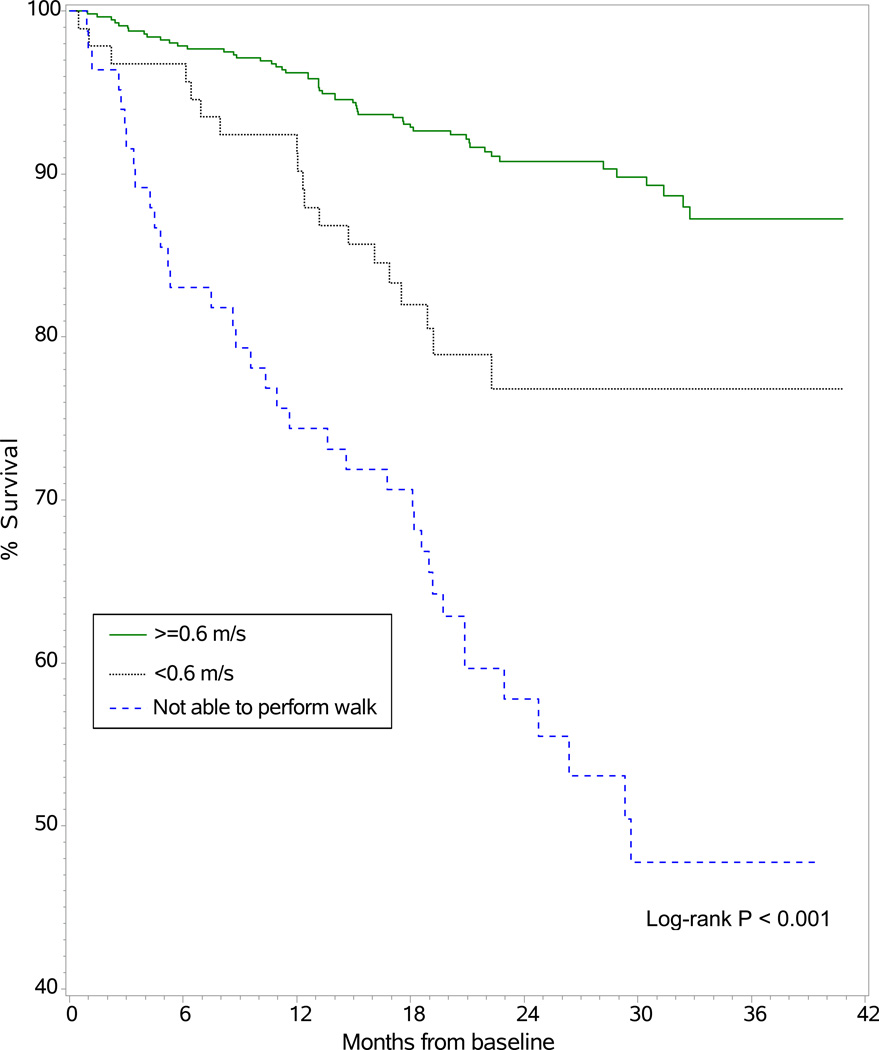
Predictor: Usual walk speed in meters per second, categorized as ≥0.6 m/s (baseline n=575), <0.6 m/s (baseline n=94), and unable to perform walk test (baseline n=83).
Outcomes: Survival; hospitalization; activities of daily living (ADL) difficulty; 36-Item Short Form Health Survey (SF-36) Physical Function score.
Measurements: Cox proportional hazards models investigated gait speed and mortality over a median follow-up of 703 days. Multivariable logistic or linear regression models estimated associations of baseline gait speed with hospitalization, need for ADL assistance, and SF-36 Physical Function score after 12 months.
Results: Participants who walked ≥0.6 m/s had 53 (9%) deaths, those who walked <0.6 m/s had 19 (20%) deaths, and those unable to walk had 37 (44%) deaths. Adjusted mortality hazard ratios were 2.17 (95% CI, 1.19-3.98) for participants who walked <0.6 m/s and 6.93 (95% CI, 4.01-11.96) for those unable to walk, compared with participants walking ≥0.6 m/s. After 12 months, compared with baseline walk speed ≥ 1.0 m/s (n=169 participants), baseline walk speed of 0.6 to <0.8 m/s (n=116) was associated with increased odds of hospitalization (OR, 2.04; 95% CI, 1.19-3.49) and ADL difficulty (OR, 3.88; 95% CI, 1.46-10.33) and a -8.20 (95% CI, -13.57 to -2.82) estimated change in SF-36 Physical Function score.
Limitations: Cohort not highly representative of overall US in-center HD population.
Conclusions: Because walking challenges the heart, lungs, and circulatory, nervous, and musculoskeletal systems, gait speed provides an informative marker of health status. The association of gait speed with HD patients' risk for functional decline warrants continued study.
Keywords: Activities of daily living (ADL) difficulty; US Renal Data System (USRDS); dismobility; end-stage renal disease (ESRD); functional status; gait speed; hemodialysis; hospitalization; mortality; physical functioning; walking ability.
Copyright © 2015 National Kidney Foundation, Inc. Published by Elsevier Inc. All rights reserved.
Figures
Comment in
-
Gait Speed in Patients With Kidney Failure Treated With Long-term Dialysis.Am J Kidney Dis. 2015 Aug;66(2):190-2. doi: 10.1053/j.ajkd.2015.05.007. Am J Kidney Dis. 2015. PMID: 26210725 Free PMC article. No abstract available.
References
-
- National Kidney Foundation. K/DOQI clinical practice guidelines for cardiovascular disease in dialysis patients. Am J Kidney Dis. 2005;45(4, Suppl 3):S1–S154. - PubMed
-
- Painter P, Marcus RL. Assessing physical function and physical activity in patients with CKD. Clin J Am Soc Nephrol. 2013;8:861–872. - PubMed
-
- Painter P, Marcus R. Physical function and gait speed in patients with chronic kidney disease. Nephrol Nurs J. 2013;40(6):529–538. - PubMed
Publication types
MeSH terms
Grants and funding
LinkOut - more resources
Full Text Sources
Other Literature Sources
Medical
