


Anogenital distance and penile width measurements in The Infant Development and the Environment Study (TIDES): methods and predictors
- PMID: 25824881
- PMCID: PMC4456209
- DOI: 10.1016/j.jpurol.2014.11.018
Anogenital distance and penile width measurements in The Infant Development and the Environment Study (TIDES): methods and predictors
Abstract
Background: Anogenital distance (AGD) is an androgen responsive anatomic measurement that may have significant utility in clinical and epidemiological research studies. We describe development of standardized measurement methods and predictors of AGD outcomes.
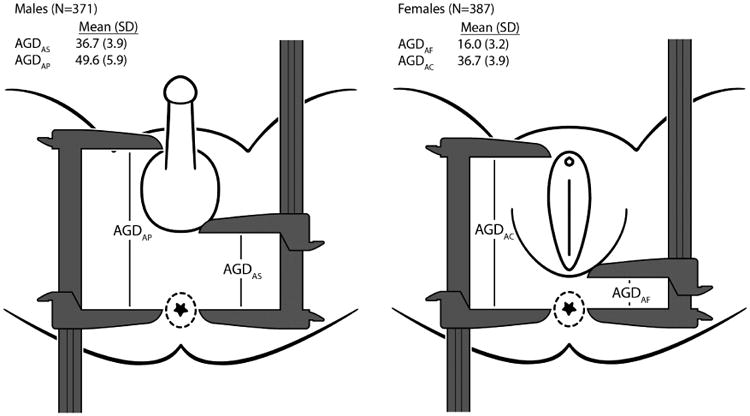
Methods: We examined infants born to 758 participants in The Infant Development and the Environment Study (TIDES cohort) in four clinical centers in 2011-2013. We developed and implemented a detailed training protocol that incorporated multiple quality control (QC) measures. In males, we measured anoscrotal distance (AGDAS), anopenile distance (AGDAP), and penile width (PW) and in females, anofourchette distance (AGDAF,) and anoclitoral distance (AGDAC). A single examiner obtained three repetitions of all measurements, and a second examiner obtained independent measurements for 14% of infants. We used the intra-rater ICC to assess within-examiner variability and the inter-rater ICC to assess between-examiner variability. We used multivariable linear regression to examine predictors of AGD outcomes including: gestational age at birth, birth weight, gestational age, several measures of body size, race, maternal age, and study center.
Results: In the full TIDES cohort, including 758 mothers and children, significant predictors of AGD and PW included: age at exam, gestational age at birth, weight-for-length Z-score, maternal age and study center. In 371 males, the mean (SD) AGDAS, AGDAP, and PW were 24.7 (4.5), 49.6 (5.9), and 10.8 (1.3) mm, respectively. In 387 females, the mean (SD) AGDAF and AGDAC were 16.0 (3.2) mm and 36.7 (3.8) mm, respectively. The intra-examiner ICC and inter-examiner ICC averaged over all subjects and examiners were between 0.89-0.92 and 0.69-0.84 respectively.
Conclusions: Our study confirms that with appropriate training and quality control measures, AGD and PW measurements can be performed reliably and accurately in male and female infants. In order for reliable interpretation, these measurements should be adjusted for appropriate covariates in epidemiologic analysis.
Keywords: Anogenital distance; Pediatric; Penile width; Urology.
Copyright © 2015 Journal of Pediatric Urology Company. Published by Elsevier Ltd. All rights reserved.
Conflict of interest statement
Figures
References
-
- Griffith JQ. The breeding of the rat. The rat in laboratory investigation. 1942:1–18.
-
- Wolf C, Jr, Lambright C, Mann P, Price M, Cooper RL, Ostby J, Gray LE., Jr Administration of potentially antiandrogenic pesticides (procymidone, linuron, iprodione, chlozolinate, p,p′-DDE, and ketoconazole) and toxic substances (dibutyl- and diethylhexyl phthalate, PCB 169, and ethane dimethane sulphonate) during sexual differentiation produces diverse profiles of reproductive malformations in the male rat. Toxicol Ind Health. 1999;15(1-2):94–118. - PubMed
-
- Foster PM. Disruption of reproductive development in male rat offspring following in utero exposure to phthalate esters. Int J Androl. 2006;29(1):140–7. discussion 181-5. - PubMed
-
- Hsieh MH, Breyer BN, Eisenberg ML, Baskin LS. Associations among hypospadias, cryptorchidism, anogenital distance, and endocrine disruption. Curr Urol Rep. 2008;9(2):137–42. - PubMed
Publication types
MeSH terms
Grants and funding
LinkOut - more resources
Full Text Sources
Other Literature Sources
Medical
