


Comment
doi: 10.1073/pnas.1502763112.
Epub 2015 Mar 30.
Sponge symbionts and the marine P cycle
Affiliations
- PMID: 25825737
- PMCID: PMC4394276
- DOI: 10.1073/pnas.1502763112
Item in Clipboard
Comment
Sponge symbionts and the marine P cycle
Proc Natl Acad Sci U S A.
.
No abstract available
Conflict of interest statement
The author declares no conflict of interest.
Figures
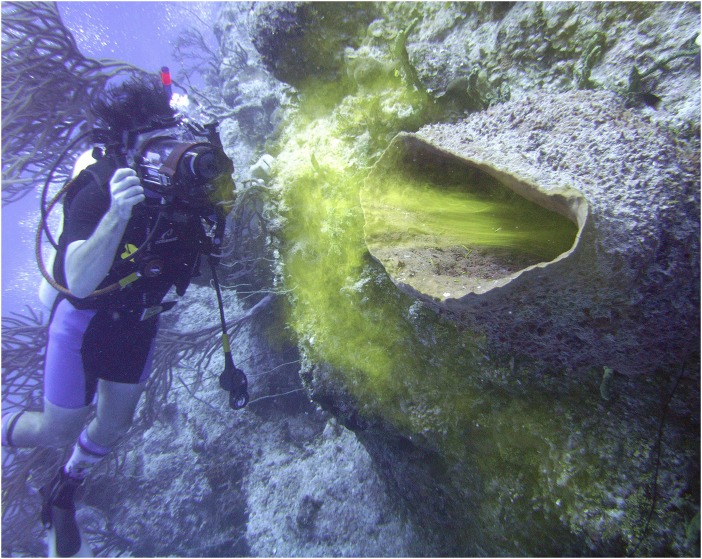
Dye tracer release in a giant barrel sponge (Xestospongia muta) illustrates the rapid rate at which sponges process sea water (10). Uptake, transformation, and release of carbon and nutrients by the sponge and its endosymbiont microbial community can have a profound impact on the surrounding water quality and ecosystem. Image courtesy of Steven E. McMurray (photographer).
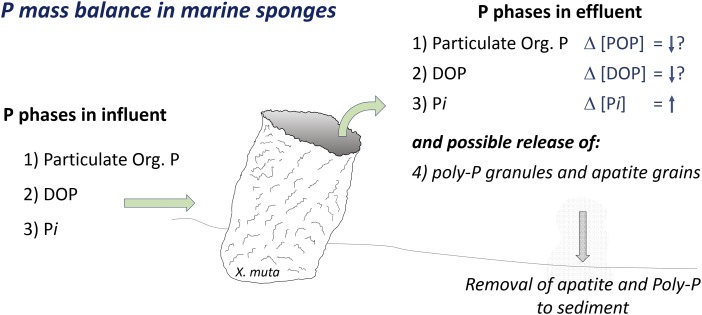
Significant uncertainties persist in our understanding of P cycling by marine sponges. The direction and magnitude of P concentration changes (Δ [P phase]) upon passage through a sponge are poorly constrained (↑ or ↓ signifies an increase or decrease in concentration; “?” signifies an absence of observations). Zhang et al. (6) show that poly-P can be produced in marine sponges and may constitute up to 40% of the P found in sponge biomass. Their results raise the question of whether poly-P storage is transient and reversible, or whether substantial amounts of poly-P and apatite are shed from sponges and lost to sediments.
Comment on
-
Phosphorus sequestration in the form of polyphosphate by microbial symbionts in marine sponges.Proc Natl Acad Sci U S A. 2015 Apr 7;112(14):4381-6. doi: 10.1073/pnas.1423768112. Epub 2015 Feb 23. Proc Natl Acad Sci U S A. 2015. PMID: 25713351 Free PMC article.
References
-
- Diaz MC, Rützler K. Sponges: An essential component of Caribbean coral reefs. Bull Mar Sci. 2001;69(2):535–546.
-
- Bell JJ. The functional roles of marine sponges. Estuar Coast Shelf Sci. 2008;79(3):341–353.
-
- Southwell MW, Weisz JB, Martens CS, Lindquist N. In situ fluxes of dissolved inorganic nitrogen from the sponge community on Conch Reef, Key Largo, Florida. Limnol Oceanogr. 2008;53(3):986–996.
-
- Maldonado M, Ribes M, van Duyl FC. Nutrient fluxes through sponges: Biology, budgets, and ecological implications. Adv Mar Biol. 2012;62:113–182. - PubMed
-
- Webster NS, Taylor MW. Marine sponges and their microbial symbionts: Love and other relationships. Environ Microbiol. 2012;14(2):335–346. - PubMed
Publication types
MeSH terms
Substances
LinkOut - more resources
Full Text Sources
Other Literature Sources
