


The human sex ratio from conception to birth
- PMID: 25825766
- PMCID: PMC4413259
- DOI: 10.1073/pnas.1416546112
The human sex ratio from conception to birth
Abstract
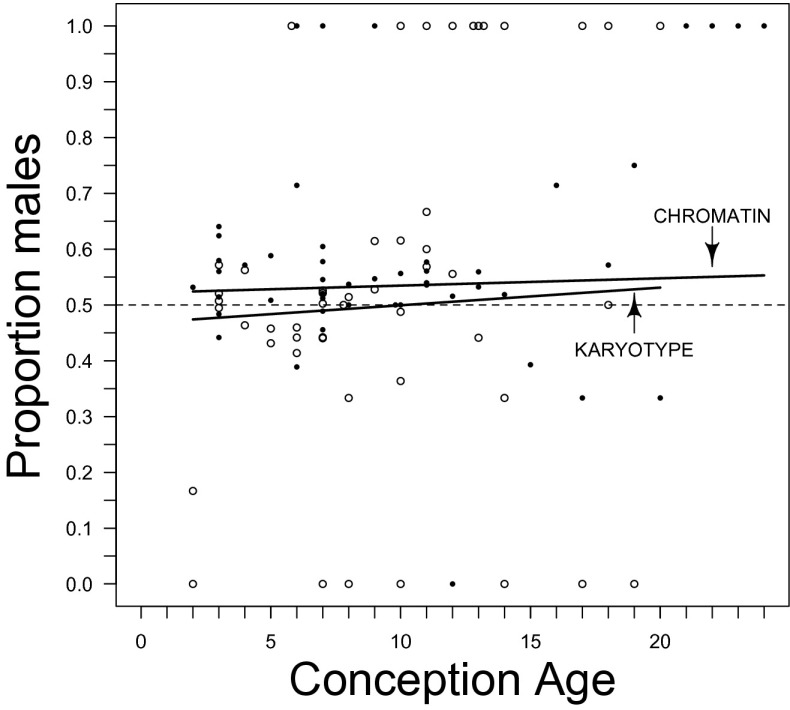
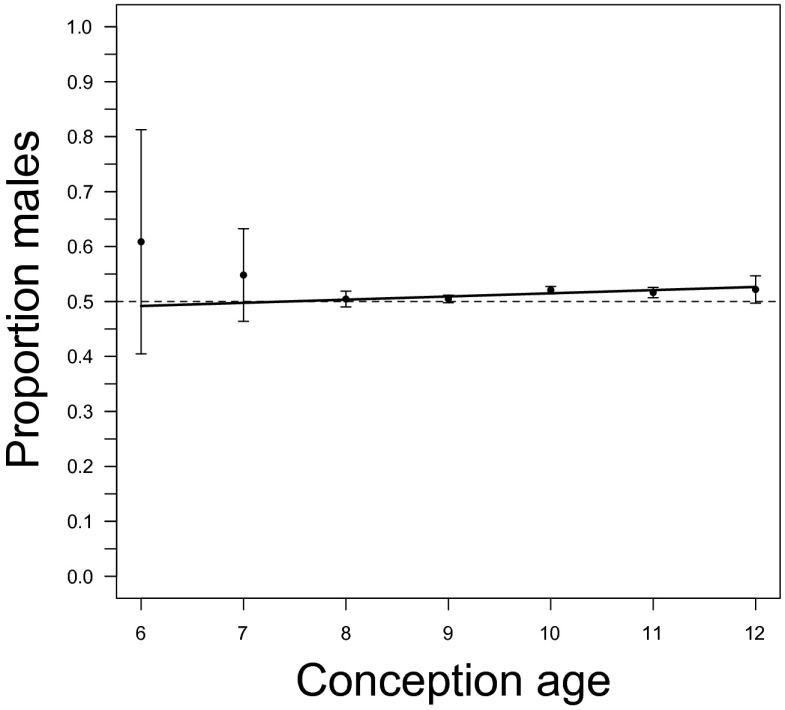
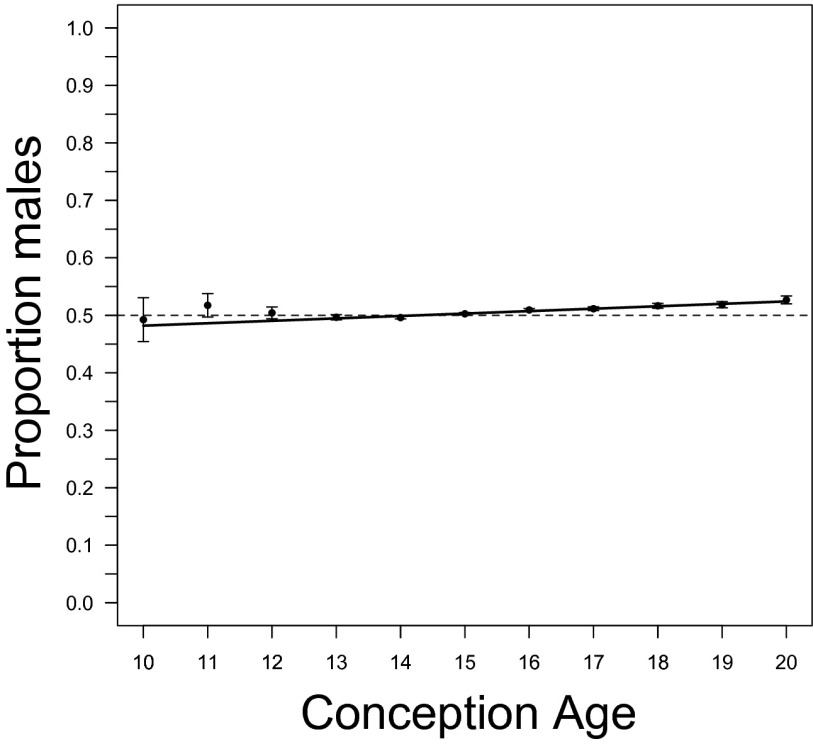
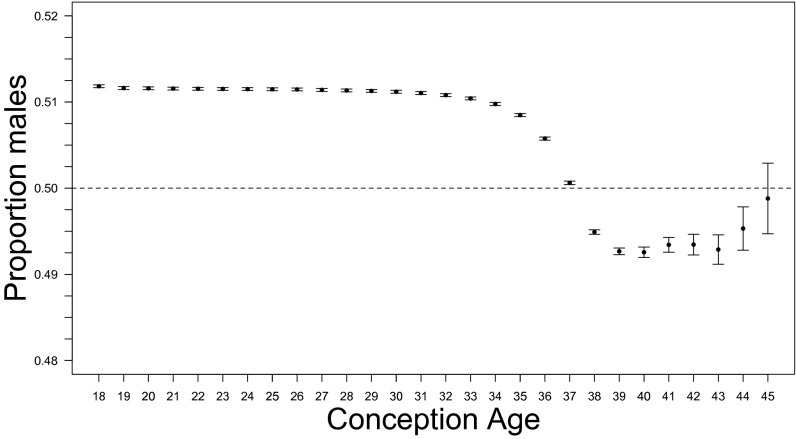
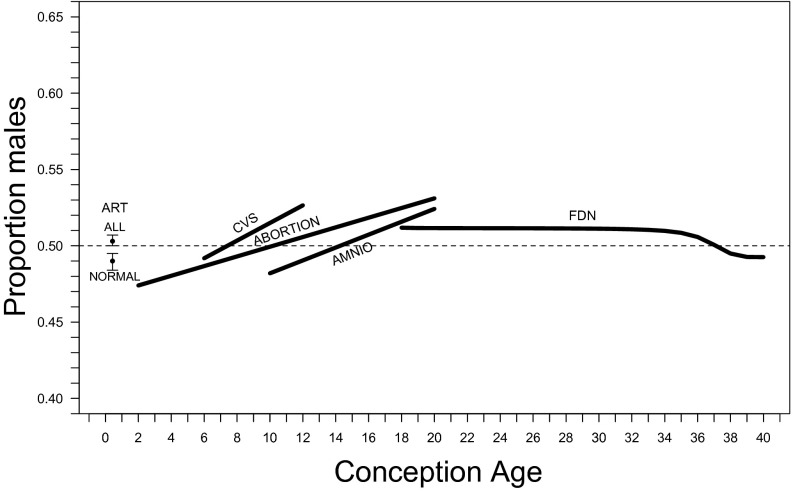
We describe the trajectory of the human sex ratio from conception to birth by analyzing data from (i) 3- to 6-d-old embryos, (ii) induced abortions, (iii) chorionic villus sampling, (iv) amniocentesis, and (v) fetal deaths and live births. Our dataset is the most comprehensive and largest ever assembled to estimate the sex ratio at conception and the sex ratio trajectory and is the first, to our knowledge, to include all of these types of data. Our estimate of the sex ratio at conception is 0.5 (proportion male), which contradicts the common claim that the sex ratio at conception is male-biased. The sex ratio among abnormal embryos is male-biased, and the sex ratio among normal embryos is female-biased. These biases are associated with the abnormal/normal state of the sex chromosomes and of chromosomes 15 and 17. The sex ratio may decrease in the first week or so after conception (due to excess male mortality); it then increases for at least 10-15 wk (due to excess female mortality), levels off after ∼20 wk, and declines slowly from 28 to 35 wk (due to excess male mortality). Total female mortality during pregnancy exceeds total male mortality. The unbiased sex ratio at conception, the increase in the sex ratio during the first trimester, and total mortality during pregnancy being greater for females are fundamental insights into early human development.
Keywords: demography; development; evolution; genetics; sex ratio.
Conflict of interest statement
The authors declare no conflict of interest.
Figures
Comment in
-
The human prenatal sex ratio: A major surprise.Proc Natl Acad Sci U S A. 2015 Apr 21;112(16):4839-40. doi: 10.1073/pnas.1505165112. Epub 2015 Apr 6. Proc Natl Acad Sci U S A. 2015. PMID: 25848060 Free PMC article. No abstract available.
-
The human sex ratio at conception.Early Hum Dev. 2020 Jan;140:104862. doi: 10.1016/j.earlhumdev.2019.104862. Epub 2019 Sep 3. Early Hum Dev. 2020. PMID: 31492545
References
-
- Graunt J. Natural and Political Observations Made Upon the Bills of Mortality. Martyn; London: 1662.
-
- Campbell RB. John Graunt, John Arbuthnott, and the human sex ratio. Hum Biol. 2001;73(4):605–610. - PubMed
-
- Nichols JB. The numerical proportions of the sexes at birth. Mem Am Anthropol Assoc. 1907;1(4):247–300.
-
- Klug WS, Cummings MR, Spencer C. Concepts of Genetics. 8th Ed Pearson/Prentice Hall; Upper Saddle River, NJ: 2006.
-
- Cunningham FG, et al. 2010 Williams Obstetrics. 23rd Ed McGraw-Hill Medical; New York: 2010.
Publication types
MeSH terms
Grants and funding
LinkOut - more resources
Full Text Sources
Other Literature Sources
