. 2015 Mar 31;6(2):e02565-14.
doi: 10.1128/mBio.02565-14.

Virus-induced dormancy in the archaeon Sulfolobus islandicus

Affiliations

Virus-induced dormancy in the archaeon Sulfolobus islandicus

Maria A Bautista et al. mBio. .

Abstract

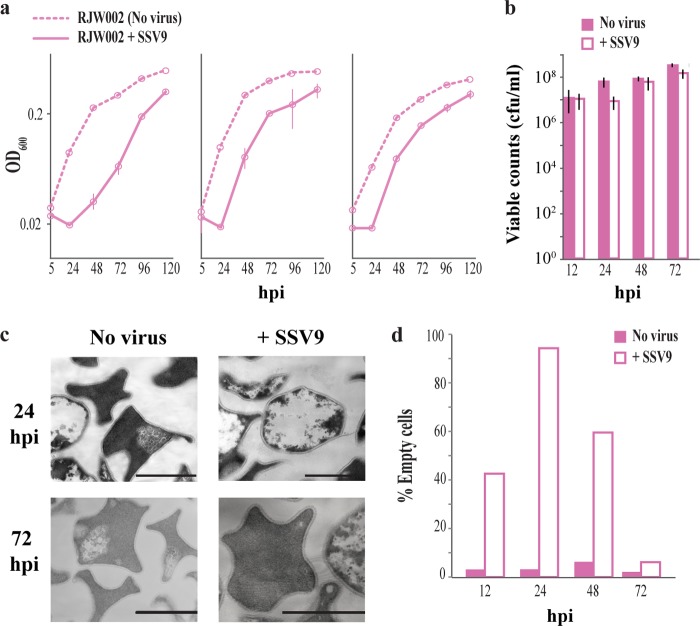
We investigated the interaction between Sulfolobus spindle-shaped virus (SSV9) and its native archaeal host Sulfolobus islandicus. We show that upon exposure to SSV9, S. islandicus strain RJW002 has a significant growth delay where the majority of cells are dormant (viable but not growing) for 24 to 48 hours postinfection (hpi) compared to the growth of controls without virus. We demonstrate that in this system, dormancy (i) is induced by both active and inactive virus particles at a low multiplicity of infection (MOI), (ii) is reversible in strains with active CRISPR-Cas immunity that prevents the establishment of productive infections, and (iii) results in dramatic and rapid host death if virus persists in the culture even at low levels. Our results add a new dimension to evolutionary models of virus-host interactions, showing that the mere presence of a virus induces host cell stasis and death independent of infection. This novel, highly sensitive, and risky bet-hedging antiviral response must be integrated into models of virus-host interactions in this system so that the true ecological impact of viruses can be predicted and understood.

Importance: Viruses of microbes play key roles in microbial ecology; however, our understanding of viral impact on host physiology is based on a few model bacteria that represent a small fraction of the life history strategies employed by hosts or viruses across the three domains that encompass the microbial world. We have demonstrated that rare and even inactive viruses induce dormancy in the model archaeon S. islandicus. Similar virus-induced dormancy strategies in other microbial systems may help to explain several confounding observations in other systems, including the surprising abundance of dormant cell types found in many microbial environments, the difficulty of culturing microorganisms in the laboratory, and the paradoxical virus-to-host abundances that do not match model predictions. A more accurate grasp of virus-host interactions will expand our understanding of the impact of viruses in microbial ecology.


Figures

FIG 1
FIG 1
SSV9 induces dormancy in S. islandicus RJW002. (a) Results of three independent experiments showing growth of SSV9-challenged cultures. Samples were collected following a 5-h incubation with SSV9, after which cells were washed twice to remove any unadsorbed virus. Solid lines represent the average results from at least two technical replicates within each experiment. Error bars show ±1 standard deviation (SD). (b) Viable counts of RJW002 cultures with and without SSV9 challenge. Bars and error bars show mean results ± 1 SD (n = 3). (c) Cell morphology changes associated with SSV9 challenge in RJW002. Scale bar, 1 µm. (d) Percentages of empty cells observed by TEM in RJW002 cultures with and without SSV9 challenge. At least 200 cells were counted at each time point in two independent experiments.
FIG 2
FIG 2
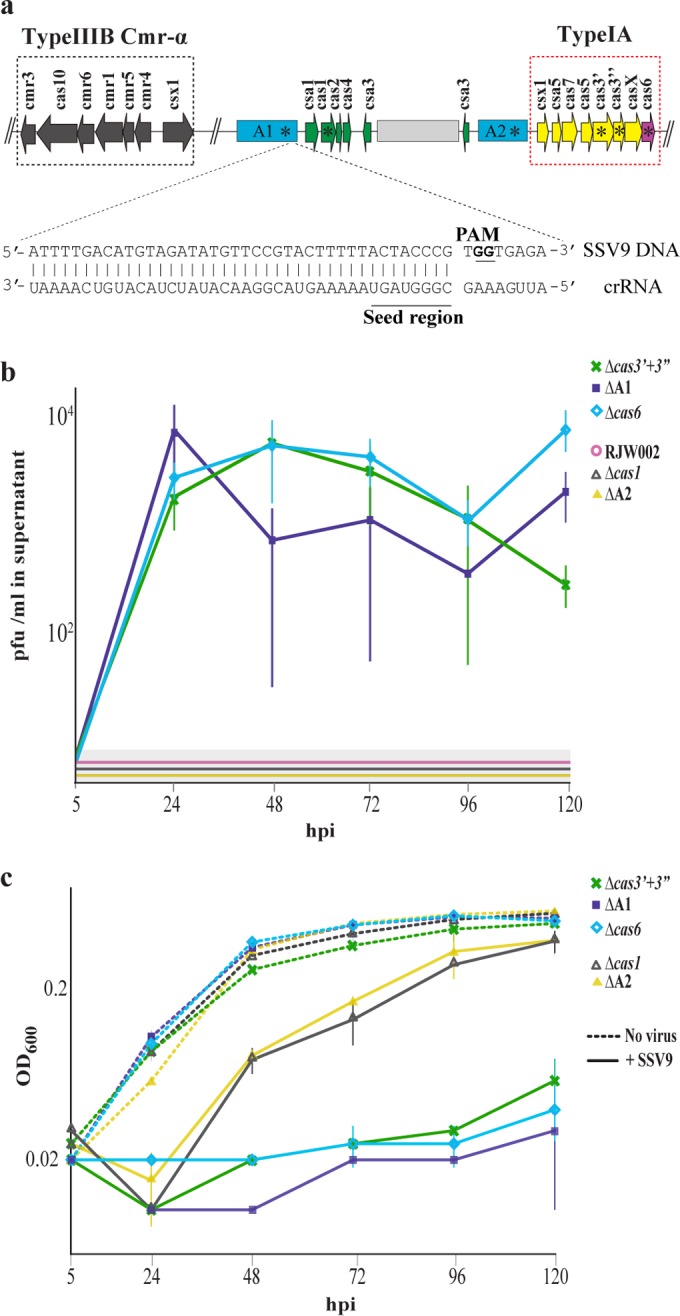
CRISPR-Cas immunity allows cultures to clear virus and recover from dormancy. (a) Schematic representation of the CRISPR-Cas locus in S. islandicus RJW002. Genes involved in type IA CRISPR-Cas immunity are colored to indicate putative function (green, spacer acquisition; pink, crRNA processing; yellow, interference). The third leadermost spacer in the A1 locus matches SSV9 with 100% identity and has a conserved protospacer-associated motif (PAM). In-frame deletions of the A1 and A2 repeat-spacer arrays and cas genes constructed for this study are denoted by asterisks. Light grey bar indicates insertion present in putative transcriptional regulator csa3. (b) Quantification of newly synthesized SSV9 infectious particles in RJW002 and CRISPR-Cas deletion mutants after 5-h challenge followed by washing of unadsorbed particles. Lines inside grey boxes indicate that no signal was detected at that time point. Lines and error bars show mean results ± 1 SD (n = 3). (c) Results of representative experiment showing growth of SSV9-challenged cultures of CRISPR-Cas mutants. Solid lines represent the average results of at least two technical replicates. Error bars show ±1 SD.
FIG 3
FIG 3
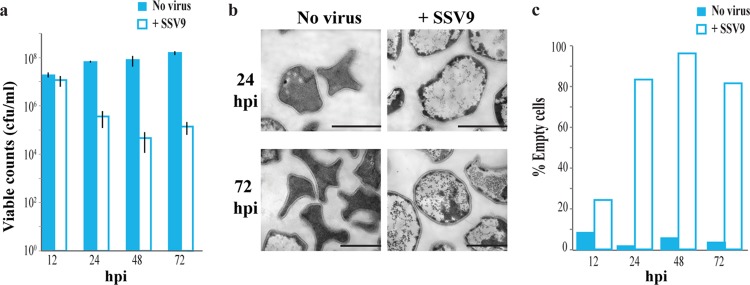
Challenge of CRISPR-deficient cultures with SSV9 induces cell death. (a) Viable counts of Δcas6 cultures with and without SSV9 challenge. Bars and error bars show mean results ± 1 SD (n = 3). (b) Cell morphology changes associated with SSV9 challenge in Δcas6. Scale bar, 1 µm. (c) Percentages of empty cells observed by TEM in Δcas6 cultures with and without SSV9 challenge. At least 200 cells were counted at each time point in two independent experiments.
FIG 4
FIG 4
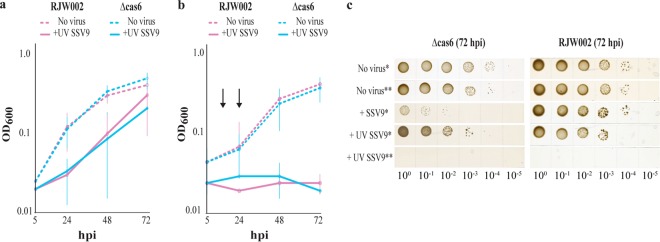
Prolonged dormancy due to continuous virus presence causes cells to die. Results show growth of immune (RJW002) and immune-deficient (Δcas6) cultures challenged with a single dose of UV-inactivated SSV9 (added once and washed out after 5 h) (a), three consecutive doses of UV-inactivated SSV9 (added at 0, as well as 18 and 24 h [arrows]) (b), or UV-irradiated RJW002 supernatant as a no-virus control (a and b). Lines and error bars show mean results ± 1 SD (n = 3). (c) Representative image showing growth of RJW002 and Δcas6 cultures at sampled at 72 hpi. One asterisk indicates that one dose was added, and 2 asterisks indicates three doses were added.

References

    1. Winter C, Bouvier T, Weinbauer MG, Thingstad TF. 2010. Trade-offs between competition and defense specialists among unicellular planktonic organisms: the “killing the winner” hypothesis revisited. Microbiol Mol Biol Rev 74:42–57. doi: 10.1128/MMBR.00034-09. - DOI - PMC - PubMed
    1. Brockhurst MA, Morgan AD, Fenton A, Buckling A. 2007. Experimental coevolution with bacteria and phage. Infect Genet Evol 7:547–552. doi: 10.1016/j.meegid.2007.01.005. - DOI - PubMed
    1. Bohannan BJM, Lenski RE. 2000. Linking genetic change to community evolution: insights from studies of bacteria and bacteriophage. Ecol Lett 3:362–377. doi: 10.1046/j.1461-0248.2000.00161.x. - DOI
    1. Weitz JS, Hartman H, Levin SA. 2005. Coevolutionary arms races between bacteria and bacteriophage. Proc Natl Acad Sci U S A 102:9535–9540. doi: 10.1073/pnas.0504062102. - DOI - PMC - PubMed
    1. Våge S, Storesund JE, Thingstad TF. 2013. Adding a cost of resistance description extends the ability of virus-host model to explain observed patterns in structure and function of pelagic microbial communities. Environ Microbiol 15:1842–1852. doi: 10.1111/1462-2920.12077. - DOI - PubMed

Publication types

MeSH terms

LinkOut - more resources