


Effect of angiotensin II on voltage-gated sodium currents in aortic baroreceptor neurons and arterial baroreflex sensitivity in heart failure rats
- PMID: 25827427
- PMCID: PMC4702522
- DOI: 10.1097/HJH.0000000000000563
Effect of angiotensin II on voltage-gated sodium currents in aortic baroreceptor neurons and arterial baroreflex sensitivity in heart failure rats
Abstract
Background: Impairment of arterial baroreflex sensitivity is associated with mortality in patients with chronic heart failure (CHF). Elevation of plasma angiotension II (Ang II) contributes to arterial baroreflex dysfunction in CHF. A reduced number of voltage-gated sodium (Nav) channels in aortic baroreceptor neurons are involved in CHF-blunted arterial baroreflex.
Method: In this study, we investigated acute effect of Ang II on Nav currents in the aortic baroreceptor neuron and on arterial baroreflex in sham and coronary artery ligation-induced CHF rats.
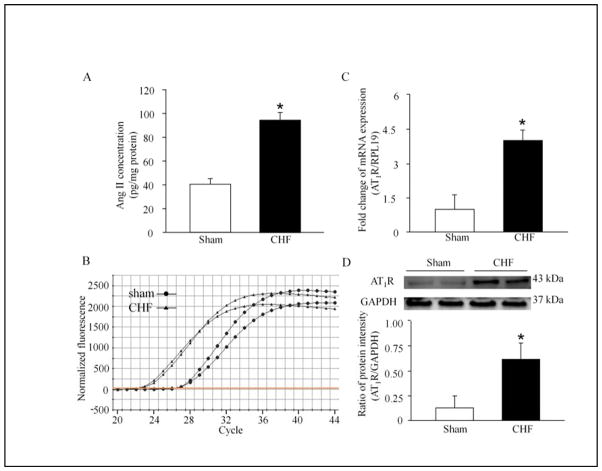
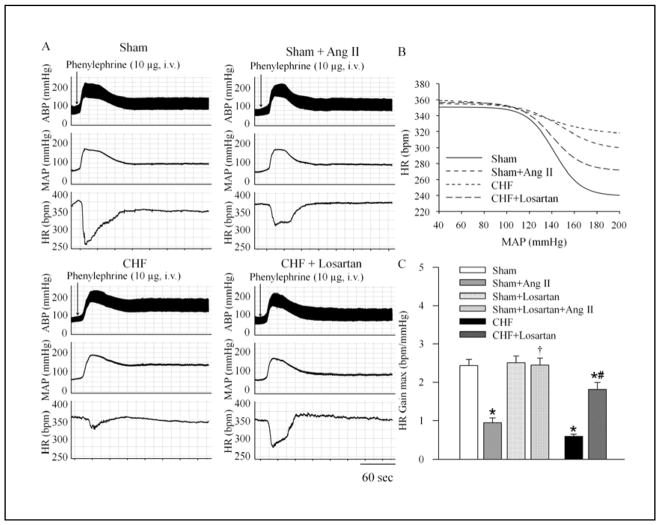
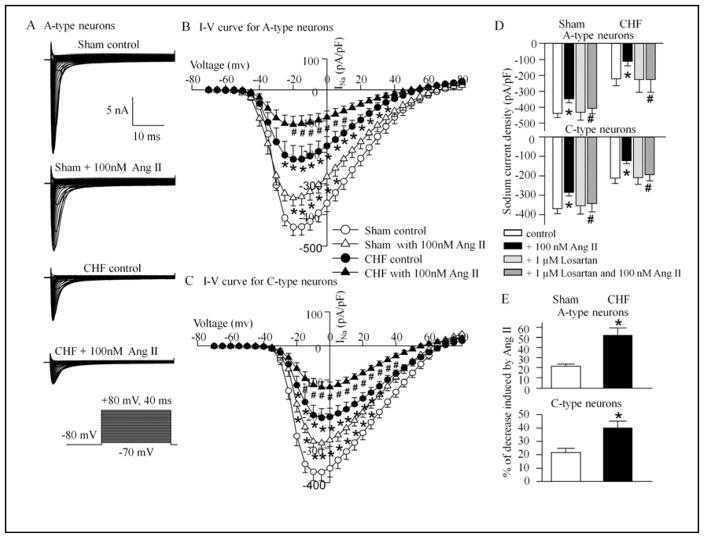
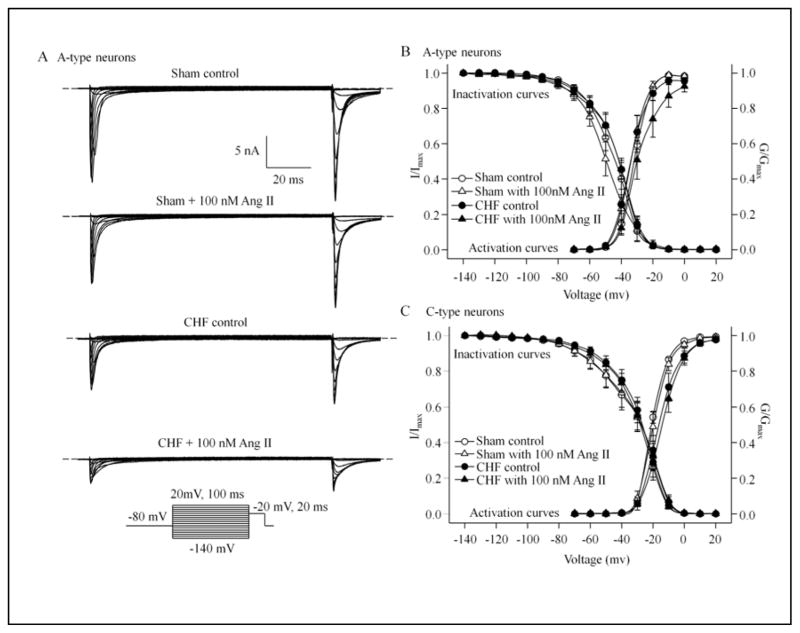
Results: Using Ang II I radioimmunoassay, real-time reverse transcription-PCR and western blot, we found that Ang II levels, and mRNA and protein expression of angiotension II type 1 receptor in nodose ganglia from CHF rats were higher than that from sham rats. Local microinjection of Ang II (0.2 nmol) into the nodose ganglia decreased the arterial baroreflex sensitivity in sham rats, whereas losartan (1 nmol, an angiotension II type 1 receptor antagonist) improved the arterial baroreflex sensitivity in CHF rats. Data from patch-clamp recording showed that Ang II (100 nmol/l) acutely inhibited Nav currents in the aortic baroreceptor neurons from sham and CHF rats. In particular, inhibitory effect of Ang II on Nav currents in the aortic baroreceptor neurons was larger in CHF rats than that in sham rats. Losartan (1 μmol/l) totally abolished the inhibitory effect of Ang II on Nav currents in sham and CHF aortic baroreceptor neurons.
Conclusion: These results suggest that elevation of endogenous Ang II in the nodose ganglia contributes to impairment of the arterial baroreflex function in CHF rats through inhibiting Nav channels.
Conflict of interest statement
No conflicts of interest, financial or otherwise, are declared by the authors.
Figures
References
-
- Ganguly PK, Beamish RE, Dhalla KS, Innes IR, Dhalla NS. Norepinephrine storage, distribution, and release in diabetic cardiomyopathy. Am J Physiol. 1987;252(6 Pt 1):E734–E739. - PubMed
-
- Lund DD, Subieta AR, Pardini BJ, Chang KS. Alterations in cardiac parasympathetic indices in STZ-induced diabetic rats. Diabetes. 1992;41(2):160–166. - PubMed
-
- Benarroch EE. The arterial baroreflex: functional organization and involvement in neurologic disease. Neurology. 2008;71(21):1733–1738. - PubMed
-
- Czachurski J, Lackner KJ, Ockert D, Seller H. Localization of neurones with baroreceptor input in the medial solitary nucleus by means of intracellular application of horseradish peroxidase in the cat. Neurosci Lett. 1982;28(2):133–137. - PubMed
-
- Spyer KM, Lambert JH, Thomas T. Central nervous system control of cardiovascular function: neural mechanisms and novel modulators. Clin Exp Pharmacol Physiol. 1997;24(9–10):743–747. - PubMed
Publication types
MeSH terms
Substances
Grants and funding
LinkOut - more resources
Full Text Sources
Medical
Miscellaneous
