


Household food insecurity and dietary intake in Korea: results from the 2012 Korea National Health and Nutrition Examination Survey
- PMID: 25828606
- PMCID: PMC10271457
- DOI: 10.1017/S1368980015000725
Household food insecurity and dietary intake in Korea: results from the 2012 Korea National Health and Nutrition Examination Survey
Abstract
Objective: To examine the prevalence of household food insecurity and compare dietary intake by food security status in a representative Korean population.
Design: Cross-sectional. Food security status of households was classified using an eighteen-item food security questionnaire. The nutrition survey comprised questions on dietary habits, a 24 h dietary recall and a semi-quantitative FFQ.
Setting: The 2012 Korea National Health and Nutrition Examination Survey.
Subjects: A total of 3007 households completed the food security questionnaire. Family members within each household aged ≥1 year (n 7118) participated in the nutrition survey.
Results: Results from the 2012 survey indicated that 88.7% of Korean households showed food security. The remaining 11.3% (9.3% for food insecurity without hunger and 2.0% for food insecurity with hunger) were in food-insecure households. The prevalence of household food insecurity was 13.2% in households with children and 10.3% in households without children. Mean daily intakes of energy, fat and carbohydrates were not significantly different between food-secure and food-insecure adults. In contrast, mean daily intakes of protein, crude fibre, vitamins and minerals as well as weekly consumption frequencies of vegetables, seaweeds, fruits, fruit juice, nuts, and milk and milk products were significantly lower in food-insecure adults compared with food-secure adults.
Conclusions: The study demonstrated that food insecurity is associated with reduced intakes of healthy foods and nutrients essential for health and growth in a representative Korean population.
Keywords: Food intake; Food security; Korea National Health and Nutrition Examination Survey; Nutrient intake.
Figures
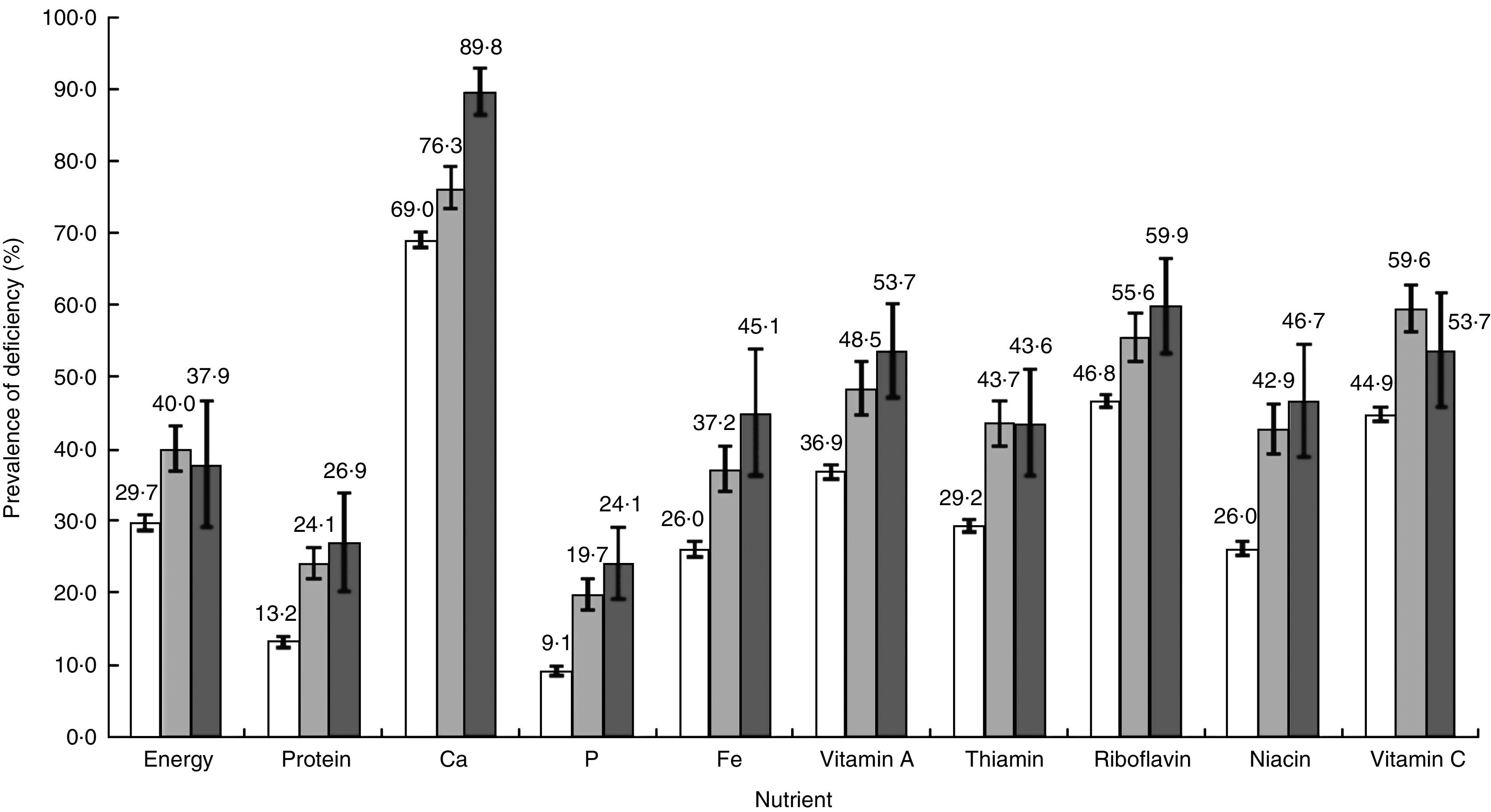
 , food-secure (n 6486);
  , food-insecure without hunger (n 546);
  , food-insecure with hunger (n 81)) among family members aged ≥1 year who participated in a 24 h dietary recall survey, 2012 Korea National Health and Nutrition Examination Survey. Energy deficiency was defined as energy intake less than 75 % of the estimated energy requirement according to sex and age for Koreans; nutrient deficiency was defined as nutrient intake less than the estimated average requirement according to sex and age for Koreans. Values are weighted percentages with their standard errors represented by vertical bars, which were calculated by applying sampling weights assigned to individual participants in the nutrition survey. Using the χ
2 test, all P values for differences in prevalence between food-secure individuals, food-insecure individuals without hunger and food-insecure individuals with hunger were <0·01
, food-insecure with hunger (n 81)) among family members aged ≥1 year who participated in a 24 h dietary recall survey, 2012 Korea National Health and Nutrition Examination Survey. Energy deficiency was defined as energy intake less than 75 % of the estimated energy requirement according to sex and age for Koreans; nutrient deficiency was defined as nutrient intake less than the estimated average requirement according to sex and age for Koreans. Values are weighted percentages with their standard errors represented by vertical bars, which were calculated by applying sampling weights assigned to individual participants in the nutrition survey. Using the χ
2 test, all P values for differences in prevalence between food-secure individuals, food-insecure individuals without hunger and food-insecure individuals with hunger were <0·01References
-
- Anderson SA (1990) Core indicators of nutritional state for difficult-to-sample populations. J Nutr 120, Suppl. 11, 1559–1600. - PubMed
-
- Kim S, Moon S & Popkin BM (2000) The nutrition transition in South Korea. Am J Clin Nutr 71, 44–53. - PubMed
-
- Hong SA, Kim K & Kim MK (2012) Trends in the inequality of fruit and vegetable consumption between education levels indicated by the Korea National Health and Nutrition Examination Surveys. Eur J Clin Nutr 66, 942–949. - PubMed
-
- Darmon N & Drewnowski A (2008) Does social class predict diet quality? Am J Clin Nutr 87, 1107–1117. - PubMed
-
- Oh SY & Hong MJ (2003) Food insecurity is associated with dietary intake and body size of Korean children from low-income families in urban areas. Eur J Clin Nutr 57, 1598–1604. - PubMed
Publication types
MeSH terms
LinkOut - more resources
Full Text Sources
Medical
