


4D hyperspherical harmonic (HyperSPHARM) representation of surface anatomy: a holistic treatment of multiple disconnected anatomical structures
- PMID: 25828650
- PMCID: PMC4405486
- DOI: 10.1016/j.media.2015.02.004
4D hyperspherical harmonic (HyperSPHARM) representation of surface anatomy: a holistic treatment of multiple disconnected anatomical structures
Abstract
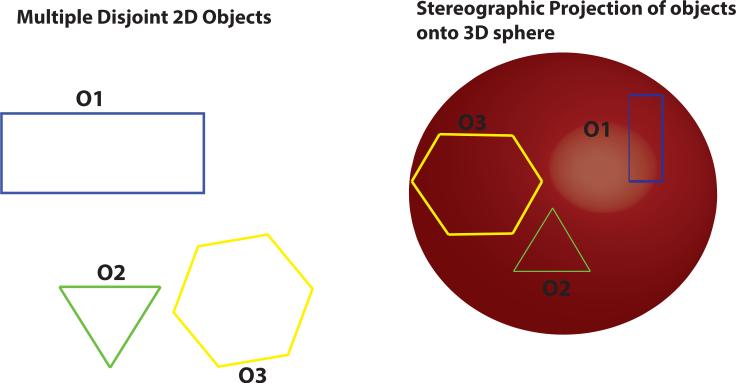
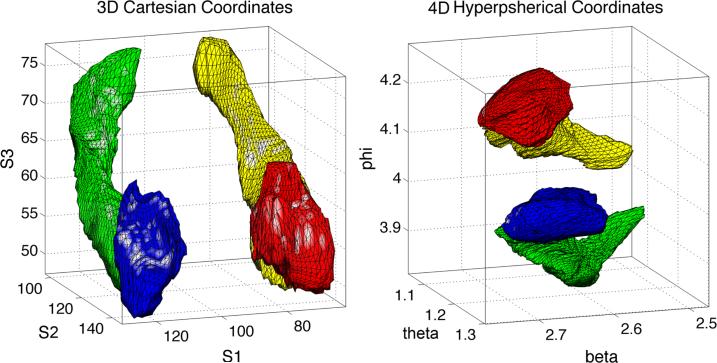
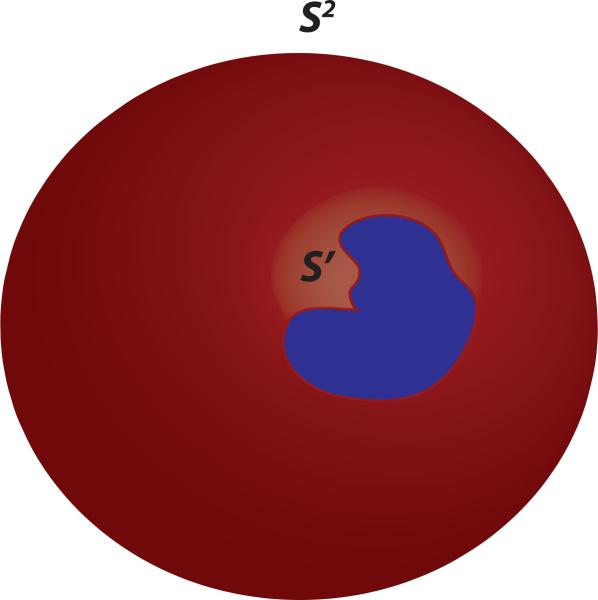
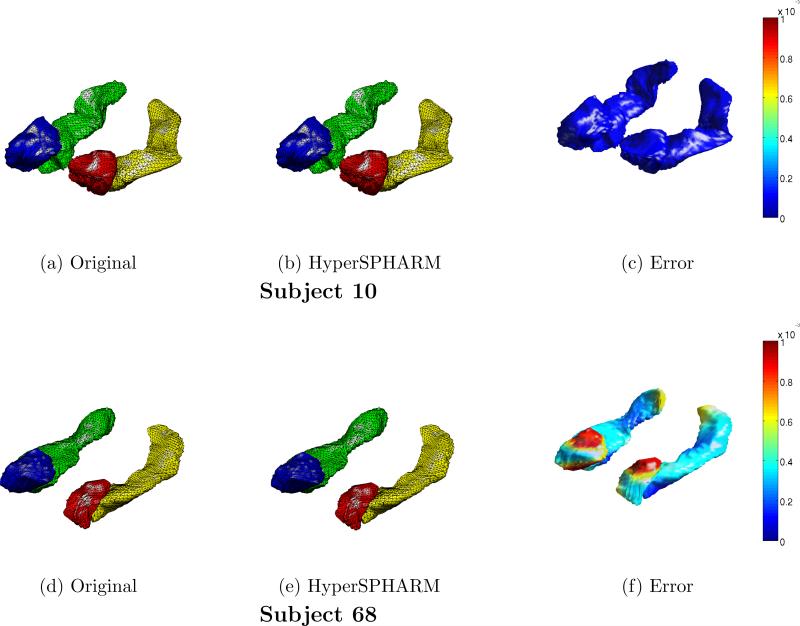
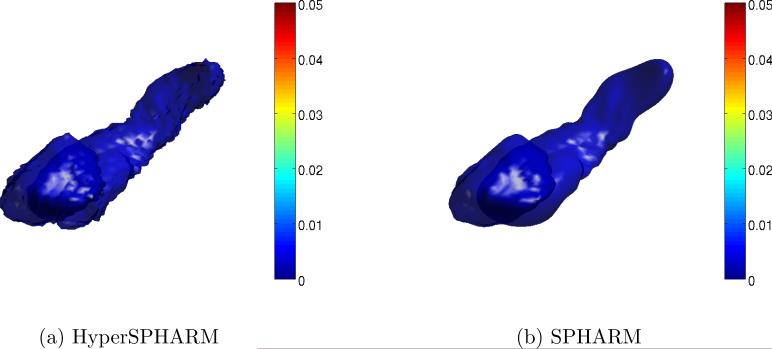
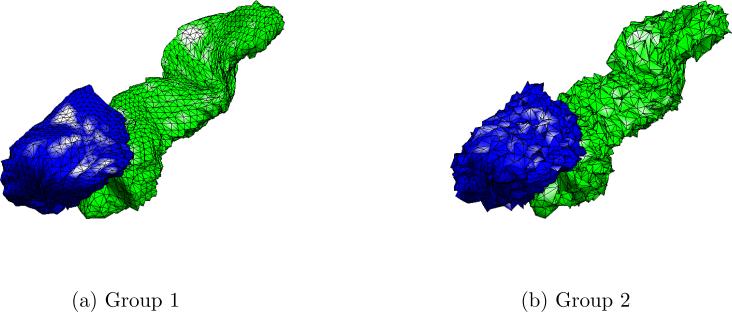
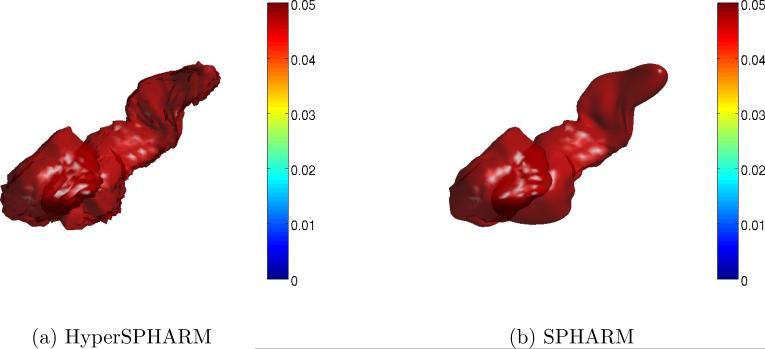
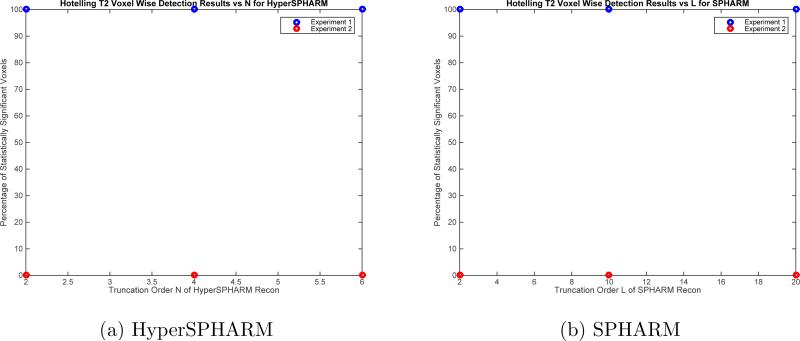
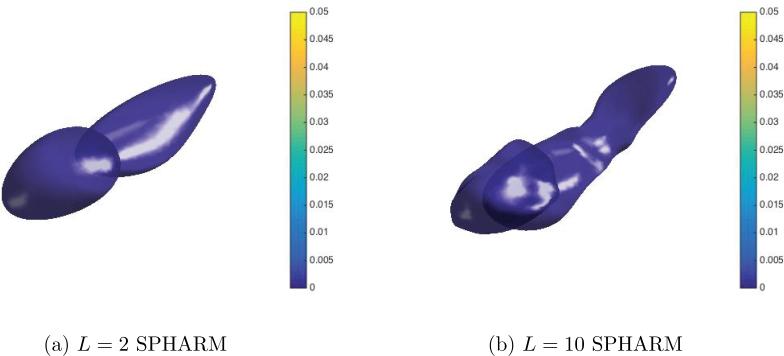
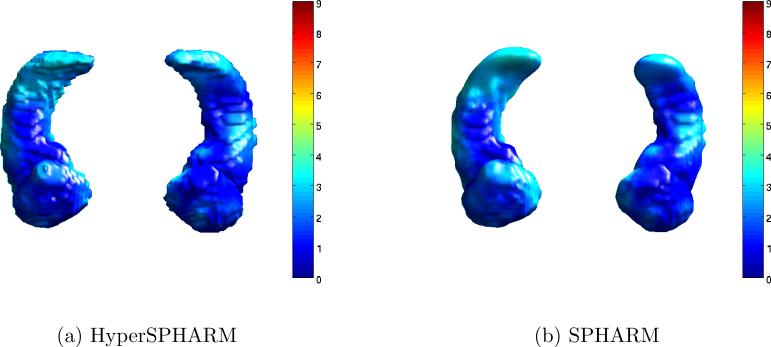
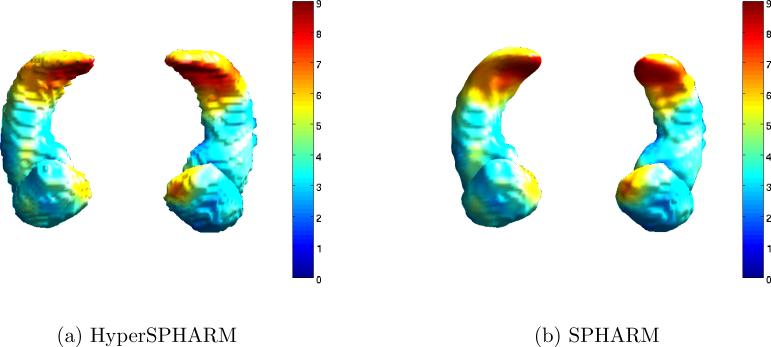
Image-based parcellation of the brain often leads to multiple disconnected anatomical structures, which pose significant challenges for analyses of morphological shapes. Existing shape models, such as the widely used spherical harmonic (SPHARM) representation, assume topological invariance, so are unable to simultaneously parameterize multiple disjoint structures. In such a situation, SPHARM has to be applied separately to each individual structure. We present a novel surface parameterization technique using 4D hyperspherical harmonics in representing multiple disjoint objects as a single analytic function, terming it HyperSPHARM. The underlying idea behind HyperSPHARM is to stereographically project an entire collection of disjoint 3D objects onto the 4D hypersphere and subsequently simultaneously parameterize them with the 4D hyperspherical harmonics. Hence, HyperSPHARM allows for a holistic treatment of multiple disjoint objects, unlike SPHARM. In an imaging dataset of healthy adult human brains, we apply HyperSPHARM to the hippocampi and amygdalae. The HyperSPHARM representations are employed as a data smoothing technique, while the HyperSPHARM coefficients are utilized in a support vector machine setting for object classification. HyperSPHARM yields nearly identical results as SPHARM, as will be shown in the paper. Its key advantage over SPHARM lies computationally; HyperSPHARM possess greater computational efficiency than SPHARM because it can parameterize multiple disjoint structures using much fewer basis functions and stereographic projection obviates SPHARM's burdensome surface flattening. In addition, HyperSPHARM can handle any type of topology, unlike SPHARM, whose analysis is confined to topologically invariant structures.
Keywords: Classification; Hippocampus & Amygdala; Hyperspherical harmonics; SPHARM; Shape analysis.
Copyright © 2015 Elsevier B.V. All rights reserved.
Figures
References
-
- Angenent S, Hacker S, Tannenbaum A, Kikinis R. On the laplace-beltrami operator and brain surface flattening. IEEE Transactions on Medical Imaging. 1999;18:700–711. - PubMed
-
- Aquilanti V, Cavalli S, Coletti C. The d-dimensional hydrogen atom: hyperspherical harmonics as momentum space orbitals and alternative Sturmian basis sets. Chemical Physics. 1997
-
- Benjamini Y, Hochberg Y. Controlling the false discovery rate: a practical and powerful approach to multiple testing. Journal of the Royal Statistical Society. 1995;57:289–300.
-
- Bonvallet B, Griffin N, Li J. 3D shape descriptors: 4D hyperspherical harmonics ’An exploration into the fourth dimension’. IASTED International Conference on Graphics and Visualization in Engineering. 2007:113–116.
Publication types
MeSH terms
Grants and funding
- P30 HD003352/HD/NICHD NIH HHS/United States
- UL1 TR000427/TR/NCATS NIH HHS/United States
- R01MH043454/MH/NIMH NIH HHS/United States
- P50 MH084051/MH/NIMH NIH HHS/United States
- P01 AG20166/AG/NIA NIH HHS/United States
- P50 MH84051/MH/NIMH NIH HHS/United States
- 5T15LM007359/LM/NLM NIH HHS/United States
- T15 LM007359/LM/NLM NIH HHS/United States
- P50 MH10031/MH/NIMH NIH HHS/United States
- UL1TR000427/TR/NCATS NIH HHS/United States
- R01 MH043454/MH/NIMH NIH HHS/United States
- P50 MH100031/MH/NIMH NIH HHS/United States
- P01 AG020166/AG/NIA NIH HHS/United States
- P50 AG033514/AG/NIA NIH HHS/United States
LinkOut - more resources
Full Text Sources
Other Literature Sources
