


Supportive care for men with prostate cancer: why are the trials not working? A systematic review and recommendations for future trials
- PMID: 25828811
- PMCID: PMC4559035
- DOI: 10.1002/cam4.446
Supportive care for men with prostate cancer: why are the trials not working? A systematic review and recommendations for future trials
Abstract
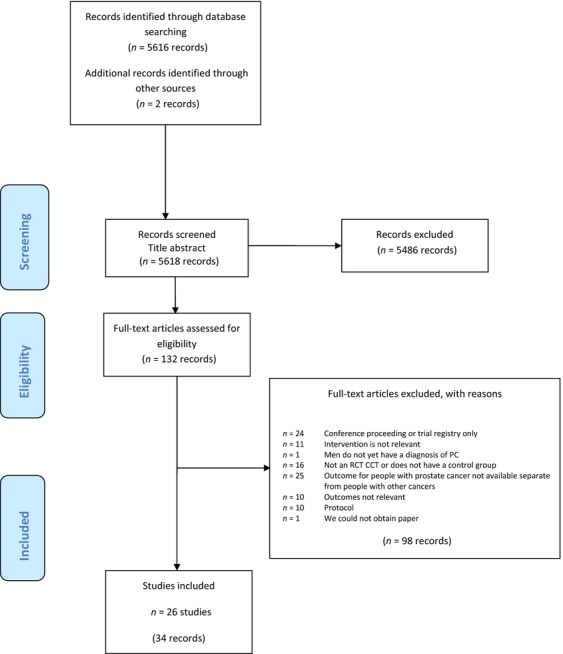
Men with prostate cancer are likely to have a long illness and experience psychological distress for which supportive care may be helpful. This systematic review describes the evidence for effectiveness and cost-effectiveness of supportive care for men with prostate cancer, taking into account treatment pathway and components of interventions. MEDLINE, EMBASE, CINAHL, CENTRAL, and Psychinfo were searched from inception--July 2013 for randomized controlled trials and controlled trials. Two authors independently assessed risk of bias and extracted data. Twenty-six studies were included (2740 participants). Interventions were delivered pre and during (n = 12), short-term (n = 8), and longer term (18 months) (n = 5) after primary treatment. No interventions were delivered beyond this time. Few trials recruited ethnic minorities and none recruited men in same sex relationships. Intervention components included information, education, health professional discussion, homework, peer discussion, buddy support, cognitive behavioral therapy, cognitive restructuring, psychoeducation, Reiki and relaxation. Most interventions were delivered for 5-10 weeks. Risk of bias of trials was assessed as unclear for most domains due to lack of information. The majority of trials measuring quality of life and depression found no effect. Relatively few trials measured anxiety, coping skills and self-efficacy, and the majority found no effect. No cost data were available. Trials of supportive care for men with prostate cancer cover a range of interventions but are limited by population diversity, inconsistent measurement and reporting of outcomes, and inability to assess risk of bias. Recommendations on design and conduct of future trials are presented.
Keywords: Critical appraisal; prostate cancer; randomized controlled trials; supportive care; systematic review.
© 2015 The Authors. Cancer Medicine published by John Wiley & Sons Ltd.
References
-
- Ferlay J, Shin HR, Bray F, Forman D, Mathers C. Parkin DM. Estimates of worldwide burden of cancer in 2008: GLOBOCAN 2008. Int. J. Cancer. 2010;127:2893–2917. - PubMed
-
- Hsing AW, Tsao L. Devesa SS. International trends and patterns of prostate cancer incidence and mortality. Int. J. Cancer. 2000;85:60–67. - PubMed
-
- Bray F, Lortet-Tieulent J, Ferlay J, Forman D. Auvinen A. Prostate cancer incidence and mortality trends in 37 European countries: an overview. Eur. J. Cancer. 2010;46:3040–3052. - PubMed
-
- National Institute of Cancer. 2014. National Institute of Cancer USA definition of supportive care . Available at http://www.cancer.gov/dictionary?cdrid=46609 on the (accessed 21 July 2014)
-
- Vieira I, Burke L. Marks-Maran D. Prostate cancer follow-up needs: do patients and professionals agree? Br. J. Nurs. 2014;23:S14–S19. S12, - PubMed
Publication types
MeSH terms
Grants and funding
LinkOut - more resources
Full Text Sources
Other Literature Sources
Medical
