


Face processing in autism spectrum disorders: From brain regions to brain networks
- PMID: 25829246
- PMCID: PMC4506751
- DOI: 10.1016/j.neuropsychologia.2015.03.029
Face processing in autism spectrum disorders: From brain regions to brain networks
Abstract
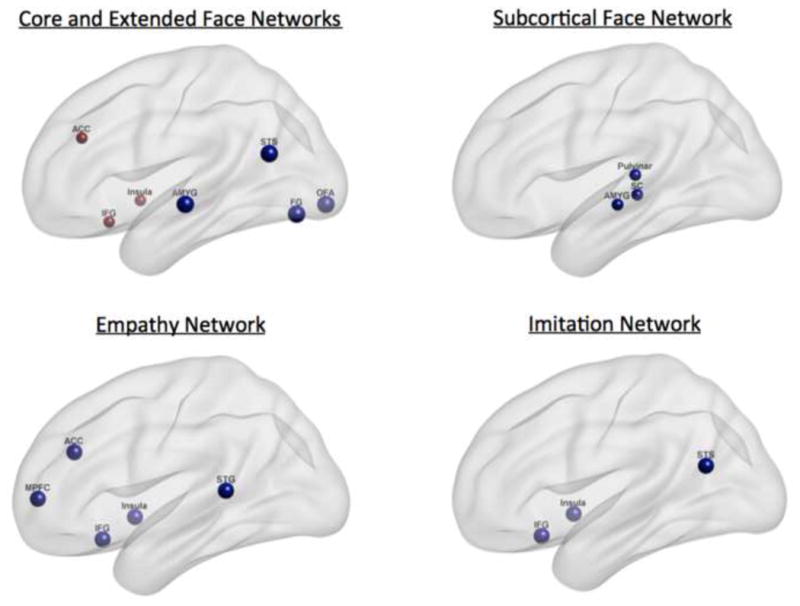
Autism spectrum disorder (ASD) is characterized by reduced attention to social stimuli including the human face. This hypo-responsiveness to stimuli that are engaging to typically developing individuals may result from dysfunctioning motivation, reward, and attention systems in the brain. Here we review an emerging neuroimaging literature that emphasizes a shift from focusing on hypo-activation of isolated brain regions such as the fusiform gyrus, amygdala, and superior temporal sulcus in ASD to a more holistic approach to understanding face perception as a process supported by distributed cortical and subcortical brain networks. We summarize evidence for atypical activation patterns within brain networks that may contribute to social deficits characteristic of the disorder. We conclude by pointing to gaps in the literature and future directions that will continue to shed light on aspects of face processing in autism that are still under-examined. In particular, we highlight the need for more developmental studies and studies examining ecologically valid and naturalistic social stimuli.
Keywords: Autism; Connectivity; Eye gaze; Faces; Social cognition; fMRI.
Copyright © 2015 Elsevier Ltd. All rights reserved.
Figures
Similar articles
-
Atypical neural encoding of faces in individuals with autism spectrum disorder.Cereb Cortex. 2024 May 2;34(13):172-186. doi: 10.1093/cercor/bhae060. Cereb Cortex. 2024. PMID: 38696606 Free PMC article.
-
Abnormal Neural Activation to Faces in the Parents of Children with Autism.Cereb Cortex. 2015 Dec;25(12):4653-66. doi: 10.1093/cercor/bhu147. Epub 2014 Jul 23. Cereb Cortex. 2015. PMID: 25056573 Free PMC article.
-
Sensory Processing Patterns and Fusiform Activity During Face Processing in Autism Spectrum Disorder.Autism Res. 2020 May;13(5):741-750. doi: 10.1002/aur.2283. Epub 2020 Feb 14. Autism Res. 2020. PMID: 32058662 Free PMC article.
-
Neural correlates of facial recognition deficits in autism spectrum disorder: a comprehensive review.Front Psychiatry. 2025 Jan 6;15:1464142. doi: 10.3389/fpsyt.2024.1464142. eCollection 2024. Front Psychiatry. 2025. PMID: 39834575 Free PMC article. Review.
-
Brain connectivity in autism spectrum disorder.Curr Opin Neurol. 2016 Apr;29(2):137-47. doi: 10.1097/WCO.0000000000000301. Curr Opin Neurol. 2016. PMID: 26910484 Free PMC article. Review.
Cited by
-
Increased Accuracy of Emotion Recognition in Individuals with Autism-Like Traits after Five Days of Magnetic Stimulations.Neural Plast. 2020 Jul 4;2020:9857987. doi: 10.1155/2020/9857987. eCollection 2020. Neural Plast. 2020. PMID: 32714385 Free PMC article. Clinical Trial.
-
Atypical frontoamygdala functional connectivity in youth with autism.Dev Cogn Neurosci. 2019 Jun;37:100603. doi: 10.1016/j.dcn.2018.12.001. Epub 2018 Dec 7. Dev Cogn Neurosci. 2019. PMID: 30581125 Free PMC article.
-
Amygdala connectivity and implications for social cognition and disorders.Handb Clin Neurol. 2022;187:381-403. doi: 10.1016/B978-0-12-823493-8.00017-1. Handb Clin Neurol. 2022. PMID: 35964984 Free PMC article. Review.
-
Changes in the geometry and robustness of diffusion tensor imaging networks: Secondary analysis from a randomized controlled trial of young autistic children receiving an umbilical cord blood infusion.Front Psychiatry. 2022 Oct 20;13:1026279. doi: 10.3389/fpsyt.2022.1026279. eCollection 2022. Front Psychiatry. 2022. PMID: 36353577 Free PMC article.
-
Looking beyond the face area: lesion network mapping of prosopagnosia.Brain. 2019 Dec 1;142(12):3975-3990. doi: 10.1093/brain/awz332. Brain. 2019. PMID: 31740940 Free PMC article.
References
-
- Ashwin C, Baron-Cohen S, Wheelwright S, O'Riordan MO, Bullmore ET. Differential activation of the amygdala and the ‘social brain’ during fearful face-processing in asperger syndrome. Neuropsychologia. 2007;45(1):2–14. - PubMed
-
- Adolphs R. Cognitive neuroscience of human social behavior. Nature Rev Neurosci. 2003;4:165–178. - PubMed
-
- Adolphs R, Spezio M. Role of the amygdala in processing visual social stimuli. Prog Brain Res. 2006;156:363–378. - PubMed
Publication types
MeSH terms
Grants and funding
LinkOut - more resources
Full Text Sources
Other Literature Sources
Medical
