


Comparison of consumers' views on electronic data sharing for healthcare and research
- PMID: 25829461
- PMCID: PMC5009901
- DOI: 10.1093/jamia/ocv014
Comparison of consumers' views on electronic data sharing for healthcare and research
Abstract
New models of healthcare delivery such as accountable care organizations and patient-centered medical homes seek to improve quality, access, and cost. They rely on a robust, secure technology infrastructure provided by health information exchanges (HIEs) and distributed research networks and the willingness of patients to share their data. There are few large, in-depth studies of US consumers' views on privacy, security, and consent in electronic data sharing for healthcare and research together.
Objective: This paper addresses this gap, reporting on a survey which asks about California consumers' views of data sharing for healthcare and research together.
Materials and methods: The survey conducted was a representative, random-digit dial telephone survey of 800 Californians, performed in Spanish and English.
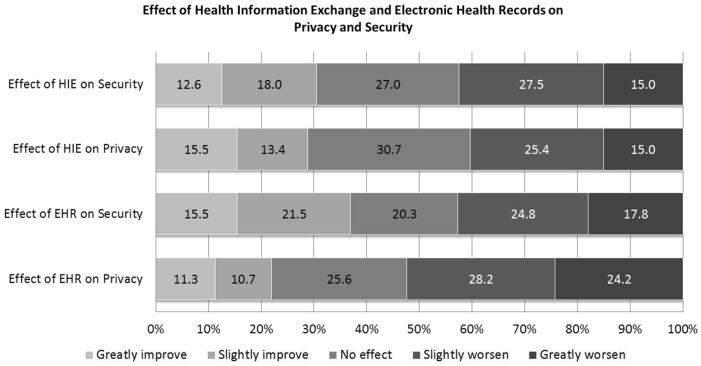
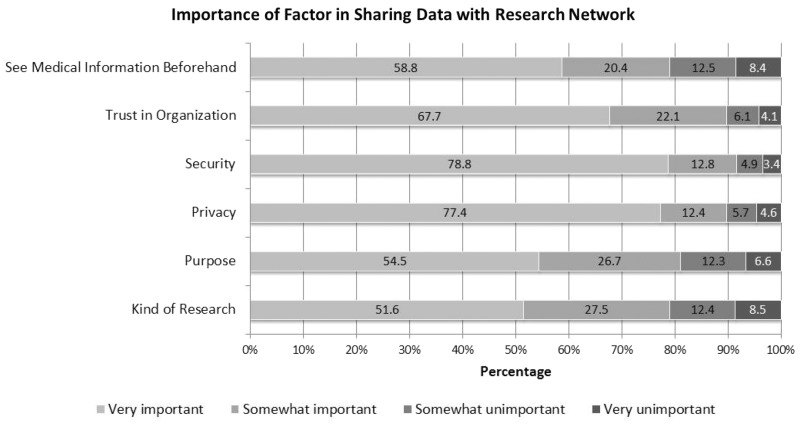
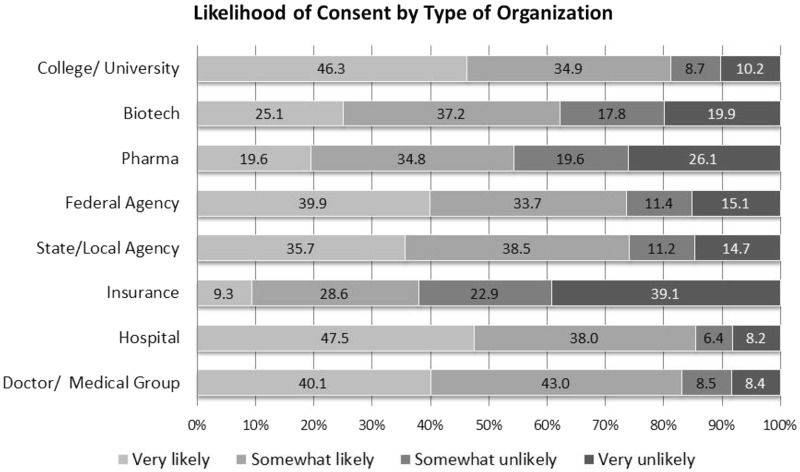
Results: There is a great deal of concern that HIEs will worsen privacy (40.3%) and security (42.5%). Consumers are in favor of electronic data sharing but elements of transparency are important: individual control, who has access, and the purpose for use of data. Respondents were more likely to agree to share deidentified information for research than to share identified information for healthcare (76.2% vs 57.3%, p < .001).
Discussion: While consumers show willingness to share health information electronically, they value individual control and privacy. Responsiveness to these needs, rather than mere reliance on Health Insurance Portability and Accountability Act (HIPAA), may improve support of data networks.
Conclusion: Responsiveness to the public's concerns regarding their health information is a pre-requisite for patient-centeredness. This is one of the first in-depth studies of attitudes about electronic data sharing that compares attitudes of the same individual towards healthcare and research.
Keywords: consent; distributed research network; health information exchange; patient-centered; privacy.
© The Author 2015. Published by Oxford University Press on behalf of the American Medical Informatics Association. All rights reserved. For Permissions, please email: journals.permissions@oup.com.
Figures
References
-
- Smith M, Saunders R, Stuckhardt L, McGinnis JM, eds. Best Care at Lower Cost: The Path to Continuously Learning Health Care in America. Pre-publication copy ed: Institute of Medicine Committee on the Learning Health Care System in America; 2012. - PubMed
-
- Lauer MS, D'Agostino RB. The Randomized Registry Trial — The Next Disruptive Technology in Clinical Research? N Engl J Med. 2013;369(17):1579–1581. - PubMed
-
- 111th Congress of the United State of America. American Recovery and Reinvestment Act of 2009, 2009.
Publication types
MeSH terms
Grants and funding
LinkOut - more resources
Full Text Sources
Other Literature Sources
Miscellaneous
