


Meta-analysis of microRNA-146a rs2910164 G>C polymorphism association with autoimmune diseases susceptibility, an update based on 24 studies
- PMID: 25830862
- PMCID: PMC4382023
- DOI: 10.1371/journal.pone.0121918
Meta-analysis of microRNA-146a rs2910164 G>C polymorphism association with autoimmune diseases susceptibility, an update based on 24 studies
Abstract
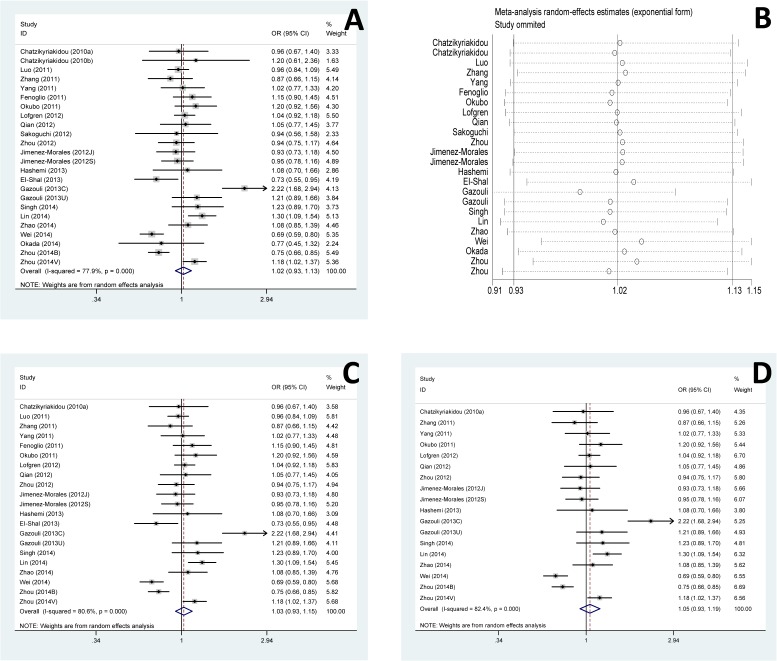
Background: Published data showed that the susceptibility of autoimmune diseases (ADs) was associated with the polymorphism rs2910164 in microRNA-146a (miR-146a). However, the results remain controversial so far. Two meta-analyses published in 2013 and 2014 came to opposite conclusions. In order to derive a more precise estimation of the relationship, we performed this meta-analysis.
Methods: We searched the PubMed, OvidSP and CNKI databases (published prior to September 8th, 2014) and extracted data from eligible studies. The procedure of meta-analysis was performed by using the Stata 12.0 software. Random effect model or fixed effect model were chosen respectively, according to the between study heterogeneities.
Results: A total of 24 case-control studies, 11 more than previous meta-analysis on this topic, were involved. We took stratified analyses by different ethnicities and different types of diseases in different genetic models. In Caucasian subgroup, significant increased risks of GC genotype and GC+CC genotype with ADs susceptibility were found in heterozygote model (GC vs GG, OR = 1.38, 95% CI 1.04-1.83, p = 0.024) and dominant model (GC+CC vs GG, OR = 1.37, 95% CI 1.01-1.85, p = 0.041), respectively. Meanwhile, in other disease subgroup, significant increased risks of C allele, CC genotype and GC+CC genotype were found in allele model (C vs G, OR = 1.16, 95% CI 1.04-1.31, p = 0.010), homozygote model (CC vs GG, OR = 1.42, 95% CI 1.10-1.84, p = 0.006) and dominant model (GC+CC vs GG, OR = 1.25, 95% CI 1.04-1.51, p = 0.020), respectively.
Conclusions: MiR-146a rs2910164 G>C polymorphism was associated with the susceptibility of ADs.
Conflict of interest statement
Figures



References
-
- Marrack P, Kappler J, Kotzin BL. Autoimmune disease: why and where it occurs. Nat Med. 2001;7:899–905. - PubMed
-
- American Autoimmune Related Diseases Association, National Coalition of Autoimmune Patient Groups. The Cost Burden of Autoimmune Disease: The Latest Front in the War on Healthcare Spending. 2011. Available: http://www.diabetesed.net/page/_files/autoimmune-diseases.pdf Accessed: 2014 Dec 31.
-
- Miller FW. Environmental agents and autoimmune diseases. Adv Exp Med Biol. 2011;711:61–81. - PubMed
Publication types
MeSH terms
Substances
LinkOut - more resources
Full Text Sources
Other Literature Sources
Medical
Miscellaneous
