


Late Pleistocene horse and camel hunting at the southern margin of the ice-free corridor: reassessing the age of Wally's Beach, Canada
- PMID: 25831543
- PMCID: PMC4394292
- DOI: 10.1073/pnas.1420650112
Late Pleistocene horse and camel hunting at the southern margin of the ice-free corridor: reassessing the age of Wally's Beach, Canada
Abstract
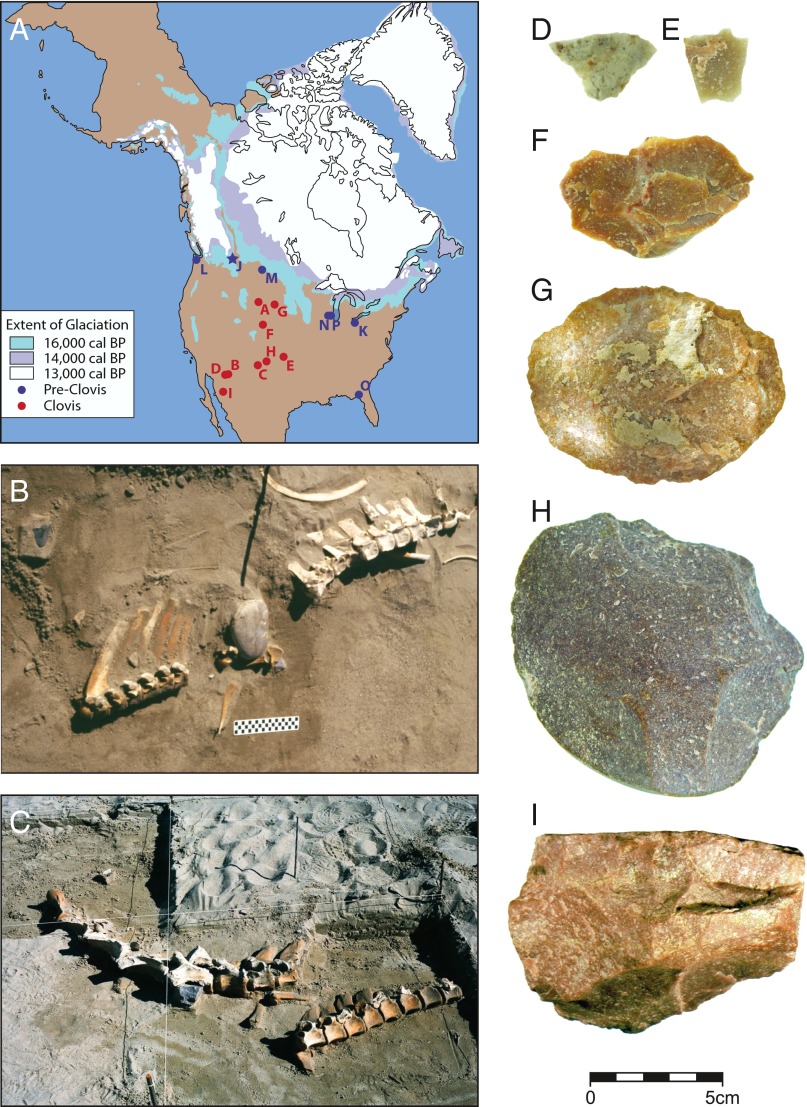
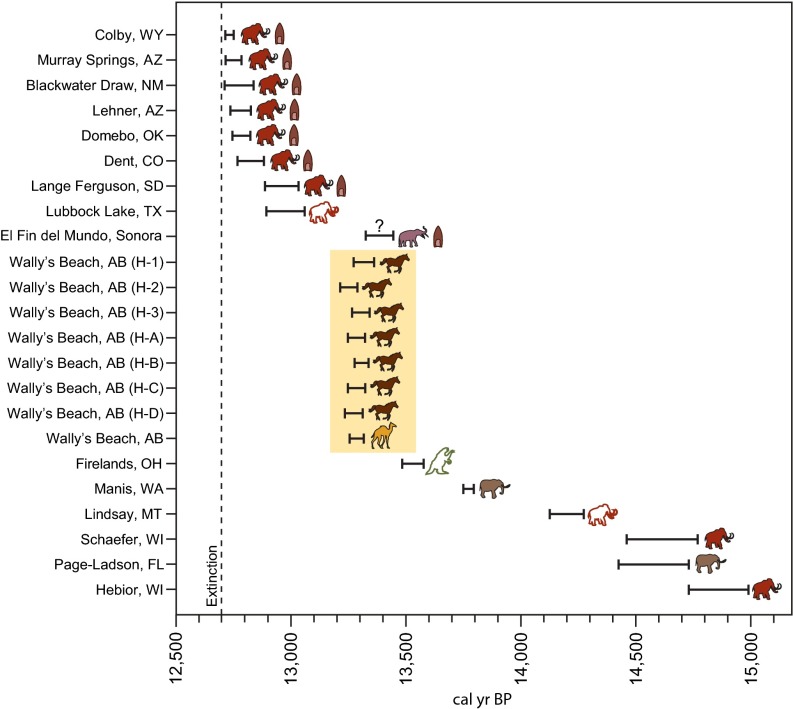
The only certain evidence for prehistoric human hunting of horse and camel in North America occurs at the Wally's Beach site, Canada. Here, the butchered remains of seven horses and one camel are associated with 29 nondiagnostic lithic artifacts. Twenty-seven new radiocarbon ages on the bones of these animals revise the age of these kill and butchering localities to 13,300 calibrated y B.P. The tight chronological clustering of the eight kill localities at Wally's Beach indicates these animals were killed over a short period. Human hunting of horse and camel in Canada, coupled with mammoth, mastodon, sloth, and gomphothere hunting documented at other sites from 14,800-12,700 calibrated y B.P., show that 6 of the 36 genera of megafauna that went extinct by approximately 12,700 calibrated y B.P. were hunted by humans. This study shows the importance of accurate geochronology, without which significant discoveries will go unrecognized and the empirical data used to build models explaining the peopling of the Americas and Pleistocene extinctions will be in error.
Keywords: Clovis; Pleistocene; Pre-Clovis; extinction; megafauna.
Conflict of interest statement
The authors declare no conflict of interest.
Figures
References
-
- Kooyman B, et al. Late Pleistocene horse hunting at the Wally’s Beach site (DhPg-8), Canada. Am Antiq. 2006;71(1):101–121.
-
- Kooyman B, et al. Late Pleistocene western camel (Camelops hesternus) hunting in southwestern Canada. Am Antiq. 2012;77(1):115–124.
-
- Stafford TW, Jr, Brendel K, Duhamel R. Radiocarbon, 13C, and 15N analysis of fossil bone: Removal of humates with XAD-2 resin. Geochim Cosmochim Acta. 1988;52(9):2257–2267.
-
- Waters MR, Stafford TW., Jr Redefining the age of Clovis: Implications for the peopling of the Americas. Science. 2007;315(5815):1122–1126. - PubMed
-
- McNeil P, et al. Mammoth tracks indicate a declining late Pleistocene population in southwestern Alberta, Canada. Quat Sci Rev. 2005;24:1253–1259.
Publication types
MeSH terms
LinkOut - more resources
Full Text Sources
Other Literature Sources
