


Poststroke suicide attempts and completed suicides: a socioeconomic and nationwide perspective
- PMID: 25832661
- PMCID: PMC4424126
- DOI: 10.1212/WNL.0000000000001514
Poststroke suicide attempts and completed suicides: a socioeconomic and nationwide perspective
Abstract
Objective: We examined attempted and completed suicides after stroke to determine whether they were associated with socioeconomic status, other patient characteristics, or time after stroke.
Methods: This nationwide cohort study included stroke patients from Riksstroke (the Swedish Stroke Register) from 2001 to 2012. We used personal identification numbers to link the Riksstroke data with other national registers. Suicide attempts were identified by a record of hospital admission for intentional self-harm (ICD-10: X60-X84), and completed suicides were identified in the national Cause of Death Register. We used multiple Cox regression to analyze time from stroke onset to first suicide attempt.
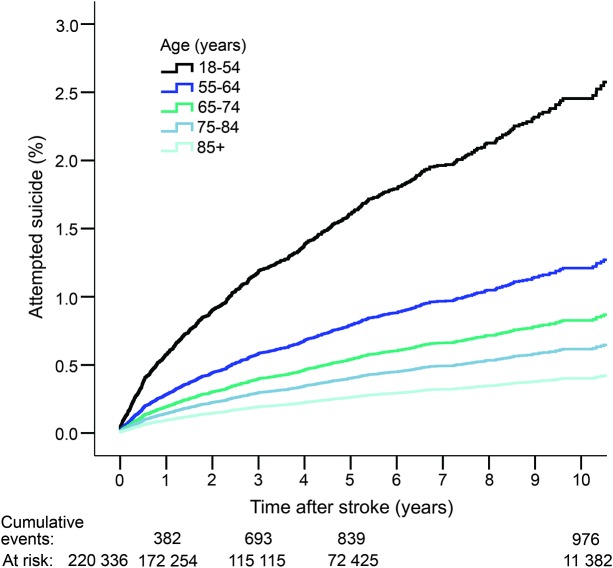
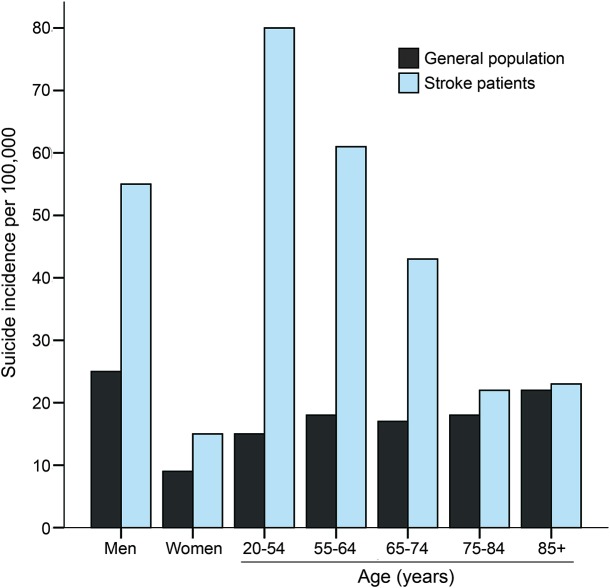
Results: We observed 220,336 stroke patients with a total follow-up time of 860,713 person-years. During follow-up, there were 1,217 suicide attempts, of which 260 were fatal. This was approximately double the rate of the general Swedish population. Patients with lower education or income (hazard ratio [HR] 1.37, 95% confidence interval [CI] 1.11-1.68) for primary vs university and patients living alone (HR 1.73, 95% CI 1.52-1.97) had an increased risk of attempted suicide, and patients born outside of Europe had a lower risk compared to patients of European origin. Male sex, young age, severe stroke, and poststroke depression were other factors associated with an increased risk of attempted suicide after stroke. The risk was highest during the first 2 years after stroke.
Conclusions: Both clinical and socioeconomic factors increase the risk of poststroke suicide attempts. This suggests a need for psychosocial support and suicide preventive interventions in high-risk groups of stroke patients.
© 2015 American Academy of Neurology.
Figures
Comment in
-
Suicide in stroke survivors: frequency and risk factors.Neurology. 2015 Apr 28;84(17):1724-5. doi: 10.1212/WNL.0000000000001531. Epub 2015 Apr 1. Neurology. 2015. PMID: 25832662 No abstract available.
References
-
- Fuller-Thomson E, Tulipano MJ, Song M. The association between depression, suicidal ideation, and stroke in a population-based sample. Int J Stroke 2012;7:188–194. - PubMed
-
- Santos CO, Caeiro L, Ferro JM, Figueira ML. A study of suicidal thoughts in acute stroke patients. J Stroke Cerebrovasc Dis 2012;21:749–754. - PubMed
Publication types
MeSH terms
LinkOut - more resources
Full Text Sources
Medical
