


Hygiene and sanitation risk factors of diarrhoeal disease among under-five children in Ibadan, Nigeria
- PMID: 25834513
- PMCID: PMC4370083
- DOI: 10.4314/ahs.v14i4.32
Hygiene and sanitation risk factors of diarrhoeal disease among under-five children in Ibadan, Nigeria
Abstract
Background: Diarrhoea diseases are among the leading causes of morbidity and mortality in under-five-children (U-5C) in Nigeria. Inadequate safe water, sanitation, and hygiene account for the disease burden. Cases of diarrhoea still occur in high proportion in the study area despite government-oriented interventions.
Objective: To determine the hygiene and sanitation risk factors predisposing U-5C to diarrhoea in Ibadan, Nigeria.
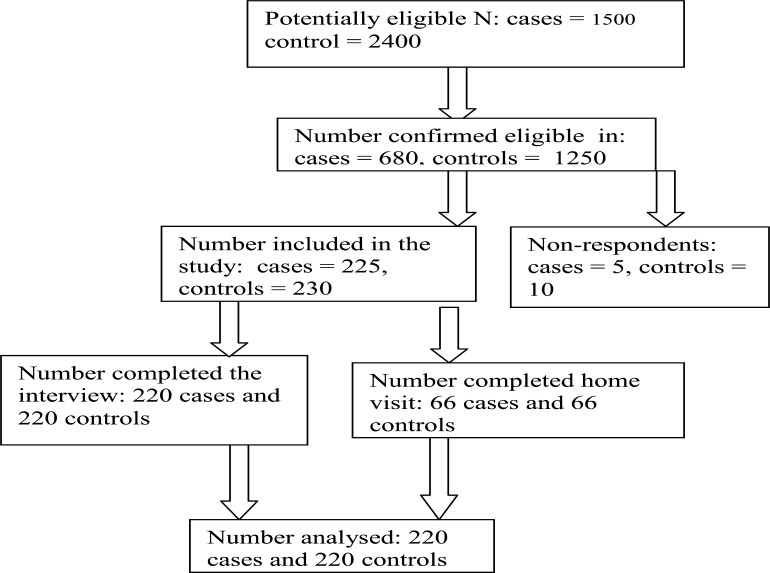
Methods: Two hundred and twenty pairs of children, matched on age, were recruited as cases and controls over a period of 5 months in Ibadan. Questionnaire and observation checklist were used to obtain information on hygiene practices from caregivers/mothers and sanitation conditions in the households of 30% of the consenting mothers/caregivers. Data were analysed using descriptive and inferential statistics.
Results: Caregivers/mothers' mean ages were 31.3 ±7.5 (cases) and 30.6 ±6.0(controls) years. The risk of diarrhoea was significantly higher among children whose mothers did not wash hands with soap before food preparation (OR=3.0, p<0.05), before feeding their children (OR=3.0, p<0.05) and after leaving the toilet (OR=4.7, p<0.05). Factors significantly associated with diarrhoea were: poor water handling (OR=2.0,CI=1.2-3.5), presence of clogged drainage near the house (OR=2.1,CI=1.2-3.7) and breeding places for flies (OR=2.7,CI=1.6-4.7). The mean risk score among cases and controls from the sanitary inspection of drinking water sources were 5.4 ± 2.2 and 3.2 ± 1.9 (p<0.05) and household storage containers were 2.4 ± 1.8 and 1.2 ± 0.7 (p<0.05) respectively.
Conclusion: Hygiene and sanitation conditions within households were risk factors for diarrhoea. This study revealed the feasibility of developing and implementing an adequate model to establish intervention priorities in sanitation in Ibadan, Nigeria.
Keywords: Diarrhoea; Drinking water; Hygiene Risk Factors; Sanitation; Under five children.
Similar articles
-
Environmental and personal hygiene practices: risk factors for diarrhoea among children of Nigerian market women.J Diarrhoeal Dis Res. 1998 Dec;16(4):241-7. J Diarrhoeal Dis Res. 1998. PMID: 10453121
-
Diarrhoea in children of Nigerian market women: prevalence, knowledge of causes, and management.J Diarrhoeal Dis Res. 1998 Sep;16(3):194-200. J Diarrhoeal Dis Res. 1998. PMID: 9919017
-
Infant feeding practices, socio-economic conditions and diarrhoeal disease in a traditional area of urban Ilorin, Nigeria.East Afr Med J. 1996 May;73(5):283-8. East Afr Med J. 1996. PMID: 8756027
-
Contaminated weaning food: a major risk factor for diarrhoea and associated malnutrition.Bull World Health Organ. 1993;71(1):79-92. Bull World Health Organ. 1993. PMID: 8440042 Free PMC article. Review.
-
Impact of drinking water, sanitation and handwashing with soap on childhood diarrhoeal disease: updated meta-analysis and meta-regression.Trop Med Int Health. 2018 May;23(5):508-525. doi: 10.1111/tmi.13051. Epub 2018 Apr 23. Trop Med Int Health. 2018. PMID: 29537671 Review.
Cited by
-
Individual and household risk factors of severe acute malnutrition among under-five children in Mao, Chad: a matched case-control study.Arch Public Health. 2018 Aug 1;76:35. doi: 10.1186/s13690-018-0281-5. eCollection 2018. Arch Public Health. 2018. PMID: 30083315 Free PMC article.
-
What are the drivers of recurrent cholera transmission in Nigeria? Evidence from a scoping review.BMC Public Health. 2020 Apr 3;20(1):432. doi: 10.1186/s12889-020-08521-y. BMC Public Health. 2020. PMID: 32245445 Free PMC article.
-
Association between socioeconomic status of mothers, food security, food safety practices and the double burden of malnutrition in the Lalitpur district, Nepal.Arch Public Health. 2016 Sep 13;74(1):35. doi: 10.1186/s13690-016-0150-z. eCollection 2016. Arch Public Health. 2016. PMID: 27625786 Free PMC article.
-
Improved Water and Waste Management Practices Reduce Diarrhea Risk in Children under Age Five in Rural Tanzania: A Community-Based, Cross-Sectional Analysis.Int J Environ Res Public Health. 2022 Apr 1;19(7):4218. doi: 10.3390/ijerph19074218. Int J Environ Res Public Health. 2022. PMID: 35409904 Free PMC article.
-
Hygiene practice and diarrhea prevalence among underfive children in Myanmar: a cross-sectional study.BMC Pediatr. 2024 Oct 23;24(1):675. doi: 10.1186/s12887-024-05158-3. BMC Pediatr. 2024. PMID: 39443847 Free PMC article.
References
-
- WHO, author. Reducing mortality from major childhood killer diseases. Mortality Country Fact Sheet. 2006. https://apps.who.int/chd/publications/imci/fs_180.htm.
-
- UNICEF Nigeria, author. The children-Maternal and child health. http://www.unicef.org/nigeria/children1926.html.
-
- Igomu T. cholera epidemic: far from being over. NBF News. www.nigerianbestforum.com/blog/?p=60321.
-
- Gyoh SK. Cholera epidemics in Nigeria: an indictment of the shameful neglect of government. Africa Health. 2011;33(1):5.
MeSH terms
Substances
LinkOut - more resources
Full Text Sources
Other Literature Sources
Medical