Review
. 2015:2015:610813.
doi: 10.1155/2015/610813. Epub 2015 Mar 5.

Interrelation of oxidative stress and inflammation in neurodegenerative disease: role of TNF

Affiliations
Review

Interrelation of oxidative stress and inflammation in neurodegenerative disease: role of TNF

Roman Fischer et al. Oxid Med Cell Longev. 2015.

Abstract

Neuroinflammation and mitochondrial dysfunction are common features of chronic neurodegenerative diseases of the central nervous system. Both conditions can lead to increased oxidative stress by excessive release of harmful reactive oxygen and nitrogen species (ROS and RNS), which further promote neuronal damage and subsequent inflammation resulting in a feed-forward loop of neurodegeneration. The cytokine tumor necrosis factor (TNF), a master regulator of the immune system, plays an important role in the propagation of inflammation due to the activation and recruitment of immune cells via its receptor TNF receptor 1 (TNFR1). Moreover, TNFR1 can directly induce oxidative stress by the activation of ROS and RNS producing enzymes. Both TNF-induced oxidative stress and inflammation interact and cooperate to promote neurodegeneration. However, TNF plays a dual role in neurodegenerative disease, since stimulation via its second receptor, TNFR2, is neuroprotective and promotes tissue regeneration. Here we review the interrelation of oxidative stress and inflammation in the two major chronic neurodegenerative diseases, Alzheimer's and Parkinson's disease, and discuss the dual role of TNF in promoting neurodegeneration and tissue regeneration via its two receptors.


Figures
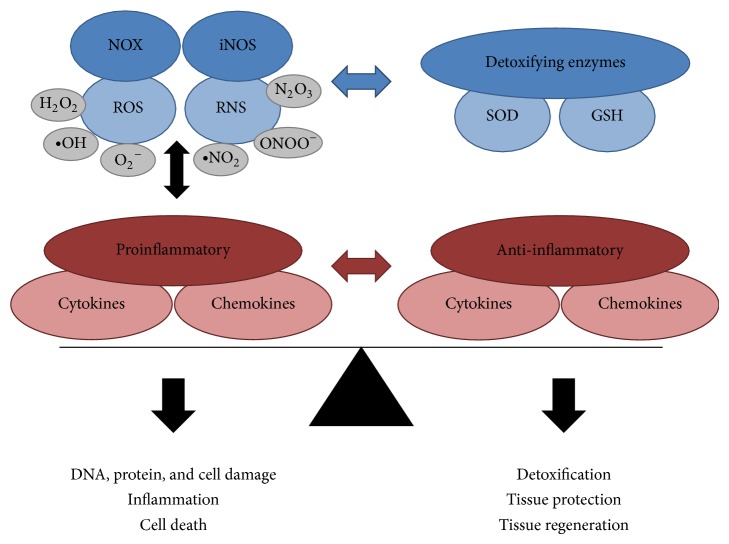
Figure 1
Figure 1
Balance between mediators of oxidative stress/inflammation and antioxidants/anti-inflammatory mediators. In a healthy organism mediators of oxidative stress and inflammation are in balance with the counteracting detoxifying and anti-inflammatory molecules. During disease this balance is shifted towards the oxidative stress and proinflammatory site, leading to DNA and protein damage, inflammation, and finally cell death.
Figure 2
Figure 2
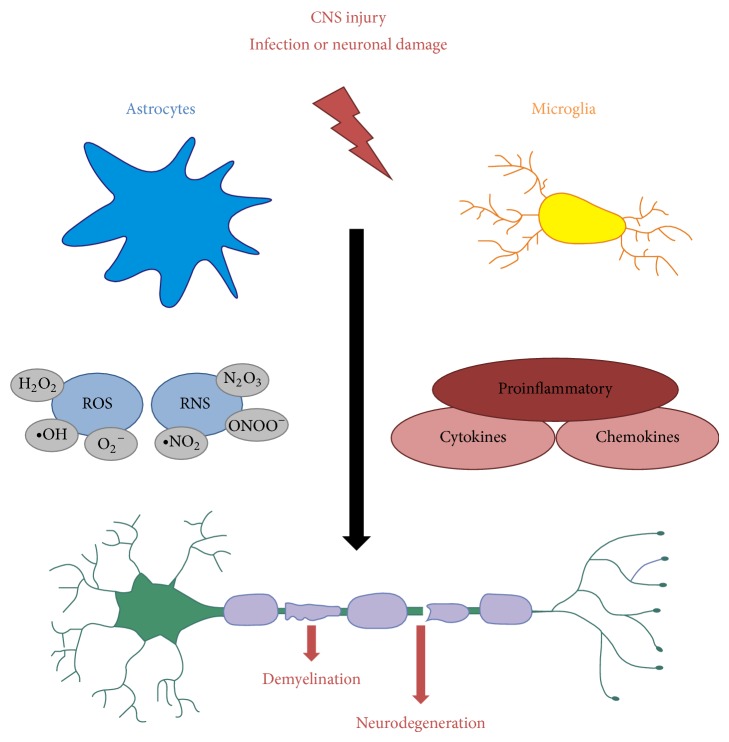
Schematic presentation of the CNS cell mediated demyelination and neurodegeneration. CNS injury, for example, during infection or due to neuronal damage, leads to the activation of astrocytes and microglia. This induces the secretion of ROS, RNS, and proinflammatory cytokines and chemokines. These factors then can promote demyelination and axonal damage, finally leading to neurodegeneration.
Figure 3
Figure 3
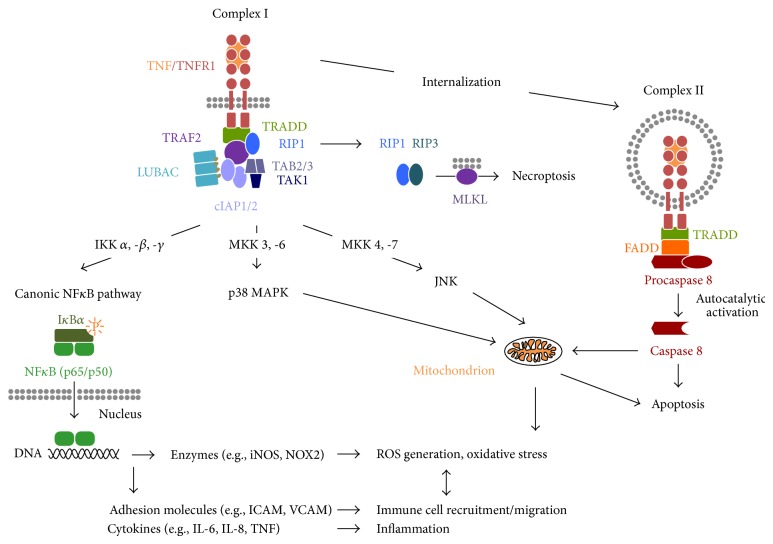
Schematic illustration of the major TNFR1-mediated signaling pathways. After binding of TNF to TNFR1 the signaling complex I is formed in the plasma membrane consisting of TRADD, RIP1, TRAF2, and cIAP1/2 and the protein complexes TAB2/TAB3/TAK1 and LUBAC. This complex I mediates the activation of the NFκB pathway via activation of the IKK complex resulting in phosphorylation and degradation of IκB and translocation of NFκB to the nucleus. NFκB binding to the DNA can then, for example, induce expression of proinflammatory cytokines, cell adhesion molecules, and ROS generating enzymes. Moreover, complex I can induce, via distinct MAP kinase kinases (MKK), the activation of the stress-activated kinases p38 MAPK and JNK, which can both induce gene transcription (not shown). In the cytosol, sustained activation of p38 and JNK can induce cell death via apoptosis. After TNFR1 internalization, a distinct signaling complex II is formed consisting of TRADD, FADD, and the procaspase 8. After autoproteolytic activation caspase 8 can cleave RIP1 and RIP3, which is followed by the induction of apoptosis either directly or by targeting the mitochondrion. If caspase 8 activity is insufficient, RIP1 and RIP3 can induce the alternative cell death program of necroptosis via their kinase activities. Here, a central step is the phosphorylation of MLKL by RIP3.
Figure 4
Figure 4
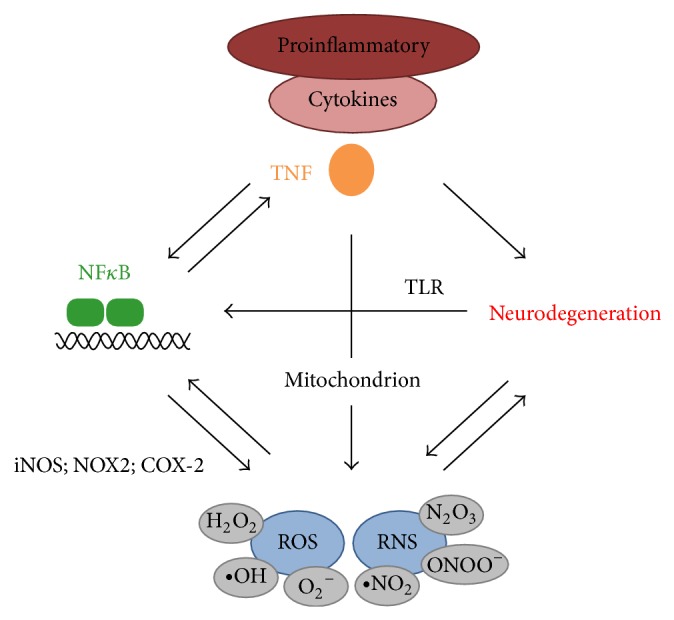
Interrelation of ROS and inflammatory cytokines in neurodegeneration. An initial neuronal damage can promote inflammation by activating the canonical NFκB pathway in glia cells via TLR activation resulting in the expression of proinflammatory cytokines and generation of ROS/RNS. Proinflammatory cytokines, in particular TNF, can promote neurodegeneration by further activating NFκB in glia cells, but also by damaging mitochondria in neurons resulting in increased ROS formation or by directly inducing neuronal cell death. ROS can further activate NFκB signaling in glia cells thereby promoting a sustained proinflammatory response. In addition, excess ROS/RNS formation by mitochondrial damage or by activated microglia and astrocytes can exacerbate neurodegeneration by damaging DNA, proteins, and membranes. Moreover, altered neuronal proteins, such as Aβ and α-synuclein, can promote ROS formation, for example, by impairing mitochondrial function. This interrelation of ROS promoting inflammation and TNF promoting ROS production can, when uncontrolled, ultimately result in chronic neurodegeneration.

References

    1. Azevedo F. A. C., Carvalho L. R. B., Grinberg L. T., et al. Equal numbers of neuronal and nonneuronal cells make the human brain an isometrically scaled-up primate brain. Journal of Comparative Neurology. 2009;513(5):532–541. doi: 10.1002/cne.21974. - DOI - PubMed
    1. Amor S., Puentes F., Baker D., van der Valk P. Inflammation in neurodegenerative diseases. Immunology. 2010;129(2):154–169. doi: 10.1111/j.1365-2567.2009.03225.x. - DOI - PMC - PubMed
    1. Yong V. W. Inflammation in neurological disorders: a help or a hindrance? The Neuroscientist. 2010;16(4):408–420. doi: 10.1177/1073858410371379. - DOI - PubMed
    1. Perry V. H., Cunningham C., Holmes C. Systemic infections and inflammation affect chronic neurodegeneration. Nature Reviews Immunology. 2007;7(2):161–167. doi: 10.1038/nri2015. - DOI - PubMed
    1. Holmes C., Cunningham C., Zotova E., et al. Systemic inflammation and disease progression in Alzheimer disease. Neurology. 2009;73(10):768–774. doi: 10.1212/WNL.0b013e3181b6bb95. - DOI - PMC - PubMed

MeSH terms

Substances