. 2015 Mar 26:3:e851.
doi: 10.7717/peerj.851. eCollection 2015.

Autonomous Sensory Meridian Response (ASMR): a flow-like mental state

Affiliations

Autonomous Sensory Meridian Response (ASMR): a flow-like mental state

Emma L Barratt et al. PeerJ. .

Abstract

Autonomous Sensory Meridian Response (ASMR) is a previously unstudied sensory phenomenon, in which individuals experience a tingling, static-like sensation across the scalp, back of the neck and at times further areas in response to specific triggering audio and visual stimuli. This sensation is widely reported to be accompanied by feelings of relaxation and well-being. The current study identifies several common triggers used to achieve ASMR, including whispering, personal attention, crisp sounds and slow movements. Data obtained also illustrates temporary improvements in symptoms of depression and chronic pain in those who engage in ASMR. A high prevalence of synaesthesia (5.9%) within the sample suggests a possible link between ASMR and synaesthesia, similar to that of misophonia. Links between number of effective triggers and heightened flow state suggest that flow may be necessary to achieve sensations associated with ASMR.

Keywords: ASMR; Autonomous sensory meridian response; Chronic pain; Depression; Flow state; Meditation; Mindfulness; Misophonia; Synaesthesia; Synesthesia.


Conflict of interest statement

The authors declare there are no competing interests.

Figures
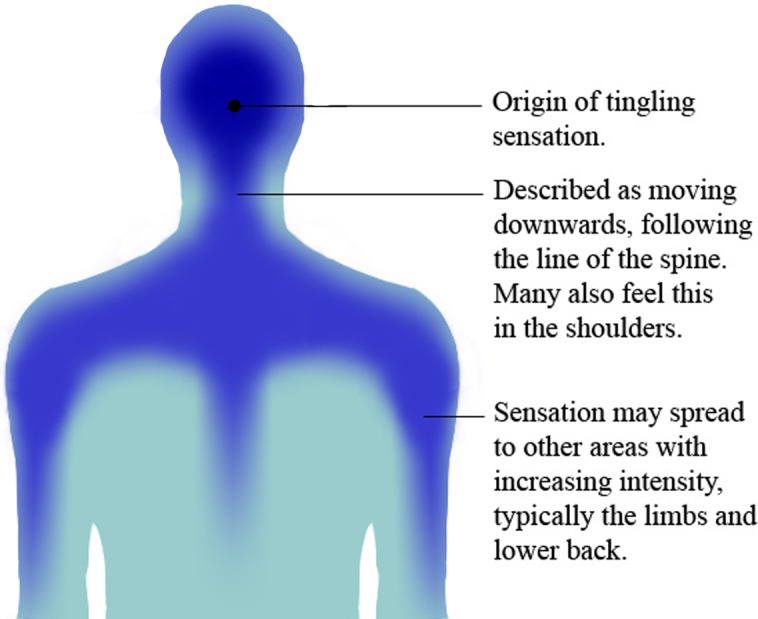
Figure 1
Figure 1. ASMR Map.
An illustration of the route of ASMR’s tingling sensation. Image shows rear view of the head and upper torso. Capable individuals typically experience the sensation as originating at the back of the head, spreading across the scalp and down the back of the neck. Half of participants reported that this sensation typically spreads to the shoulders and back with increasing intensity. Though this diagram represents the most common areas involved in the tingling sensation, there is a huge amount of individual variation in where tingles spread to with increased intensity, with legs and arms also commonly reported as hotspots in some individuals.
Figure 2
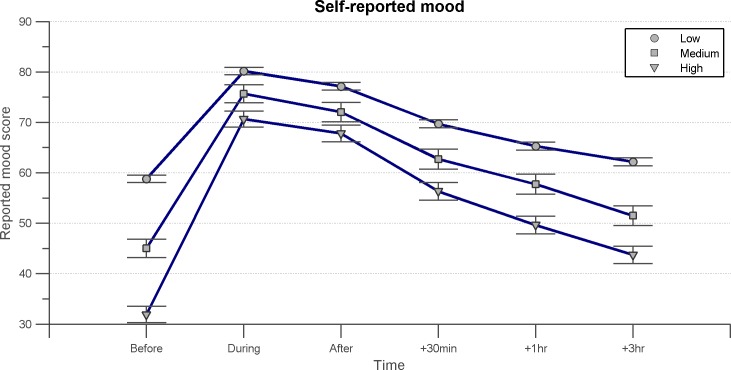
Figure 2. BDI graph.
The time course of mood before, during, immediately following, and several hours after engaging in ASMR. Data shown is the mean mood score given to each time frame by all participants (N = 475), with participants grouped according to their Beck Depression Index. Mood scores could range from 0 to 100, 0 representing the worst the individual had ever felt, 100 representing the best they have ever felt. Error bars represent ±1 standard error.
Figure 3
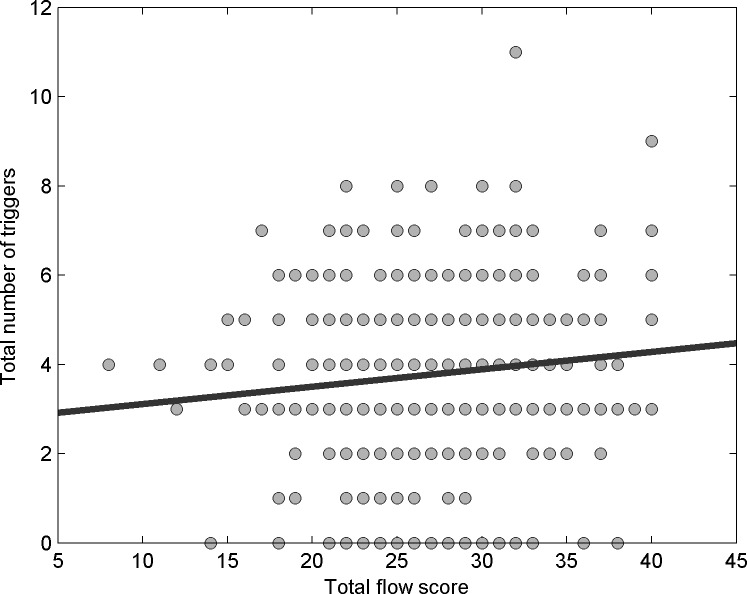
Figure 3. Flow and Triggers figure.
Relationship between participants’ susceptibility to the flow state (expressed as a sum of the scores on the modified Flow State Scale) and the number of triggers of the ASMR state.

References

    1. Asher JE, Aitken MR, Farooqi N, Kurmani S, Baron-Cohen S. Diagnosing and phenotyping visual synaesthesia: a preliminary evaluation of the revised test of genuineness (TOG-R) Cortex. 2006;42(2):137–146. doi: 10.1016/S0010-9452(08)70337-X. - DOI - PubMed
    1. Banissy MJ, Jonas C, Kadosh RC. Synesthesia: an introduction. Frontiers in Psychology. 2014;5:e851. doi: 10.3389/fpsyg.2014.01414. - DOI - PMC - PubMed
    1. Beck AT, Epstein N, Brown G, Steer RA. An inventory for measuring clinical anxiety: psychometric properties. Journal of Consulting and Clinical Psychology. 1988;56(6):893. doi: 10.1037/0022-006X.56.6.893. - DOI - PubMed
    1. Beck AT, Steer RA, Brown GK. Manual for the beck depression inventory-II. San Antonio: Psychological Corporation; 1996.
    1. Csikszentmihalyi M, Csikzentmihaly M. Flow: the psychology of optimal experience. New York: HarperPerennial; 1991.

LinkOut - more resources