Review
. 2015:2015:167283.
doi: 10.1155/2015/167283. Epub 2015 Mar 5.

Regulation of hyaluronan synthesis in vascular diseases and diabetes

Affiliations
Review

Regulation of hyaluronan synthesis in vascular diseases and diabetes

Paola Moretto et al. J Diabetes Res. 2015.

Abstract

Cell microenvironment has a critical role determining cell fate and modulating cell responses to injuries. Hyaluronan (HA) is a ubiquitous extracellular matrix glycosaminoglycan that can be considered a signaling molecule. In fact, interacting with several cell surface receptors can deeply shape cell behavior. In vascular biology, HA triggers smooth muscle cells (SMCs) dedifferentiation which contributes to vessel wall thickening. Furthermore, HA is able to modulate inflammation by altering the adhesive properties of endothelial cells. In hyperglycemic conditions, HA accumulates in vessels and can contribute to the diabetic complications at micro- and macrovasculature. Due to the pivotal role in favoring atherogenesis and neointima formation after injuries, HA could be a new target for cardiovascular pathologies. This review will focus on the recent findings regarding the regulation of HA synthesis in human vascular SMCs. In particular, the effects of the intracellular HA substrates availability, adenosine monophosphate-activated protein kinase (AMPK), and protein O-GlcNAcylation on the main HA synthetic enzyme (i.e., HAS2) will be discussed.


Figures
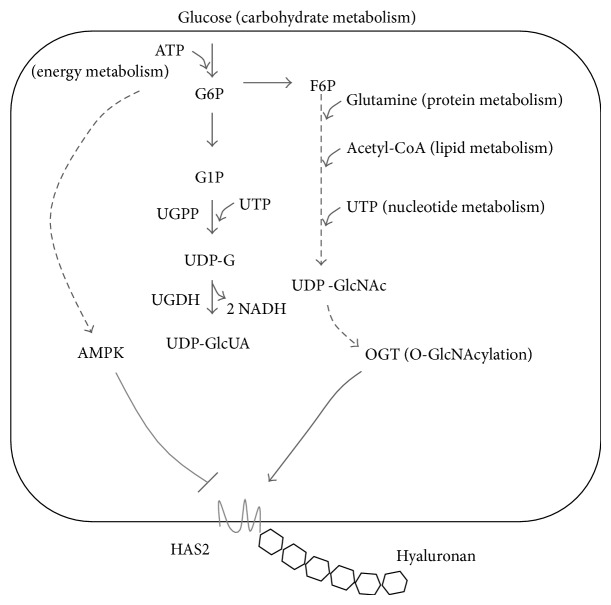
Figure 1
Figure 1
HA precursors biosynthesis and main HAS2 regulation in SMCs. Glucose enters in the cells and is phosphorylated by ATP. Glucose 6 phosphate (G6P) can be converted into glucose 1 phosphate (G1P), UDP-glucose (UDP-G), and UDP-glucuronic acid (UDP-GlcUA) by the enzymatic reactions catalyzed by UDP-G pyrophosphorylase (UGPP) and UDP-G dehydrogenase (UGDH). This latter reaction produces 2 NADH. G6P can enter in the hexosamine biosynthetic pathway, which starts from fructose 6 phosphate (F6P) and, in several steps, produces UDP-N-acetylglucosamine (UDP-GlcNAc). These steps depend on carbohydrates, energy, proteins, lipids, and nucleotides metabolisms making UDP-GlcNAc a master nutrient sensor. AMPK in condition of ATP depletion (or activation by metformin) inhibits HAS2 by threonine 110 phosphorylation. An increment of UDP-GlcNAc induces O-GlcNAcylation of serine 221 of HAS2 by OGT. This glycosylation strongly stabilizes HAS2 protein avoiding its degradation.
Figure 2
Figure 2
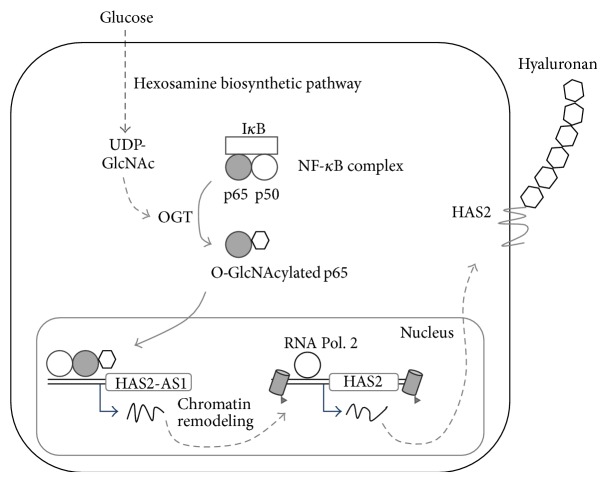
Nuclear control of HAS2 transcription by O-GlcNAcylation. In condition of glucose abundance, OGT modifies p65 by means of O-GlcNAcylation. Glycosylated p65 induces the transcription of HAS2-AS1 that, in turn, enhances HAS2 transcription. The mechanism through which HAS2-AS1 drives HAS2 transcription is complex and partially unknown. Natural antisense RNA can bind enzymes involved in epigenetic modifications. Recent evidences highlight that HAS2-AS1 is able to open chromatin structure around HAS2 promoter enhancing RNA polymerase 2 and other factors accessibility.

References

    1. Roger V. L., Go A. S., Lloyd-Jones D. M., et al. Heart disease and stroke statistics—2012 update: a report from the American Heart Association. Circulation. 2012;125(1):e2–e220. - PMC - PubMed
    1. Brownlee M. Biochemistry and molecular cell biology of diabetic complications. Nature. 2001;414(6865):813–820. doi: 10.1038/414813a. - DOI - PubMed
    1. Nigro J., Osman N., Dart A. M., Little P. J. Insulin resistance and atherosclerosis. Endocrine Reviews. 2006;27(3):242–259. doi: 10.1210/er.2005-0007. - DOI - PubMed
    1. Davis G. E., Senger D. R. Endothelial extracellular matrix: biosynthesis, remodeling, and functions during vascular morphogenesis and neovessel stabilization. Circulation Research. 2005;97(11):1093–1107. doi: 10.1161/01.res.0000191547.64391.e3. - DOI - PubMed
    1. Ross R. Atherosclerosis—an inflammatory disease. The New England Journal of Medicine. 1999;340(2):115–126. doi: 10.1056/nejm199901143400207. - DOI - PubMed

LinkOut - more resources