


Interactive multimedia consent for biobanking: a randomized trial
- PMID: 25834945
- PMCID: PMC4592360
- DOI: 10.1038/gim.2015.33
Interactive multimedia consent for biobanking: a randomized trial
Abstract
Purpose: The potential of interactive multimedia to improve biobank informed consent has yet to be investigated. The aim of this study was to test the separate effectiveness of interactivity and multimedia at improving participant understanding and confidence in understanding of informed consent compared with a standard, face-to-face (F2F) biobank consent process.
Methods: A 2 (face-to-face versus multimedia) × 2 (standard versus enhanced interactivity) experimental design was used with 200 patients randomly assigned to receive informed consent. All patients received the same information provided in the biobank's nine-page consent document.
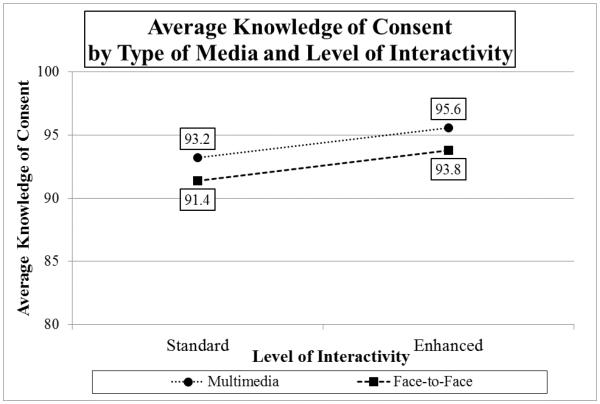
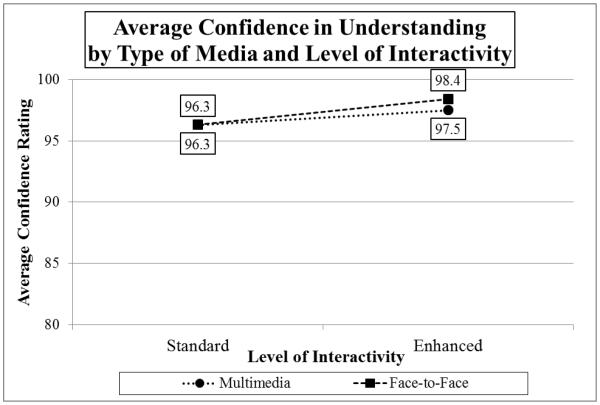
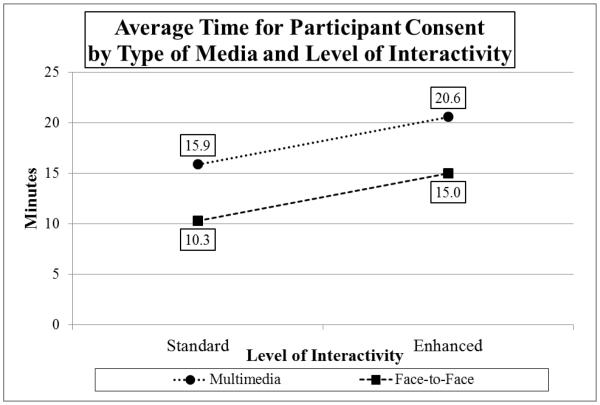
Results: Interactivity (F(1,196) = 7.56, P = 0.007, partial η(2) = 0.037) and media (F(1,196) = 4.27, P = 0.04, partial η(2) = 0.021) independently improved participants' understanding of the biobank consent. Interactivity (F(1,196) = 6.793, P = 0.01, partial η(2) = 0.033), but not media (F(1,196) = 0.455, not significant), resulted in increased participant confidence in their understanding of the biobank's consent materials. Patients took more time to complete the multimedia condition (mean = 18.2 min) than the face-to-face condition (mean = 12.6 min).
Conclusion: This study demonstrated that interactivity and multimedia each can be effective at promoting an individual's understanding and confidence in their understanding of a biobank consent, albeit with additional time investment. Researchers should not assume that multimedia is inherently interactive, but rather should separate the two constructs when studying electronic consent.
Figures
References
-
- Simon CM, Klein DW, Schartz HA. Traditional and electronic informed consent for biobanking: A survey of U.S. biobanks. Biopreserv Biobank. In press. - PubMed
-
- Simeon-Dubach D, Watson P. Biobanking 3.0: evidence based and customer focused biobanking. Clin Biochem. 2014;47:300–308. - PubMed
-
- Ahmed FE. Biobanking perspective on challenges in sample handling, collection, processing, storage, analysis and retrieval for genomics, transcriptomics and proteomics data. Anal Methods. 2011;3:1029–1038.
Publication types
MeSH terms
Grants and funding
LinkOut - more resources
Full Text Sources
Other Literature Sources
