Endovascular management of iatrogenic renal arterial lesions and clinical outcomes
- PMID: 25835080
- PMCID: PMC4463263
- DOI: 10.5152/dir.2014.14286
Endovascular management of iatrogenic renal arterial lesions and clinical outcomes
Abstract
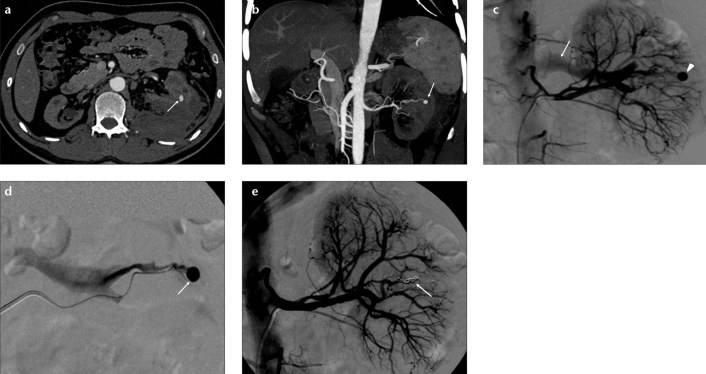
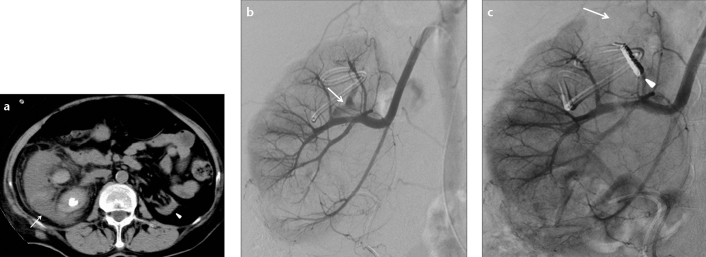
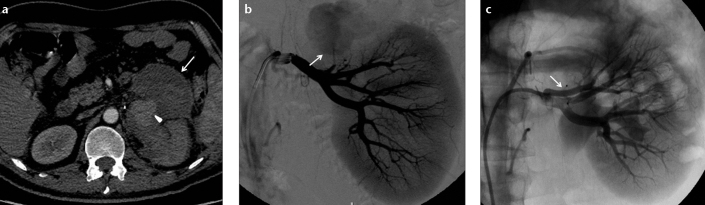
Purpose: We aimed to evaluate iatrogenic renal arterial lesions, including pseudoaneurysm, arteriovenous fistula, and arteriocaliceal fistula, their management by endovascular embolization, and the clinical results.
Methods: Fifty-five patients (forty males, fifteen females) with a median age of 40 years (range, 8-85 years), who underwent endovascular embolization of iatrogenic renal arterial lesions between March 2003 and December 2013 were included in this retrospective study. Types of iatrogenic lesions and details of embolization procedures were reported. Estimated glomerular filtration rate (eGFR), renal function tests, hemoglobin, and hematocrit levels before and after embolization were recorded and compared.
Results: Median follow-up was 24 months. We identified 53 pseudoaneurysms, 30 arteriovenous fistulas, and 11 arteriocaliceal fistulas in 55 patients, after percutaneous nephrolithotomy (n=26), renal biopsy (n=21), nephrostomy (n=3), renal surgery (n=3), and extracorporeal shock wave lithotripsy (n=2). Median number of pseudoaneurysms was 1 (range, 1-4) with a median size of 7 mm (range, 1.5-35 mm). Fifty-one patients underwent coil embolization. Median number of coils was 5 (range, 2-21) and median renal parenchymal loss was 5% (range, 1%-50%). There were no significant differences between pre- and postoperative eGFR and serum parameters.
Conclusion: Iatrogenic renal arterial lesion can be a life threatening condition. Superselective coil embolization is a safe, minimally invasive treatment option with minimal renal parenchymal loss and without significant change in renal function.
Figures
References
-
- Hyams ES, Pierorazio P, Proteek O, et al. Iatrogenic vascular lesions after minimally invasive partial nephrectomy: a multi-institutional study of clinical and renal functional outcomes. Urology. 2011;78:820–826. http://dx.doi.org/10.1016/j.urology.2011.04.063. - DOI - PubMed
-
- Inci K, Cil B, Yazici S, et al. Renal artery pseudoaneurysm: complication of minimally invasive kidney surgery. J Endourol. 2010;24:149–154. http://dx.doi.org/10.1089/end.2009.0342. - DOI - PubMed
-
- Singh D, Gill IS. Renal artery pseudoaneurysm following laparoscopic partial nephrectomy. J Urol. 2005;174:2256–2259. http://dx.doi.org/10.1097/01.ju.0000181827.49239.8e. - DOI - PubMed
-
- Albani JM, Novick AC. Renal artery pseudoaneurysm after partial nephrectomy: three case reports and a literature review. Urology. 2003;62:227–231. http://dx.doi.org/10.1016/S0090-4295(03)00364-9. - DOI - PubMed
-
- Van Poppel H, Bamelis B, Oyen R, Baert L. Partial nephrectomy for renal cell carcinoma can achieve long-term tumor control. J Urol. 1998;160:674–678. http://dx.doi.org/10.1097/00005392-199809010-00007. - DOI - PubMed
MeSH terms
LinkOut - more resources
Full Text Sources
Other Literature Sources
Research Materials
Miscellaneous