Review
. 2015 May;19(5):259-67.
doi: 10.1016/j.tics.2015.02.009. Epub 2015 Mar 30.

The slow forgetting of emotional episodic memories: an emotional binding account

Affiliations
Review

The slow forgetting of emotional episodic memories: an emotional binding account

Andrew P Yonelinas et al. Trends Cogn Sci. 2015 May.

Abstract

Emotional events are remembered better than neutral events, and this emotion advantage becomes particularly pronounced over time. The time-dependent effects of emotion impact upon recollection rather than on familiarity-based recognition, and they influence the recollection of item-specific details rather than contextual details. Moreover, the amygdala, but not the hippocampus, is crucial for producing these effects. Time-dependent effects of emotion have been attributed to an emotional consolidation process whereby the amygdala gradually facilitates the storage of emotional memories by other medial temporal lobe regions. However, we propose that these effects can be better understood by an emotional binding account whereby the amygdala mediates the recollection of item-emotion bindings that are forgotten more slowly than item-context bindings supported by the hippocampus.

Keywords: emotional memory; medial temporal lobes.


Figures

Figure 1
Figure 1
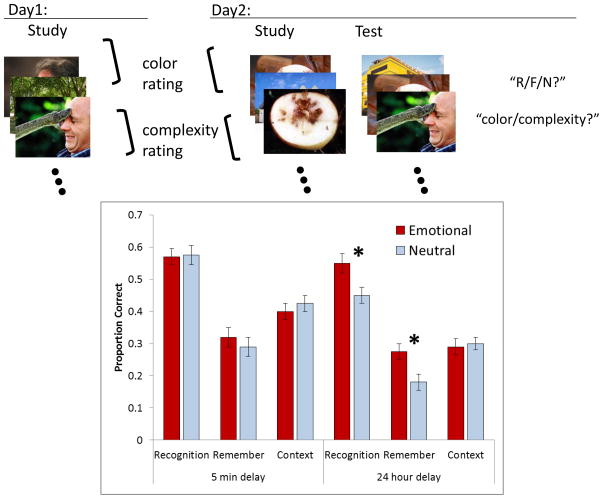
Procedures and results from [8]. A) On day 1, subjects studied a mixture of negative and neutral images, half while rating visual complexity and half while rating the range of colors used in each image. On day 2, subjects studied a second list of images under similar encoding conditions, then after a 5 minute delay they received a recognition memory test containing a mixture of old items from both days and new items. For each test item subjects indicated if they could remember the occurrence of the item (“R”), if they just knew it was studied on the basis of familiarity in the absence of recollection (“F”), or if they thought it was new (“N”). In addition, they indicated whether the item was encoded in the context of the color or complexity rating task. B) The proportions of correct recognition responses are plotted for emotional and neutral materials for items tested after the 5 minute retention interval and the 24 hour retention interval. Item recognition was greater for emotional than neutral materials, but only after the longer retention interval, and this effect was due to the relative increase in remember responses. In contrast, memory for the study context task was not influenced by emotion in either delay condition.
Figure 2
Figure 2
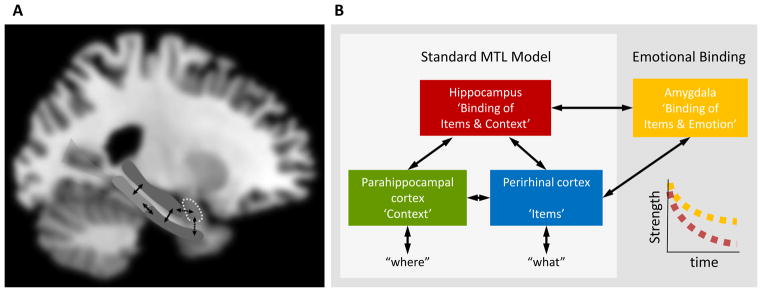
A) The medial temporal lobe (MTL) regions involved in episodic memory. B) Overview of the standard model of MTL function and the emotional binding model. In the standard model, the perirhinal cortex receives projections from the ventral ‘what’ stream and is thought to play a role in identifying and processing of the items and objects in the environment. The parahippocampal cortex receives projections from the dorsal ‘where’ stream and is thought to play a role in processing contextual information such as the ongoing spatial and temporal context. The hippocampus receives information from the perirhinal and parahippocampal cortex via entorhinal projections and binds the item and context information together to form episodic memories. The emotional binding model subsumes the standard MTL model, but in addition assumes that the amygdala forms item-emotion bindings that are forgotten more slowly than the item-context bindings supported by the hippocampus.

References

    1. Hamann S. Cognitive and neural mechanisms of emotional memory. Trends in Cognitive Sciences. 2001;5:394–400. - PubMed
    1. LaBar KS, Cabeza R. Cognitive neuroscience of emotional memory. Nature Reviews Neuroscience. 2006;7:54–64. - PubMed
    1. Phelps EA. Human emotion and memory: interactions of the amygdala and hippocampal complex. Current Opinion in Neurobiology. 2004;14:198–202. - PubMed
    1. Talmi D. Enhanced emotional memory: Cognitive and neural mechanisms (vol 22, pg 430, 2013) Current Directions in Psychological Science. 2014;23:83–83.
    1. Kleinsmith LJ, Kaplan S. Paired-associate learning as a function of arousal and interpolated interval. Journal of Experimental Psychology. 1963;65:190–193. - PubMed