Incidence and clinical characteristics of pulmonary hypertension in patients with idiopathic pulmonary fibrosis
- PMID: 25836609
- PMCID: PMC4834005
- DOI: 10.4103/0366-6999.154284
Incidence and clinical characteristics of pulmonary hypertension in patients with idiopathic pulmonary fibrosis
Abstract
Background: Pulmonary hypertension (PH) frequently complicates the course of idiopathic pulmonary fibrosis (IPF) patients and is associated with significantly worse outcomes. The aim of the present study was to investigate the incidence of PH in IPF patients and evaluate the correlation between clinical parameters and systolic pulmonary artery pressure (sPAP).
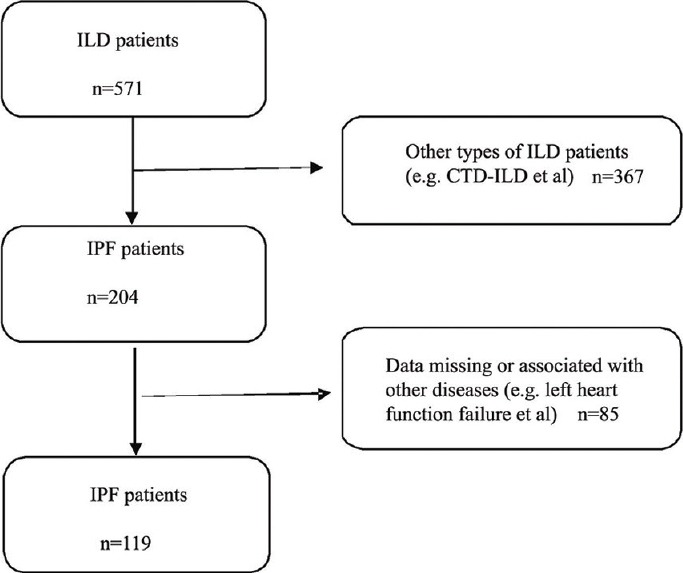
Methods: Hospitalized patients with IPF, who were evaluated for sPAP by Doppler echocardiography from January 2004 to December 2011, were enrolled in our study. Patients were defined as PH by an estimated sPAP > 50 mmHg and graded as PH likely, PH possible and PH unlikely, based on the 2009 European Society of Cardiology/European Respiratory Society PH Guidelines. The correlations between clinical parameters and sPAP were analyzed by multiple linear regression.
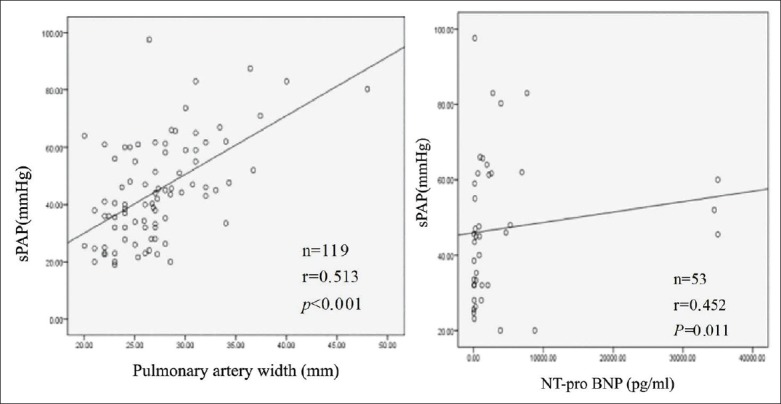
Results: Totally, 119 IPF patients were enrolled in our study and 28 (23.5%), 20 (16.8%) and 71 (59.7%) patients were PH likely, PH possible and PH unlikely, respectively. Borg dyspnea score was positively correlated with sPAP, r = 0.467, P < 0.001. Oxygen saturation was negatively correlated with sPAP, r = -0.416, P < 0.001. Diffusing capacity of the lung for carbon monoxide percentage predicted was negatively correlated with sPAP, r = -0.424, P = 0.003. N-terminal fragment of pro-brain natriuretic peptide and pulmonary artery width was positively correlated with sPAP, r = 0.452, P = 0.011 and r = 0.513, P < 0.001, respectively.
Conclusions: The incidence of PH in IPF patients was 23.5% in a single center of China. PH may worsen the dyspnea, right heart dysfunction and decrease the life quality of the patients with IPF.
Conflict of interest statement
Figures
References
-
- Nadrous HF, Pellikka PA, Krowka MJ, Swanson KL, Chaowalit N, Decker PA, et al. Pulmonary hypertension in patients with idiopathic pulmonary fibrosis. Chest. 2005;128:2393–9. - PubMed
-
- Lettieri CJ, Nathan SD, Barnett SD, Ahmad S, Shorr AF. Prevalence and outcomes of pulmonary arterial hypertension in advanced idiopathic pulmonary fibrosis. Chest. 2006;129:746–52. - PubMed
-
- Hamada K, Nagai S, Tanaka S, Handa T, Shigematsu M, Nagao T, et al. Significance of pulmonary arterial pressure and diffusion capacity of the lung as prognosticator in patients with idiopathic pulmonary fibrosis. Chest. 2007;131:650–6. - PubMed
Publication types
MeSH terms
Substances
LinkOut - more resources
Full Text Sources
Other Literature Sources
Medical