


Obesity Early in Adulthood Increases Risk but Does Not Affect Outcomes of Hepatocellular Carcinoma
- PMID: 25836985
- PMCID: PMC4778392
- DOI: 10.1053/j.gastro.2015.03.044
Obesity Early in Adulthood Increases Risk but Does Not Affect Outcomes of Hepatocellular Carcinoma
Abstract
Background & aims: Despite the significant association between obesity and several cancers, it has been difficult to establish an association between obesity and hepatocellular carcinoma (HCC). Patients with HCC often have ascites, making it a challenge to determine body mass index (BMI) accurately, and many factors contribute to the development of HCC. We performed a case-control study to investigate whether obesity early in adulthood affects risk, age of onset, or outcomes of patients with HCC.
Methods: We interviewed 622 patients newly diagnosed with HCC from January 2004 through December 2013, along with 660 healthy controls (frequency-matched by age and sex) to determine weights, heights, and body sizes (self-reported) at various ages before HCC development or enrollment as controls. Multivariable logistic and Cox regression analyses were performed to determine the independent effects of early obesity on risk for HCC and patient outcomes, respectively. BMI was calculated, and patients with a BMI of 30 kg/m(2) or greater were considered obese.
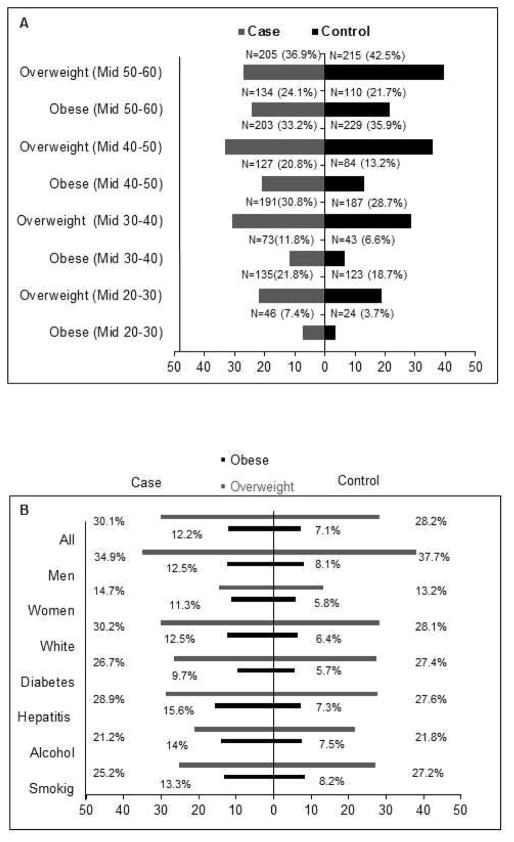
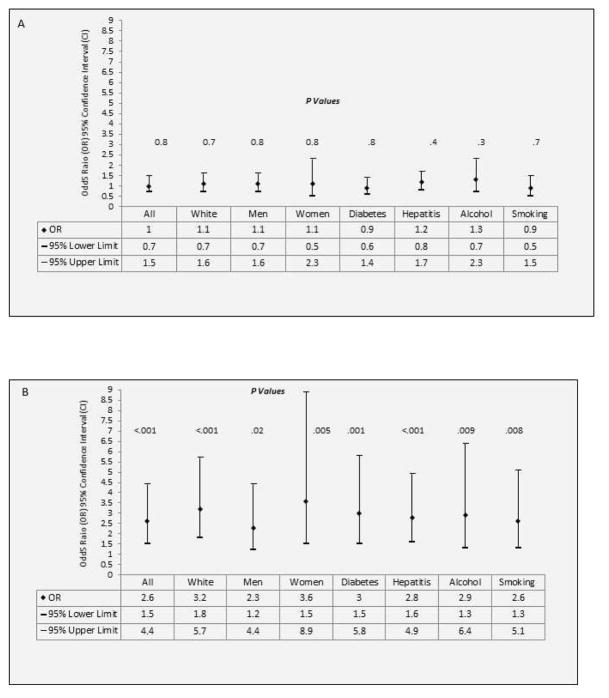
Results: Obesity in early adulthood (age, mid-20s to mid-40s) is a significant risk factor for HCC. The estimated odds ratios were 2.6 (95% confidence interval [CI], 1.4-4.4), 2.3 (95% CI, 1.2-4.4), and 3.6 (95% CI, 1.5-8.9) for the entire population, for men, and for women, respectively. Each unit increase in BMI at early adulthood was associated with a 3.89-month decrease in age at HCC diagnosis (P < .001). Moreover, there was a synergistic interaction between obesity and hepatitis virus infection. However, we found no effect of obesity on the overall survival of patients with HCC.
Conclusions: Early adulthood obesity is associated with an increased risk of developing HCC at a young age in the absence of major HCC risk factors, with no effect on outcomes of patients with HCC.
Keywords: Case-Control; HCC; Obesity; Risk Factor.
Copyright © 2015 AGA Institute. Published by Elsevier Inc. All rights reserved.
Figures
Comment in
-
Obesity and Hepatocellular Carcinoma: A Complex Relationship.Gastroenterology. 2015 Jul;149(1):18-20. doi: 10.1053/j.gastro.2015.05.024. Epub 2015 May 23. Gastroenterology. 2015. PMID: 26008860 No abstract available.
-
Central obesity early in adulthood may affect outcomes of hepatocellular carcinoma.Gastroenterology. 2015 Nov;149(6):1642-3. doi: 10.1053/j.gastro.2015.05.064. Epub 2015 Oct 1. Gastroenterology. 2015. PMID: 26432664 No abstract available.
-
Reply: To PMID 25836985.Gastroenterology. 2015 Nov;149(6):1643-4. doi: 10.1053/j.gastro.2015.09.035. Epub 2015 Oct 1. Gastroenterology. 2015. PMID: 26433110 No abstract available.
References
-
- Wild S, Roglic G, Green A, et al. Global prevalence of diabetes: estimates for the year 2000 and projections for 2030. Diabetes Care. 2004;27:1047–1053. - PubMed
-
- Venook AP, Papandreou C, Furuse J, et al. The incidence and epidemiology of hepatocellular carcinoma: a global and regional perspective. Oncologist. 2010;15 (Suppl 4):5–13. - PubMed
Publication types
MeSH terms
Grants and funding
LinkOut - more resources
Full Text Sources
Other Literature Sources
Medical
