


Review
doi: 10.1021/op400349g.
Epub 2014 Mar 11.
Late-Stage Fluorination: From Fundamentals to Application
Affiliations
- PMID: 25838756
- PMCID: PMC4372057
- DOI: 10.1021/op400349g
Item in Clipboard
Review
Late-Stage Fluorination: From Fundamentals to Application
Org Process Res Dev.
.
Abstract
In this brief account, we review work from our lab with a focus on late-stage introduction of fluorine and fluorinated functional groups into small molecules. We attempt to highlight practical developments, which we believe may have potential for industrial applications, and critically reflect on developments that may not yet meet the bar for practical use.
Figures
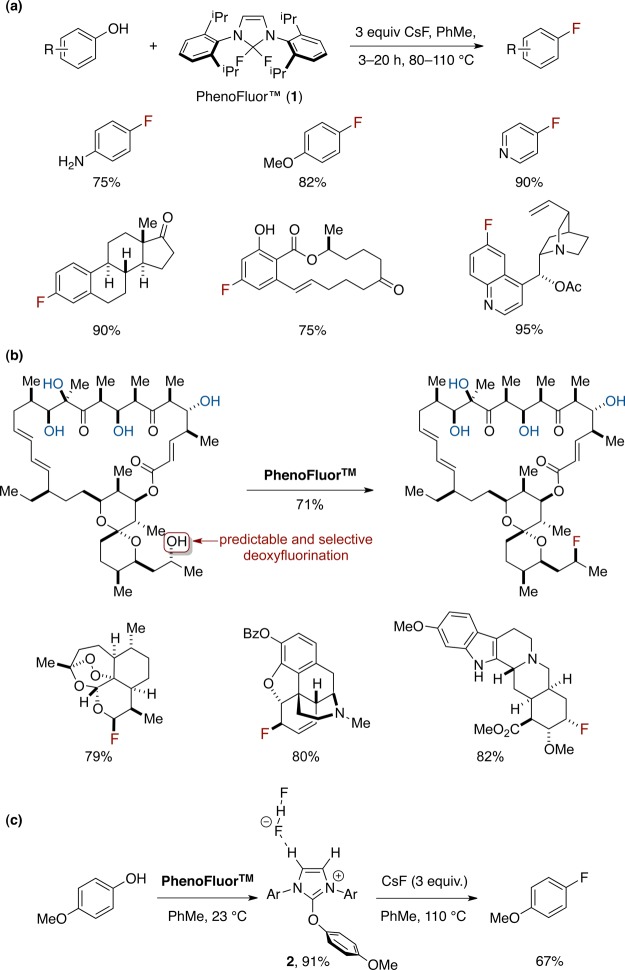
(a) Deoxyfluorination of phenols with PhenoFluor. (b) Late-stage
deoxyfluorination of complex aliphatic alcohols with PhenoFluor. (c)
Intermediate 2 observed upon treatment of phenols with
PhenoFluor, with hydrogen-bonding interaction observed via X-ray crystallography
and 1H NMR spectroscopy.
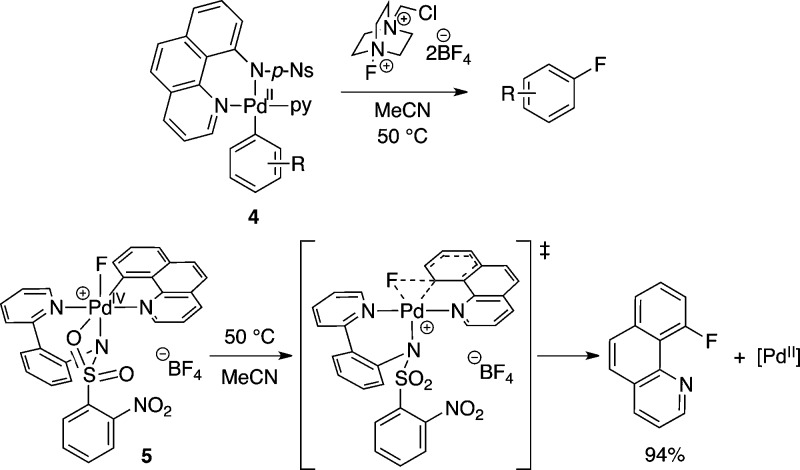
Pd-mediated electrophilic fluorination of arenes, and
well-defined C–F reductive elimination from Pd(IV) fluoride 5 featuring a hemilabile pyridyl-sulfonamide ligand to promote
reductive elimination via a five-coordinate transition state.
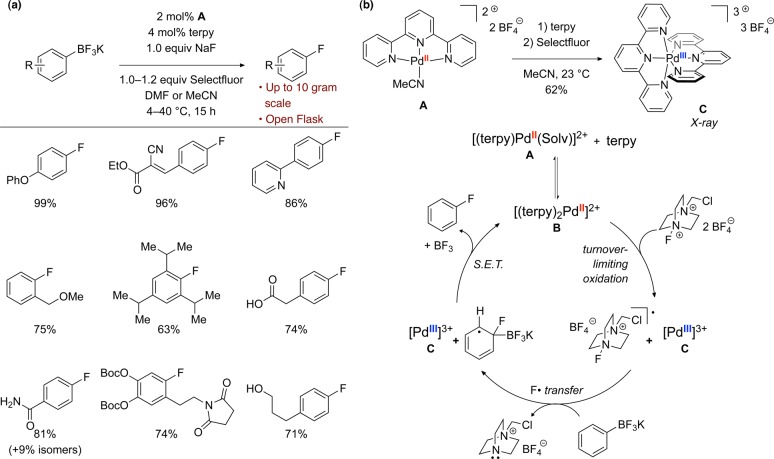
(a) Palladium-catalyzed fluorination of aryl
trifluoroborates. (b) Proposed mechanism for palladium-catalyzed fluorination,
involving a single-electron-transfer (SET) pathway and isolated Pd(III)
intermediate C.
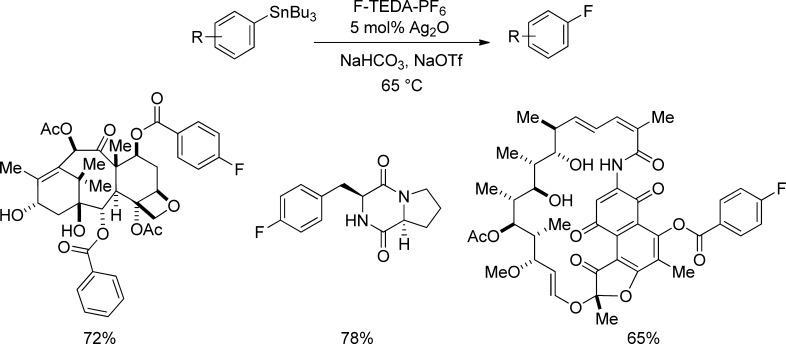
Silver-catalyzed
late-stage fluorination of complex small molecules.
(a)
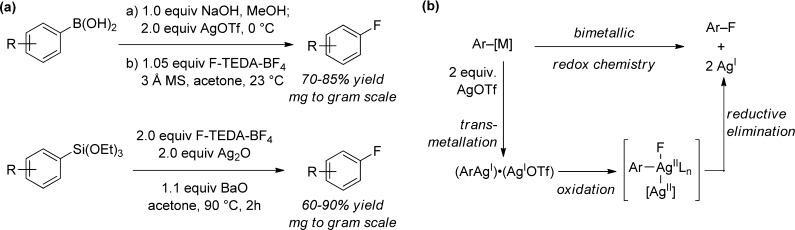
Silver-mediated fluorination of arylboronic acids and aryl silanes.
(b) Proposed bimetallic mechanism for Ag-mediated C–F bond
formation ([M] = SnBu3, B(OH)2, Si(OEt)3).

C–18F bond formation for 18F-PET tracer synthesis via two-step 18F– capture/transfer sequence.
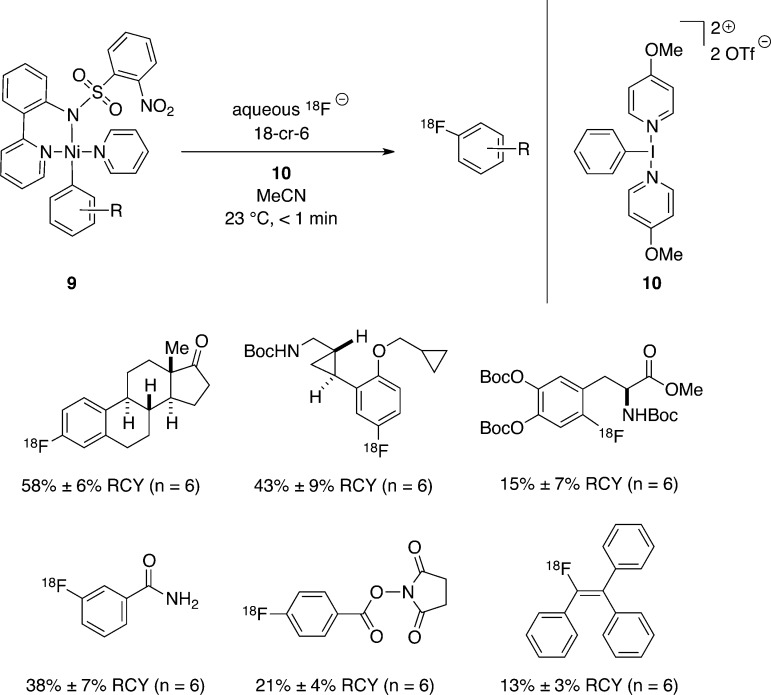
One-step Ni-mediated
C–18F bond formation using aqueous 18F– and oxidant 10.

Silver-mediated
trifluoromethoxylation of aryl stannanes.
References
-
- O’Hagan D. Chem. Soc. Rev. 2008, 37, 308–319. - PubMed
-
- Gribble G. W. In Progress in the Chemistry of Organic Natural Products; Herz W., Kirby G. W., Moore R. E., Steglich W., Tamm C., Eds.; Springer: New York, 1996; Vol. 68, pp 1–498.
-
- Gribble G. W. In Progress in the Chemistry of Organic Natural Products; Kinghord A. D., Falk H., Kobayashi J., Eds.; Springer: New York, 2009; Vol. 91, pp 1–613.
-
- O’Hagan D.; Schaffrath C.; Cobb S. L.; Hamilton J. T. G.; Murphy C. D. Nature 2002, 416, 279. - PubMed
-
- Dong C. Nature 2004, 427, 561–565. - PubMed
Publication types
Grants and funding
LinkOut - more resources
Full Text Sources
Other Literature Sources
Miscellaneous