


Association between serum uric acid and nonalcoholic fatty liver disease in the US population
- PMID: 25839764
- PMCID: PMC6312686
- DOI: 10.1016/j.jfma.2012.11.014
Association between serum uric acid and nonalcoholic fatty liver disease in the US population
Abstract
Background/purpose: Studies conducted in Eastern Asia suggest that serum uric acid (SUA) level is highly related to nonalcoholic fatty liver disease (NAFLD). However, limited information is available in the USA. Our objective was to determine the association between NAFLD and SUA levels in the USA and to determine if this is independent of age, sex, and components of metabolic syndrome (MetS).
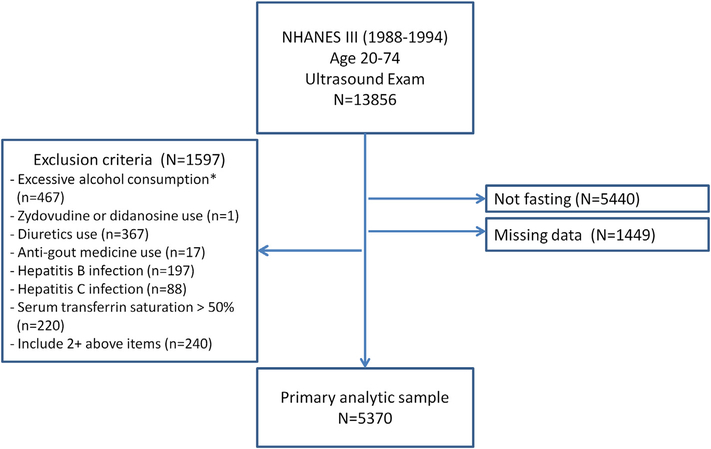
Methods: We analyzed 5370 men and women aged 20-74 years from the Third National Health and Nutrition Examination Survey (NHANES III) (1988-1994) in the USA. We calculated the prevalence and odds ratio (OR) of NAFLD and elevated liver enzymes by SUA and sex-specific quintiles of SUA, adjusting for multiple factors.
Results: The prevalence of NAFLD was higher in participants with higher SUA levels (10.9%, 9.6%, 15.9%, 21.8% and 33.1%, respectively, from the second to the fifth sex-specific quintile of uric acid). After adjustment, individuals with hyperuricemia were more likely to have NAFLD (OR: 1.4, 95% CI: 1.1-1.9). Similarly, the adjusted odds of NAFLD were increasingly higher from the second to the fifth quintile of SUA (ORs: 0.8, 1.2, 1.5 and 1.7, respectively; p < 0.01) as compared to the lowest quintile. Finally, individuals with hyperuricemia were more likely to have elevated liver enzymes (aspartate aminotransferase or alanine aminotransferase) (adjusted OR: 1.8, 95% CI: 1.1-2.7).
Conclusion: NAFLD and SUA levels were strongly and independently associated in this nationally representative sample of men and women after adjustment for multiple factors.
Keywords: hyperuricemia; nonalcoholic fatty liver disease; serum uric acid.
Copyright © 2012. Published by Elsevier B.V.
Figures
Comment in
-
Association between serum uric acid and nonalcoholic fatty liver disease.J Formos Med Assoc. 2016 Feb;115(2):136. doi: 10.1016/j.jfma.2015.06.007. Epub 2015 Jul 15. J Formos Med Assoc. 2016. PMID: 26187725 No abstract available.
-
Uncovered issues in the association between uric acid and nonalcoholic fatty liver disease.J Formos Med Assoc. 2016 Nov;115(11):1022-1023. doi: 10.1016/j.jfma.2016.09.015. Epub 2016 Oct 22. J Formos Med Assoc. 2016. PMID: 27780656 No abstract available.
References
-
- Angulo P Nonalcoholic fatty liver disease. N Engl J Med 2002; 346:1221–31. - PubMed
-
- Bellentani S, Scaglioni F, Marino M, Bedogni G. Epidemiology of non-alcoholic fatty liver disease. Dig Dis 2010;28:155–61. - PubMed
-
- Starley BQ, Calcagno CJ, Harrison SA. Nonalcoholic fatty liver disease and hepatocellular carcinoma: a weighty connection. Hepatol 2010;51:1820–32. - PubMed
-
- Lim JS, Mietus-Snyder M, Valente A, Schwarz JM, Lustig RH. The role of fructose in the pathogenesis of NAFLD and the metabolic syndrome. Nat Rev Gastroenterol Hepatol 2010;7: 251–64. - PubMed
-
- Fan J-G, Saibara T, Chitturi S, Kim BI, Sung JJY, Chutaputti A. What are the risk factors and settings for non-alcoholic fatty liver disease in Asia-Pacific? J Gastroenterol Hepatol 2007;22: 794–800. - PubMed
MeSH terms
Substances
Grants and funding
LinkOut - more resources
Full Text Sources
Other Literature Sources
Medical
