Comparative Study
. 2015 May;220(5):940-50.
doi: 10.1016/j.jamcollsurg.2015.01.056. Epub 2015 Feb 14.

Impact of National Cancer Institute Comprehensive Cancer Centers on ovarian cancer treatment and survival

Affiliations
Comparative Study

Impact of National Cancer Institute Comprehensive Cancer Centers on ovarian cancer treatment and survival

Robert E Bristow et al. J Am Coll Surg. 2015 May.

Abstract

Background: The regional impact of care at a National Cancer Institute Comprehensive Cancer Center (NCI-CCC) on adherence to National Comprehensive Cancer Network (NCCN) ovarian cancer treatment guidelines and survival is unclear.

Study design: We performed a retrospective population-based study of consecutive patients diagnosed with epithelial ovarian cancer between January 1, 1996 and December 31, 2006 in southern California. Patients were stratified according to care at an NCI-CCC (n = 5), non-NCI high-volume hospital (≥ 10 cases/year, HVH, n = 29), or low-volume hospital (<10 cases/year, LVH, n = 158). Multivariable logistic regression and Cox-proportional hazards models were used to examine the effect of NCI-CCC status on treatment guideline adherence and ovarian cancer-specific survival.

Results: A total of 9,933 patients were identified (stage I, 22.8%; stage II, 7.9%; stage III, 45.1%; stage IV, 24.2%), and 8.1% of patients were treated at NCI-CCCs. Overall, 35.7% of patients received NCCN guideline adherent care, and NCI-CCC status (odds ratio [OR] 1.00) was an independent predictor of adherence to treatment guidelines compared with HVHs (OR 0.83, 95% CI 0.70 to 0.99) and LVHs (OR 0.56, 95% CI 0.47 to 0.67). The median ovarian cancer-specific survivals according to hospital type were: NCI-CCC 77.9 (95% CI 61.4 to 92.9) months, HVH 51.9 (95% CI 49.2 to 55.7) months, and LVH 43.4 (95% CI 39.9 to 47.2) months (p < 0.0001). National Cancer Institute Comprehensive Cancer Center status (hazard ratio [HR] 1.00) was a statistically significant and independent predictor of improved survival compared with HVH (HR 1.18, 95% CI 1.04 to 1.33) and LVH (HR 1.30, 95% CI 1.15 to 1.47).

Conclusions: National Cancer Institute Comprehensive Cancer Center status is an independent predictor of adherence to ovarian cancer treatment guidelines and improved ovarian cancer-specific survival. These data validate NCI-CCC status as a structural health care characteristic correlated with superior ovarian cancer quality measure performance. Increased access to NCI-CCCs through regional concentration of care may be a mechanism to improve clinical outcomes.


Figures

Figure 1
Figure 1
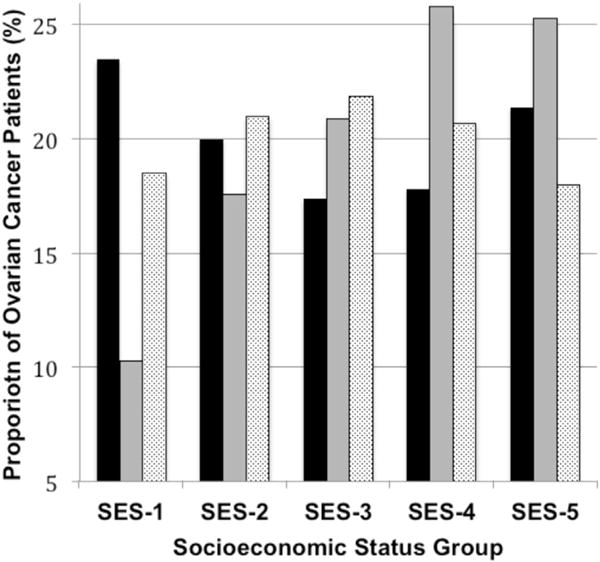
Proportional distribution of ovarian cancer patients in southern California (n = 9,933), 1996 to 2006, according to socioeconomic status (SES) and stratified by hospital type. Chi-square test, 2-sided p value < 0.0001. Black bar, National Cancer Institute Comprehensive Cancer Center; gray bar, high-volume hospital; light gray bar, low-volume hospital.
Figure 2
Figure 2
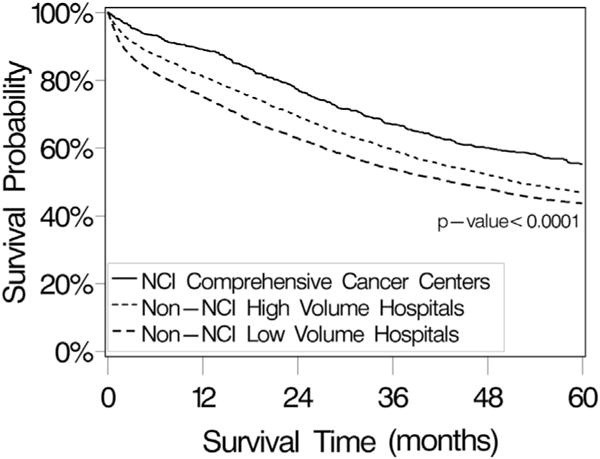
Ovarian cancer-specific survival probability for patients with invasive primary epithelial ovarian cancer in southern California, from the California Cancer Registry, 1996 to 2006, stratified by hospital type. Survival analyses were performed using the Kaplan-Meier method and 2-sided log rank test. The median survival time for all patients (n = 9,933) was 49.9 months (95% CI 47.8 to 52.1 months). Median survival times were 77.9 months (95% CI 61.4 to 92.9 months) for National Cancer Institute (NCI) Comprehensive Cancer Center patients (n = 800), 51.9 months (95% CI 49.2 to 55.7 months) for non-NCI high-volume hospital patients (n = 4,654), and 43.4 months (95% CI 39.9 to 47.2 months) for non-NCI low-volume hospital patients (n = 4,479).
Figure 3
Figure 3
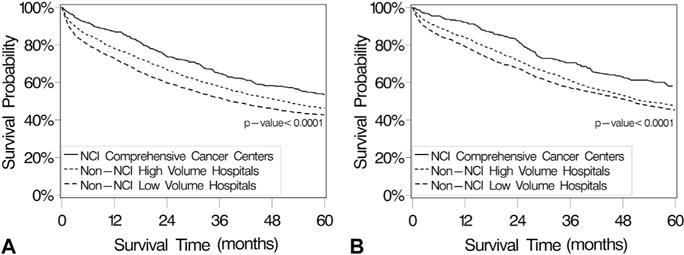
(A) Ovarian cancer-specific survival probability for patients in the low to middle socioeconomic strata (SES-1 to SES-3) with invasive primary epithelial ovarian cancer in southern California, from the California Cancer Registry, 1996 to 2006, stratified by hospital type. Survival analyses were performed using the Kaplan-Meier method and 2-sided log rank test. The median survival time for all patients (n = 5,508) was 46.1 months (95% CI 42.7 to 50 months). Median survival times were 67.0 months (95% CI 54.9 to 90.3 months) for National Cancer Institute (NCI) Comprehensive Cancer Center patients (n = 487), 50.8 months (95% CI 45.4 to 55.5 months) for non-NCI high-volume hospital patients (n = 2,275), and 38.5 months (95% CI 35.1 to 42.9 months) for non-NCI low-volume hospital patients (n = 2,746). (B) Ovarian cancer-specific survival probability for patients in the higher-middle to highest socioeconomic strata (SES-4 and SES-5) with invasive primary epithelial ovarian cancer in southern California from the California Cancer Registry, 1996 to 2006, stratified by hospital type. Survival analyses were performed using the Kaplan-Meier method and 2-sided log rank test. Median survival time for all patients (n = 4,425) was 53.1 months (95% CI 50.1 to 57.7 months). Median survival times were 80.0 months (95% CI 60.5 to 100.6 months) for NCI Comprehensive Cancer Center patients (n = 313), 52.7 months (95% CI 49.3 to 60.0 months) for non-NCI high-volume hospital patients (n = 2,379), and 49.9 months (95% CI 45.1 to 54.9 months) for non-NCI low-volume hospital patients (n = 1,733).

References

    1. Siegel R, Naishadham D, Jemal A. Cancer statistics 2013. CA Cancer J Clin. 2013;63:11–30. - PubMed
    1. Bristow RE, Powell MA, Al-Hammadi N, et al. Disparities in ovarian cancer care quality and survival according to race and socioeconomic status. J Natl Cancer Inst. 2013;105:823–832. - PMC - PubMed
    1. Bristow RE, Chang J, Ziogas A, et al. Adherence to treatment guidelines for ovarian cancer as a measure of quality care. Obstet Gynecol. 2013;121:1226–1234. - PubMed
    1. Erickson BK, Martin JY, Shah MM, et al. Reasons for failure to deliver National Comprehensive Cancer Network (NCCN)-adherent care in the treatment of epithelial ovarian cancer at an NCCN cancer center. Gynecol Oncol. 2014;133:142–146. - PMC - PubMed
    1. Read C, Elit L. Trends in gynecologic cancer care in North America. Obstet Gynecol Clin North Am. 2012;39:107–129. - PubMed

Publication types

MeSH terms

Substances